




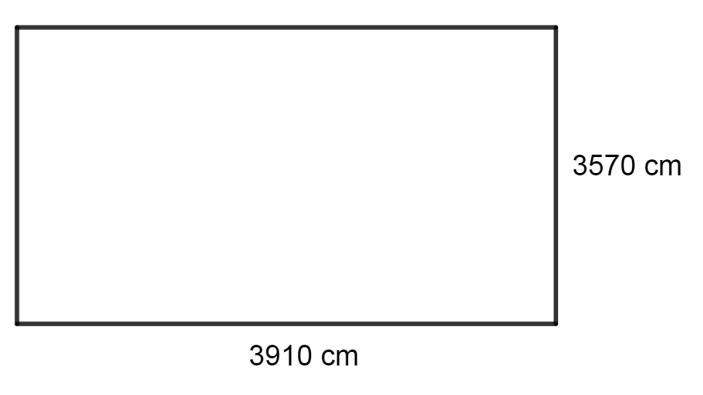
A hall-room 39m 10cm long and 35 m 70 cm broad is to be paved with equal square tiles. Find the number of tiles exactly fit.
A. 483
B. 358
C. 475
D. 583
Answer
 Verified
596.1k+ views
Hint: Convert the length and width of a given room into centimeters, so, as to have the values in a single unit. Then, find the \[\text{HCF (Highest common factor)}\] of length and width by writing down the factors and then choosing the highest common factor. HCF is the side of a given square tile, on dividing the area of the rectangle by the area of one square tile, the total number of tiles required for paving the room would come.
Complete step by step solution:
We are given the length and width of the hall-room and we have to find the total number of tiles to pave the given rectangular hall.
First convert the given length and width of hall into centimeters.
\[\because \text{ 1 meter = 100 centimeters}\text{.}\]
\[\begin{align}
& \therefore \text{ 39m10cm=39}\times \text{100+10=3910cm} \\
& \text{35m70cm=35}\times \text{100+70=3570cm} \\
\end{align}\]
Now, in the next step split these values into their factors. Before doing the question, let us first understand what a factor is.
Factor is a number that divides into another number exactly and without leaving a remainder.
For example, \[10=2\times 5\] here, 2 and 5 are factors of 10.
So, we can write down the factors of:
\[\begin{align}
& 3910=2\times 5\times 17\times 23 \\
& 3570=2\times 3\times 5\times 7\times 17 \\
\end{align}\]
Now, let us find the \[\text{HCF (Highest common factor)}\] of both values given above. HCF is the product of factors which are common in both length and width values.
Here, common factors are:
\[\begin{align}
& 2,5,17 \\
& \therefore \text{ HCF = 2}\times \text{5}\times \text{17=170cm} \\
\end{align}\]
HCF will be the side of our required square tile, \[S=170cm\]
\[\begin{align}
& \text{Area of 1 square tile = }{{\text{S}}^{2}}={{\left( 170 \right)}^{2}} \\
& \text{A tile = 28900c}{{\text{m}}^{\text{2}}} \\
\end{align}\]
Now, find the area of the given rectangular hall.
\[\begin{align}
& \text{Area = length}\times \text{width} \\
& {{\text{A}}_{hall}}=3910\times 3570=13958700c{{m}^{2}} \\
\end{align}\]
Suppose, the total number of square tiles required is 'n' then the total area of 'n' tiles would be,
\[\begin{align}
& {{A}_{n\text{ tiles}}}=n\times area\text{ of one tile} \\
& \Rightarrow \text{n}\times \text{28900c}{{\text{m}}^{\text{2}}} \\
\end{align}\]
Equate this area with that of the rectangular hall for complete paving, i.e.
\[\begin{align}
& 28900n=13958700 \\
& \Rightarrow n=\dfrac{13958700}{28900} \\
& \therefore n=483\text{ tiles} \\
\end{align}\]
So, the total tiles required to pave 3910m long and 3570m broad hall room is 483.
Note: Students can get confused at first, but need not to worry, just observe the question and then proceed. Students might take wrong factors by considering non-prime factors also, so one must know how to factory any number and also know how to take HCF of given numbers. While finding HCF, we can also use the long division method, but that would be a very long approach for this question.
Complete step by step solution:
We are given the length and width of the hall-room and we have to find the total number of tiles to pave the given rectangular hall.
First convert the given length and width of hall into centimeters.
\[\because \text{ 1 meter = 100 centimeters}\text{.}\]
\[\begin{align}
& \therefore \text{ 39m10cm=39}\times \text{100+10=3910cm} \\
& \text{35m70cm=35}\times \text{100+70=3570cm} \\
\end{align}\]
Now, in the next step split these values into their factors. Before doing the question, let us first understand what a factor is.
Factor is a number that divides into another number exactly and without leaving a remainder.
For example, \[10=2\times 5\] here, 2 and 5 are factors of 10.
So, we can write down the factors of:
\[\begin{align}
& 3910=2\times 5\times 17\times 23 \\
& 3570=2\times 3\times 5\times 7\times 17 \\
\end{align}\]
Now, let us find the \[\text{HCF (Highest common factor)}\] of both values given above. HCF is the product of factors which are common in both length and width values.
Here, common factors are:
\[\begin{align}
& 2,5,17 \\
& \therefore \text{ HCF = 2}\times \text{5}\times \text{17=170cm} \\
\end{align}\]
HCF will be the side of our required square tile, \[S=170cm\]
\[\begin{align}
& \text{Area of 1 square tile = }{{\text{S}}^{2}}={{\left( 170 \right)}^{2}} \\
& \text{A tile = 28900c}{{\text{m}}^{\text{2}}} \\
\end{align}\]
Now, find the area of the given rectangular hall.
\[\begin{align}
& \text{Area = length}\times \text{width} \\
& {{\text{A}}_{hall}}=3910\times 3570=13958700c{{m}^{2}} \\
\end{align}\]
Suppose, the total number of square tiles required is 'n' then the total area of 'n' tiles would be,
\[\begin{align}
& {{A}_{n\text{ tiles}}}=n\times area\text{ of one tile} \\
& \Rightarrow \text{n}\times \text{28900c}{{\text{m}}^{\text{2}}} \\
\end{align}\]
Equate this area with that of the rectangular hall for complete paving, i.e.
\[\begin{align}
& 28900n=13958700 \\
& \Rightarrow n=\dfrac{13958700}{28900} \\
& \therefore n=483\text{ tiles} \\
\end{align}\]
So, the total tiles required to pave 3910m long and 3570m broad hall room is 483.
Note: Students can get confused at first, but need not to worry, just observe the question and then proceed. Students might take wrong factors by considering non-prime factors also, so one must know how to factory any number and also know how to take HCF of given numbers. While finding HCF, we can also use the long division method, but that would be a very long approach for this question.
Recently Updated Pages
Master Class 9 General Knowledge: Engaging Questions & Answers for Success

Master Class 9 Social Science: Engaging Questions & Answers for Success
Master Class 9 English: Engaging Questions & Answers for Success
Master Class 9 Maths: Engaging Questions & Answers for Success
Master Class 9 Science: Engaging Questions & Answers for Success
Class 9 Question and Answer - Your Ultimate Solutions Guide
Trending doubts
Difference Between Plant Cell and Animal Cell
Fill the blanks with the suitable prepositions 1 The class 9 english CBSE
Who is eligible for RTE class 9 social science CBSE
Which places in India experience sunrise first and class 9 social science CBSE
What is pollution? How many types of pollution? Define it
Name 10 Living and Non living things class 9 biology CBSE