




A hall is 15m long and 12m broad. If the sum of the areas of the floor and the ceiling is equal to the sum of the areas of the 4 walls, what is the volume of the hall?
(A). $2200{{m}^{3}}$
(B). $1500{{m}^{3}}$
(C). $1620{{m}^{3}}$
(D). $1200{{m}^{3}}$
Answer
 Verified
546.1k+ views
Hint: Assume variables for length, breadth, height. Now by using the area of rectangle formula, find the area of each rectangle present in the room. Now, find the areas which are inverse of height. By using the condition given in the question, substitute all the areas you found in this condition. Now you have an equation with only one variable height. By bringing all terms of this variable to the right hand side and by subtracting the value of constant in the right hand side on both sides of the question, we have a variable only on the right hand side. Now divide the coefficient of variable on both sides. By this you get a value of variable. Now use volume of cuboids formula as you know value of height, also use the formula:
Area of rectangle $=l\times b$ .
Volume of cuboid $=lbh$ .
Complete step-by-step answer:
Assume the room as cuboid. So, by this we can say
Area of floor, ceiling are equal …………………………….. (1)
The Areas of opposite walls are equal ………………………… (2)
By assuming length, breadth and height as variables, l, b, h, we get:
Given equation, the values of length, breadth, we can say:
$l=15m;b=12m.$
Now, we know the sides of floor are length, breadth sides of 2 pairs of walls possible are (breadth, length) (length, height)
So, by knowledge of geometry, we can say area of rectangle is:
Rectangle’s area $=a\times b$ where a, b are 2 sides.
Now, by using this formula, we get the area of floor as:
Area of floor $=\text{length}\times \text{breadth}$
By substituting their values, we get the area as:
Area of floor $=15\times 12$
By simplifying this above equation, we get it as:
Area of floor $=180{{m}^{2}}$ ………………… (3)
By using equation (1), we can say that, area as:
Area of ceiling $=180{{m}^{2}}$ ……………… (4)
By using the formula of area, we can find the area of:
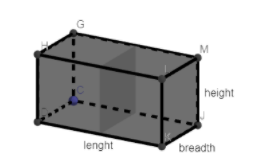
Let, wall 1 = wall formed by (length, height)
Wall 2 =wall formed by (height, breadth)
By basic knowledge of cuboid, we can say that other wall will be:
Wall 3 = wall formed by (length, height)
Wall 4 = wall formed by (height, breadth).
By using formula of area of rectangle, we get area as:
Area of wall 1 $=\text{length}\times \text{height}$
By substituting the values, we get area of wall 1 as:
Area or wall 1 $=15\times h=15h{{m}^{2}}$ ………………….. (5)
By conditions we know, condition (2) can say is that:
Area of wall 3 $=15h{{m}^{2}}$ ……………………… (6)
By using formula of area of rectangle, we get area as:
Area of wall 2 $=\text{breadth}\times \text{height}$
By substituting the values, we get the area to be:
Area of wall 2 $=12h{{m}^{2}}$ ………………. (7)
By condition (2), we can say area of other wall to be:
Area of wall 4 $=12h{{m}^{2}}$ ……………….. (8)
Given condition in the question, we can say that:
Sum of areas of floor and ceiling = sum of areas of 4 walls.
By substituting equations (3), (4), (5), (6), (7), (8), we get –
$180+180=12h+12h+15h+15h$
By simplifying the equation, we get the equation:
$54h=360$
By dividing with 54 on both sides, we get –
$h=\dfrac{20}{3}m$
We know the volume of cuboid formula as $V=lbh$ .
By substituting the values of l, b, h into V, we get it as:
$V=\left( 12 \right)\left( 15 \right)\left( \dfrac{20}{3} \right)$
By simplifying we get the value of V to be as:
$V=1200{{m}^{3}}$ .
Therefore, the option (d) is correct.
Note: While calculating the h, better leave it in fraction because the length, breadths are multiples of 3. It will be easy for calculation while calculating the areas be careful with substituting l, b, h as it is the only point of the question, the conditions of the first solution are very important, remember that.
Area of rectangle $=l\times b$ .
Volume of cuboid $=lbh$ .
Complete step-by-step answer:
Assume the room as cuboid. So, by this we can say
Area of floor, ceiling are equal …………………………….. (1)
The Areas of opposite walls are equal ………………………… (2)
By assuming length, breadth and height as variables, l, b, h, we get:
Given equation, the values of length, breadth, we can say:
$l=15m;b=12m.$
Now, we know the sides of floor are length, breadth sides of 2 pairs of walls possible are (breadth, length) (length, height)
So, by knowledge of geometry, we can say area of rectangle is:
Rectangle’s area $=a\times b$ where a, b are 2 sides.
Now, by using this formula, we get the area of floor as:
Area of floor $=\text{length}\times \text{breadth}$
By substituting their values, we get the area as:
Area of floor $=15\times 12$
By simplifying this above equation, we get it as:
Area of floor $=180{{m}^{2}}$ ………………… (3)
By using equation (1), we can say that, area as:
Area of ceiling $=180{{m}^{2}}$ ……………… (4)
By using the formula of area, we can find the area of:
Let, wall 1 = wall formed by (length, height)
Wall 2 =wall formed by (height, breadth)
By basic knowledge of cuboid, we can say that other wall will be:
Wall 3 = wall formed by (length, height)
Wall 4 = wall formed by (height, breadth).
By using formula of area of rectangle, we get area as:
Area of wall 1 $=\text{length}\times \text{height}$
By substituting the values, we get area of wall 1 as:
Area or wall 1 $=15\times h=15h{{m}^{2}}$ ………………….. (5)
By conditions we know, condition (2) can say is that:
Area of wall 3 $=15h{{m}^{2}}$ ……………………… (6)
By using formula of area of rectangle, we get area as:
Area of wall 2 $=\text{breadth}\times \text{height}$
By substituting the values, we get the area to be:
Area of wall 2 $=12h{{m}^{2}}$ ………………. (7)
By condition (2), we can say area of other wall to be:
Area of wall 4 $=12h{{m}^{2}}$ ……………….. (8)
Given condition in the question, we can say that:
Sum of areas of floor and ceiling = sum of areas of 4 walls.
By substituting equations (3), (4), (5), (6), (7), (8), we get –
$180+180=12h+12h+15h+15h$
By simplifying the equation, we get the equation:
$54h=360$
By dividing with 54 on both sides, we get –
$h=\dfrac{20}{3}m$
We know the volume of cuboid formula as $V=lbh$ .
By substituting the values of l, b, h into V, we get it as:
$V=\left( 12 \right)\left( 15 \right)\left( \dfrac{20}{3} \right)$
By simplifying we get the value of V to be as:
$V=1200{{m}^{3}}$ .
Therefore, the option (d) is correct.
Note: While calculating the h, better leave it in fraction because the length, breadths are multiples of 3. It will be easy for calculation while calculating the areas be careful with substituting l, b, h as it is the only point of the question, the conditions of the first solution are very important, remember that.
Recently Updated Pages
Master Class 12 Business Studies: Engaging Questions & Answers for Success

Master Class 12 Biology: Engaging Questions & Answers for Success
Master Class 12 Chemistry: Engaging Questions & Answers for Success
Class 12 Question and Answer - Your Ultimate Solutions Guide
Master Class 11 Social Science: Engaging Questions & Answers for Success
Master Class 11 English: Engaging Questions & Answers for Success
Trending doubts
Explain the Treaty of Vienna of 1815 class 10 social science CBSE
Which Indian city is known as the "City of Victory"?
Which instrument is used to measure the Blood Pressure?
Who Won 36 Oscar Awards? Record Holder Revealed
What is the median of the first 10 natural numbers class 10 maths CBSE
Why is it 530 pm in india when it is 1200 afternoon class 10 social science CBSE