




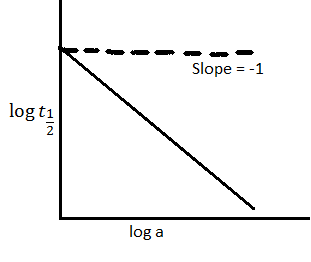
A graph between $\log {{t}_{1/2}}$ and log a (abscissa), 'a' is the initial concentration of A in the given reaction. For the reaction, $A\to \text{Product}$ , the rate law is:-
(A)$\dfrac{-d[A]}{dt}=K$
(B)$\dfrac{-d[A]}{dt}=K[A]$
(C)$\dfrac{-d[A]}{dt}=K{{[A]}^{2}}$
(D)$\dfrac{-d[A]}{dt}=K{{[A]}^{3}}$
Answer
 Verified
600.3k+ views
Hint: The half-life of a reaction can be described as the amount of time required for a reactant concentration to decrease by half compared to its initial concentration. We will attempt this question by using the half time mathematical relation with initial concentration and convert it into a logarithmic equation as per the requirement of the graph and compare the values to get the desired answer.
Formula used:
The half-time relation with initial concentration is as follows:-
${{t}_{1/2}}=K{{a}^{1-n}}$
where,
n = order of the reaction.
K = rate constant
a = initial concentration of a substance.
${{t}_{1/2}}$ = half-life of the reaction
Complete step-by-step answer:
As we know that half-life is the time required for a quantity to reduce to half of its initial concentration. For any order of kinetics, the half-life relation with concentration is shown below:-
${{t}_{1/2}}=K{{a}^{1-n}}$
-Now we will convert this relation into logarithmic equation so as to compare it to the given graph:-
$\begin{align}
& \Rightarrow {{t}_{1/2}}=K{{a}^{1-n}} \\
& \text{On taking log both sides:} \\
& \Rightarrow \log {{t}_{1/2}}=\log (K{{a}^{1-n}}) \\
& \Rightarrow \log {{t}_{1/2}}=\log K+\log {{a}^{1-n}}\text{ (as log AB = log A+log B)} \\
& \Rightarrow \log {{t}_{1/2}}=\log K+(1-n)\log a\text{ (as log}{{\text{A}}^{x}}\text{ = xlogA)} \\
\end{align}$
-Since this is a straight line graph y = mx+c where m is the slope and c is the intercept. On comparing the above equation with straight line equation we get:-
Slope = (1-n)
Now let us take the help of given graph to determine the order of reaction:-
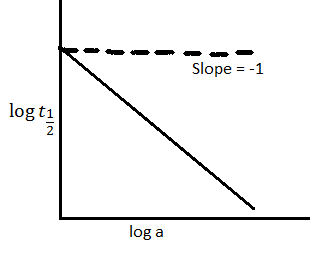
As it is given that slope = -1
Therefore, (1-n) = 1
And order of reaction (n) is = 2
-The rate law for a chemical reaction is an expression that provides the relationship between the concentration of the participating reactants and the rate of reaction.
For second order reaction, the rate law is: $\dfrac{-d[A]}{dt}=K{{[A]}^{2}}$
So, the correct answer is “Option C”.
Note:
The misunderstandings we have while solving kinetics questions are as follows:
(A)Order of a reaction is equal to the molecularity of the reaction. This is true but only for elementary reaction, not for complex reactions as molecularity is a positive integral value whereas order can be zero, negative, positive or fractional.
(B)We should not forget to consider stoichiometry while writing or using the rate expression or our obtained results will be wrong.
Formula used:
The half-time relation with initial concentration is as follows:-
${{t}_{1/2}}=K{{a}^{1-n}}$
where,
n = order of the reaction.
K = rate constant
a = initial concentration of a substance.
${{t}_{1/2}}$ = half-life of the reaction
Complete step-by-step answer:
As we know that half-life is the time required for a quantity to reduce to half of its initial concentration. For any order of kinetics, the half-life relation with concentration is shown below:-
${{t}_{1/2}}=K{{a}^{1-n}}$
-Now we will convert this relation into logarithmic equation so as to compare it to the given graph:-
$\begin{align}
& \Rightarrow {{t}_{1/2}}=K{{a}^{1-n}} \\
& \text{On taking log both sides:} \\
& \Rightarrow \log {{t}_{1/2}}=\log (K{{a}^{1-n}}) \\
& \Rightarrow \log {{t}_{1/2}}=\log K+\log {{a}^{1-n}}\text{ (as log AB = log A+log B)} \\
& \Rightarrow \log {{t}_{1/2}}=\log K+(1-n)\log a\text{ (as log}{{\text{A}}^{x}}\text{ = xlogA)} \\
\end{align}$
-Since this is a straight line graph y = mx+c where m is the slope and c is the intercept. On comparing the above equation with straight line equation we get:-
Slope = (1-n)
Now let us take the help of given graph to determine the order of reaction:-
As it is given that slope = -1
Therefore, (1-n) = 1
And order of reaction (n) is = 2
-The rate law for a chemical reaction is an expression that provides the relationship between the concentration of the participating reactants and the rate of reaction.
For second order reaction, the rate law is: $\dfrac{-d[A]}{dt}=K{{[A]}^{2}}$
So, the correct answer is “Option C”.
Note:
The misunderstandings we have while solving kinetics questions are as follows:
(A)Order of a reaction is equal to the molecularity of the reaction. This is true but only for elementary reaction, not for complex reactions as molecularity is a positive integral value whereas order can be zero, negative, positive or fractional.
(B)We should not forget to consider stoichiometry while writing or using the rate expression or our obtained results will be wrong.
Recently Updated Pages
If x a + bt + ct2 where x is in meters and t is in class 11 physics CBSE

A car covers the first half distance between two places class 11 physics CBSE
The resultant of two vectors overrightarrow P and overrightarrow class 11 physics CBSE
Find the value of cos 135 class 11 maths CBSE
A mass M is held in place by an applied force F and class 11 physics CBSE
A solution of glucose in water is labelled as 10 dfracwv class 11 chemistry CBSE
Trending doubts
One Metric ton is equal to kg A 10000 B 1000 C 100 class 11 physics CBSE
Find the value of the expression given below sin 30circ class 11 maths CBSE
Draw a diagram of nephron and explain its structur class 11 biology CBSE
10 examples of friction in our daily life
Proton was discovered by A Thomson B Rutherford C Chadwick class 11 chemistry CBSE
Bond order ofO2 O2+ O2 and O22 is in order A O2 langle class 11 chemistry CBSE