



Why is a golgi body like a post office?
Answer
 Verified
555.3k+ views
Hint: The Golgi body is an organelle found in the cytoplasm of a eukaryotic cell. It is also known as Golgi apparatus, Golgi complex, and dictyosome. It bundles the macromolecules like lipids and proteins, which are synthesized inside the cell. Generally, proteins are synthesized in the rough endoplasmic reticulum and are traveled to the Golgi body, where they are processed and sent throughout the cell.
Complete answer:
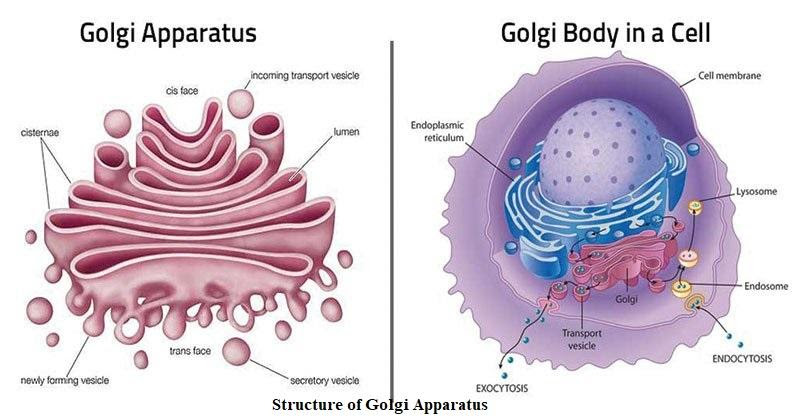
Fig: Structure and Location of Golgi Body in a Cell
The Golgi bodies aid in the translocation of vesicles to the final destination. They transport the materials to the destinations. The molecules are packaged in vesicles and the vesicles work like a shipping envelope for the cell.
The packaged vesicles move to the Golgi bodies. The Golgi bodies open the packages and modify the contents to their final forms and aid in the movement for their final destinations.
In a lot of ways, the Golgi bodies act as the shipping and receiving department of the cell. They package and sort the proteins and other biomolecules before they are sent to final destinations.
Assuming the cell as a city, the Golgi body acts as a post office. It is a stack of membranes, which package, sort, and deliver proteins to the region of the cell they require to go. The Golgi body is the post office of the cell as post offices pack, sort, and deliver mail similarly, Golgi bodies also work with proteins.
Note:
For survival, a cell has to make proteins, as proteins are essential for structure, movement, and energy production. The protein products need to be transported to the right location in the cell for fulfilling their functions. The proteins need to be sent out of the cell sometimes. But proteins are not able to move independently and that’s why they are transported through carrier vesicles arranged by Golgi bodies.
Complete answer:
Fig: Structure and Location of Golgi Body in a Cell
The Golgi bodies aid in the translocation of vesicles to the final destination. They transport the materials to the destinations. The molecules are packaged in vesicles and the vesicles work like a shipping envelope for the cell.
The packaged vesicles move to the Golgi bodies. The Golgi bodies open the packages and modify the contents to their final forms and aid in the movement for their final destinations.
In a lot of ways, the Golgi bodies act as the shipping and receiving department of the cell. They package and sort the proteins and other biomolecules before they are sent to final destinations.
Assuming the cell as a city, the Golgi body acts as a post office. It is a stack of membranes, which package, sort, and deliver proteins to the region of the cell they require to go. The Golgi body is the post office of the cell as post offices pack, sort, and deliver mail similarly, Golgi bodies also work with proteins.
Note:
For survival, a cell has to make proteins, as proteins are essential for structure, movement, and energy production. The protein products need to be transported to the right location in the cell for fulfilling their functions. The proteins need to be sent out of the cell sometimes. But proteins are not able to move independently and that’s why they are transported through carrier vesicles arranged by Golgi bodies.
Recently Updated Pages
If x a + bt + ct2 where x is in meters and t is in class 11 physics CBSE

A car covers the first half distance between two places class 11 physics CBSE
The resultant of two vectors overrightarrow P and overrightarrow class 11 physics CBSE
Find the value of cos 135 class 11 maths CBSE
A mass M is held in place by an applied force F and class 11 physics CBSE
A solution of glucose in water is labelled as 10 dfracwv class 11 chemistry CBSE
Trending doubts
One Metric ton is equal to kg A 10000 B 1000 C 100 class 11 physics CBSE
Find the value of the expression given below sin 30circ class 11 maths CBSE
What do you mean by retardation What is its SI uni class 11 physics CBSE
Draw a diagram of nephron and explain its structur class 11 biology CBSE
10 examples of friction in our daily life
Difference between physical and chemical change class 11 chemistry CBSE