




A glass prism is immersed in a hypothetical liquid. The curves showing the refractive index $n$ as a function of the wavelength $\lambda $ for glass and liquid are shown in the figure. When a ray of white light is incident on the prism, parallel to the base :
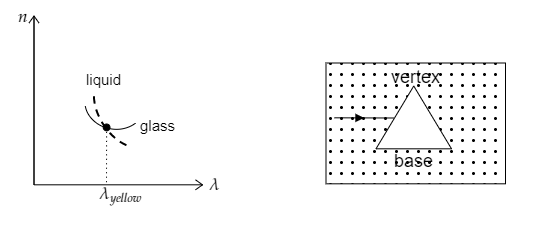
A) yellow ray travels without deviation.
B) the blue ray is deviated towards the vertex.
C) the red ray is deviated towards the base.
D) there is no dispersion.
E) Options A, B, C
Answer
 Verified
595.8k+ views
Hint:When light enters a denser medium from a rarer medium, the light ray bends towards the normal and when light enters a rarer medium from a denser medium, the light ray bends away from the normal. The wavelength of the red ray is longer than the yellow ray and the wavelength of the blue ray is shorter than the yellow ray.
Complete step by step answer.
Step 1: Sketch the graph between the refractive index and wavelength as given in the question and mention the observations of the graph.
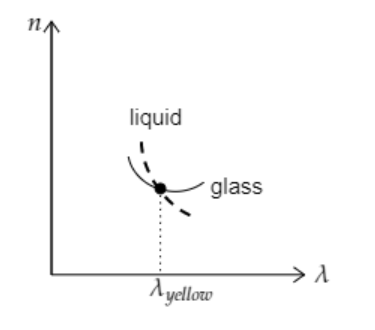
From the above graph, we see that the curve depicting the refractive index of liquid and that of the glass intersect when $\lambda = {\lambda _{yellow}}$ .
$ \Rightarrow {n_{liquid}} = {n_{glass}}$ at $\lambda = {\lambda _{yellow}}$ .
Since the refractive index of the liquid and the glass are equal for the yellow light, it will pass through the prism without suffering deviation.
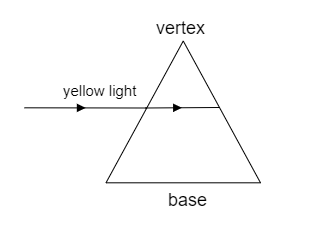
So option A is correct.
We know that the wavelength of red light is the longest i.e., ${\lambda _{red}} > {\lambda _{yellow}}$ .
From the graph, we observe that the refractive index of the liquid is smaller than the refractive index of glass when $\lambda > {\lambda _{yellow}}$. This implies that the red light passes from a rarer medium to a denser medium and so it will bend towards the base of the prism.
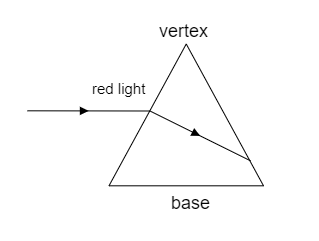
So option C is correct.
We know that the wavelength of blue light is shorter than that of the yellow light i.e., ${\lambda _{blue}} < {\lambda _{yellow}}$ .
From the graph, we observe that the refractive index of the liquid is greater than the refractive index of glass when $\lambda < {\lambda _{yellow}}$. This implies that the blue light passes from a denser medium to a rarer medium and so will bend away from the base and towards the vertex of the prism.
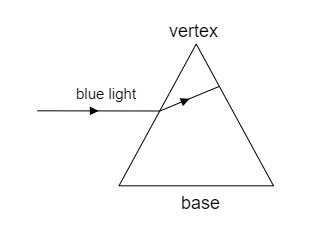
So option B is correct.
When white light is incident on the prism, the ray does undergo dispersion as it splits into its component rays – violet, indigo, blue, green, yellow, orange and red. So the option D is incorrect.
Thus the correct options are A, B, C and E.
Note: An optically denser material will have a higher refractive index than an optically rarer medium. As the light ray enters a denser medium, the velocity of the ray will decrease as more matter is present there to scatter the light ray. However, when the light ray enters a rarer medium, the less matter will make the ray travel faster. So the refractive index of a material is essentially a measure of the optical density of that material.
Complete step by step answer.
Step 1: Sketch the graph between the refractive index and wavelength as given in the question and mention the observations of the graph.
From the above graph, we see that the curve depicting the refractive index of liquid and that of the glass intersect when $\lambda = {\lambda _{yellow}}$ .
$ \Rightarrow {n_{liquid}} = {n_{glass}}$ at $\lambda = {\lambda _{yellow}}$ .
Since the refractive index of the liquid and the glass are equal for the yellow light, it will pass through the prism without suffering deviation.
So option A is correct.
We know that the wavelength of red light is the longest i.e., ${\lambda _{red}} > {\lambda _{yellow}}$ .
From the graph, we observe that the refractive index of the liquid is smaller than the refractive index of glass when $\lambda > {\lambda _{yellow}}$. This implies that the red light passes from a rarer medium to a denser medium and so it will bend towards the base of the prism.
So option C is correct.
We know that the wavelength of blue light is shorter than that of the yellow light i.e., ${\lambda _{blue}} < {\lambda _{yellow}}$ .
From the graph, we observe that the refractive index of the liquid is greater than the refractive index of glass when $\lambda < {\lambda _{yellow}}$. This implies that the blue light passes from a denser medium to a rarer medium and so will bend away from the base and towards the vertex of the prism.
So option B is correct.
When white light is incident on the prism, the ray does undergo dispersion as it splits into its component rays – violet, indigo, blue, green, yellow, orange and red. So the option D is incorrect.
Thus the correct options are A, B, C and E.
Note: An optically denser material will have a higher refractive index than an optically rarer medium. As the light ray enters a denser medium, the velocity of the ray will decrease as more matter is present there to scatter the light ray. However, when the light ray enters a rarer medium, the less matter will make the ray travel faster. So the refractive index of a material is essentially a measure of the optical density of that material.
Recently Updated Pages
Master Class 12 Social Science: Engaging Questions & Answers for Success

Master Class 12 Physics: Engaging Questions & Answers for Success
Master Class 12 Maths: Engaging Questions & Answers for Success
Master Class 12 Economics: Engaging Questions & Answers for Success
Master Class 12 Chemistry: Engaging Questions & Answers for Success
Master Class 12 Business Studies: Engaging Questions & Answers for Success
Trending doubts
Which are the Top 10 Largest Countries of the World?
Draw a labelled sketch of the human eye class 12 physics CBSE
Explain the structure of megasporangium class 12 biology CBSE
What are the major means of transport Explain each class 12 social science CBSE
How many chromosomes are found in human ovum a 46 b class 12 biology CBSE
The diagram of the section of a maize grain is given class 12 biology CBSE