




A gland which secretes both hormone and enzyme is the
A. Pituitary
B. Pancreas
C. Thyroid
D. Adrenal
Answer
 Verified
580.5k+ views
Hint: The gland which produces both hormones and enzymes important for food digestion. It plays an important part in the gastrointestinal tract. It is located below the liver.
Complete answer: In option A, Pituitary gland is mentioned. It is called the master gland of the human body. It secretes many hormones. Some of them are-
Growth hormones: It regulates the growth and metabolism of a human being.
Thyroid stimulating hormones: as the name suggests, it regulates the production of thyroid hormones.
Prolactin: It is a hormone regulating milk production.
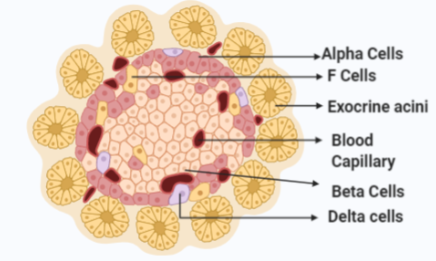
In option B, Pancreas is mentioned. The alpha and beta cells of the islet produce hormones like insulin and glucagon respectively. The F cells of the pancreatic islet produce trypsin, amylase, and lipase which are incorporated in the bile juice and are used in the digestion process.
In option C, Thyroid gland is mentioned. The thyroid gland, located near the larynx produces two hormones: triiodothyronine and thyroxine. They are formed from iodine which is absorbed from the food intake.
In option D, Adrenal gland is mentioned. The adrenal gland is located just above the kidneys. They are responsible for producing androgens. The two main androgens are cortisol and androstenedione. They help in regulating salt and minerals in the blood and water regulation as well.
Hence option B is correct.
Note: The insulin hormone promotes glucose uptake, promotes cell processes like glycogenesis and lipogenesis. This hormone also promotes protein synthesis of skeletal muscle and lipid tissue. Hormone glucagon is responsible to increase the concentration of glucose and fatty acids in the blood. It is also considered as the main catabolic hormone of the body. Amylase breaks starch and helps in starch digestion. Trypsin cleaves amino acids and lipase helps in the cleaving of lipids during digestion in the small intestine.
Complete answer: In option A, Pituitary gland is mentioned. It is called the master gland of the human body. It secretes many hormones. Some of them are-
Growth hormones: It regulates the growth and metabolism of a human being.
Thyroid stimulating hormones: as the name suggests, it regulates the production of thyroid hormones.
Prolactin: It is a hormone regulating milk production.
In option B, Pancreas is mentioned. The alpha and beta cells of the islet produce hormones like insulin and glucagon respectively. The F cells of the pancreatic islet produce trypsin, amylase, and lipase which are incorporated in the bile juice and are used in the digestion process.
In option C, Thyroid gland is mentioned. The thyroid gland, located near the larynx produces two hormones: triiodothyronine and thyroxine. They are formed from iodine which is absorbed from the food intake.
In option D, Adrenal gland is mentioned. The adrenal gland is located just above the kidneys. They are responsible for producing androgens. The two main androgens are cortisol and androstenedione. They help in regulating salt and minerals in the blood and water regulation as well.
Hence option B is correct.
Note: The insulin hormone promotes glucose uptake, promotes cell processes like glycogenesis and lipogenesis. This hormone also promotes protein synthesis of skeletal muscle and lipid tissue. Hormone glucagon is responsible to increase the concentration of glucose and fatty acids in the blood. It is also considered as the main catabolic hormone of the body. Amylase breaks starch and helps in starch digestion. Trypsin cleaves amino acids and lipase helps in the cleaving of lipids during digestion in the small intestine.
Recently Updated Pages
Master Class 11 Computer Science: Engaging Questions & Answers for Success

Master Class 11 Business Studies: Engaging Questions & Answers for Success
Master Class 11 Economics: Engaging Questions & Answers for Success
Master Class 11 English: Engaging Questions & Answers for Success
Master Class 11 Maths: Engaging Questions & Answers for Success
Master Class 11 Biology: Engaging Questions & Answers for Success
Trending doubts
One Metric ton is equal to kg A 10000 B 1000 C 100 class 11 physics CBSE
There are 720 permutations of the digits 1 2 3 4 5 class 11 maths CBSE
Discuss the various forms of bacteria class 11 biology CBSE
Draw a diagram of a plant cell and label at least eight class 11 biology CBSE
State the laws of reflection of light
10 examples of friction in our daily life