




A given quantity of metal is to be cast into a solid half-circular cylinder (i.e. with a rectangular base and semicircular ends) Show that in order that the total surface area may be minimum, the ratio of the length of the cylinder to the diameter of the circular ends is $\dfrac{\pi }{\pi +2}$ .
Answer
 Verified
636k+ views
Hint: To find the extrema we need to find the first differentiation and equate it to zero. The condition is written as follows, $\dfrac{dS}{dr}=0$ . And to check which it’s minima and maxima the condition is $\dfrac{{{d}^{2}}S}{d{{r}^{2}}}>0$ , then it’s a minima and when $\dfrac{{{d}^{2}}S}{d{{r}^{2}}}<0$ then it’s a maxima.
Complete step by step answer:
We need to minimize the surface area of the half-cylinder.
The half-cylinder is the cylinder chopped in half such that there is a rectangular base and semicircular ends.
It can be shown in figures are below,
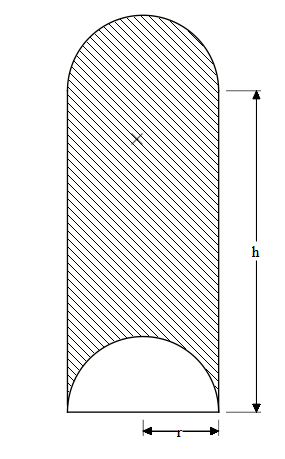
Let this be the half-cylinder with radius $r$ and height $h$ .
This half cylinder is exactly half of the original cylinder so the volume of the cylinder will be also halved.
Therefore, the volume of the half-cylinder $V=\dfrac{1}{2}\times \pi {{r}^{2}}h$ .
We will find the expression of $h$ in terms if V we get,
$\Rightarrow h=\dfrac{2V}{\pi {{r}^{2}}}..............(i)$
Now, let's find the surface area of this half-cylinder,
There is a rectangular base, two half circles and a curved surface.
Therefore, Total surface area (S) = area of rectangle + area of 2 semi-circles + area of the curved surface,
By looking at the figure, we can see that,
$S=h\times 2r+2\times \dfrac{1}{2}\pi {{r}^{2}}+\dfrac{1}{2}\times 2\pi rh$ .
Simplifying it further, we get,
$S=2rh+\pi {{r}^{2}}+\pi h..................(ii)$
From equation (i) let's substitute the value of $h$ ,
By substituting we get,
$S=2r\times \left( \dfrac{2V}{\pi {{r}^{2}}} \right)+\pi {{r}^{2}}+\pi r\left( \dfrac{2V}{\pi {{r}^{2}}} \right)..........................(iii)$
In order to find the extrema, we need to find the first differentiation and equate it to zero.
Therefore, $\dfrac{dS}{dr}=0$ .
Solving we get,
$\dfrac{dS}{dr}=\dfrac{-4V}{\pi {{r}^{2}}}+2\pi r-\dfrac{2V}{{{r}^{2}}}=0$
Solving for the value of $r$ , we get,
$\begin{align}
& 2\pi r=\dfrac{2V}{{{r}^{2}}}+\dfrac{4V}{\pi {{r}^{2}}} \\
& \Rightarrow {{r}^{3}}=\dfrac{V}{\pi }+\dfrac{2V}{{{\pi }^{2}}}.................(iv) \\
\end{align}$
To find whether it’s maxima or minima we need to differentiate again. If $\dfrac{{{d}^{2}}S}{d{{r}^{2}}}>0$ then it’s a minima and if $\dfrac{{{d}^{2}}S}{d{{r}^{2}}}<0$ it’s a maxima.
Therefore, $\dfrac{{{d}^{2}}S}{d{{r}^{2}}}=2\pi +\dfrac{1}{{{r}^{3}}}\left( \dfrac{4V}{\pi }+2V \right)$ . As all the numbers are positive $\dfrac{{{d}^{2}}S}{d{{r}^{2}}}>0$,
Therefore, it’s minima.
Now we need to eliminate the V from equation (iv) and (i),
From (iv) we get,
$\begin{align}
& \Rightarrow {{r}^{3}}=V\left( \dfrac{1}{\pi }+\dfrac{2}{{{\pi }^{2}}} \right) \\
& \Rightarrow V=\dfrac{{{r}^{3}}}{\left( \dfrac{1}{\pi }+\dfrac{2}{{{\pi }^{2}}} \right)}..................(v) \\
\end{align}$
Substituting in equation (i) we get,
$\dfrac{{{r}^{3}}}{\left( \dfrac{1}{\pi }+\dfrac{2}{{{\pi }^{2}}} \right)}=\dfrac{1}{2}\times \pi {{r}^{2}}h$
Solving for $\dfrac{2r}{h}$ , we get,
$\begin{align}
& \dfrac{2r}{h}=\pi \left( \dfrac{1}{\pi }+\dfrac{2}{{{\pi }^{2}}} \right) \\
& \Rightarrow \dfrac{2r}{h}=1+\dfrac{2}{\pi } \\
& \Rightarrow \dfrac{2r}{h}=\dfrac{\pi +2}{\pi } \\
\end{align}$
Taking the inverse, we get,
$\dfrac{h}{2r}=\dfrac{\pi }{\pi +2}$
Hence, the ratio of the length of the cylinder to diameter is $\dfrac{\pi }{\pi +2}$ .
Note: We need to calculate the surface area carefully because there are chances that anyone semicircle can be easily missed out. Also, we need to find the ratio of the length to the diameter and not the radius so we need to consider $2r$ instead of $r$ . While differentiation we need to also check the double differentiation and if it is greater than zero then the extrema is minima.
Complete step by step answer:
We need to minimize the surface area of the half-cylinder.
The half-cylinder is the cylinder chopped in half such that there is a rectangular base and semicircular ends.
It can be shown in figures are below,
Let this be the half-cylinder with radius $r$ and height $h$ .
This half cylinder is exactly half of the original cylinder so the volume of the cylinder will be also halved.
Therefore, the volume of the half-cylinder $V=\dfrac{1}{2}\times \pi {{r}^{2}}h$ .
We will find the expression of $h$ in terms if V we get,
$\Rightarrow h=\dfrac{2V}{\pi {{r}^{2}}}..............(i)$
Now, let's find the surface area of this half-cylinder,
There is a rectangular base, two half circles and a curved surface.
Therefore, Total surface area (S) = area of rectangle + area of 2 semi-circles + area of the curved surface,
By looking at the figure, we can see that,
$S=h\times 2r+2\times \dfrac{1}{2}\pi {{r}^{2}}+\dfrac{1}{2}\times 2\pi rh$ .
Simplifying it further, we get,
$S=2rh+\pi {{r}^{2}}+\pi h..................(ii)$
From equation (i) let's substitute the value of $h$ ,
By substituting we get,
$S=2r\times \left( \dfrac{2V}{\pi {{r}^{2}}} \right)+\pi {{r}^{2}}+\pi r\left( \dfrac{2V}{\pi {{r}^{2}}} \right)..........................(iii)$
In order to find the extrema, we need to find the first differentiation and equate it to zero.
Therefore, $\dfrac{dS}{dr}=0$ .
Solving we get,
$\dfrac{dS}{dr}=\dfrac{-4V}{\pi {{r}^{2}}}+2\pi r-\dfrac{2V}{{{r}^{2}}}=0$
Solving for the value of $r$ , we get,
$\begin{align}
& 2\pi r=\dfrac{2V}{{{r}^{2}}}+\dfrac{4V}{\pi {{r}^{2}}} \\
& \Rightarrow {{r}^{3}}=\dfrac{V}{\pi }+\dfrac{2V}{{{\pi }^{2}}}.................(iv) \\
\end{align}$
To find whether it’s maxima or minima we need to differentiate again. If $\dfrac{{{d}^{2}}S}{d{{r}^{2}}}>0$ then it’s a minima and if $\dfrac{{{d}^{2}}S}{d{{r}^{2}}}<0$ it’s a maxima.
Therefore, $\dfrac{{{d}^{2}}S}{d{{r}^{2}}}=2\pi +\dfrac{1}{{{r}^{3}}}\left( \dfrac{4V}{\pi }+2V \right)$ . As all the numbers are positive $\dfrac{{{d}^{2}}S}{d{{r}^{2}}}>0$,
Therefore, it’s minima.
Now we need to eliminate the V from equation (iv) and (i),
From (iv) we get,
$\begin{align}
& \Rightarrow {{r}^{3}}=V\left( \dfrac{1}{\pi }+\dfrac{2}{{{\pi }^{2}}} \right) \\
& \Rightarrow V=\dfrac{{{r}^{3}}}{\left( \dfrac{1}{\pi }+\dfrac{2}{{{\pi }^{2}}} \right)}..................(v) \\
\end{align}$
Substituting in equation (i) we get,
$\dfrac{{{r}^{3}}}{\left( \dfrac{1}{\pi }+\dfrac{2}{{{\pi }^{2}}} \right)}=\dfrac{1}{2}\times \pi {{r}^{2}}h$
Solving for $\dfrac{2r}{h}$ , we get,
$\begin{align}
& \dfrac{2r}{h}=\pi \left( \dfrac{1}{\pi }+\dfrac{2}{{{\pi }^{2}}} \right) \\
& \Rightarrow \dfrac{2r}{h}=1+\dfrac{2}{\pi } \\
& \Rightarrow \dfrac{2r}{h}=\dfrac{\pi +2}{\pi } \\
\end{align}$
Taking the inverse, we get,
$\dfrac{h}{2r}=\dfrac{\pi }{\pi +2}$
Hence, the ratio of the length of the cylinder to diameter is $\dfrac{\pi }{\pi +2}$ .
Note: We need to calculate the surface area carefully because there are chances that anyone semicircle can be easily missed out. Also, we need to find the ratio of the length to the diameter and not the radius so we need to consider $2r$ instead of $r$ . While differentiation we need to also check the double differentiation and if it is greater than zero then the extrema is minima.
Recently Updated Pages
Master Class 11 English: Engaging Questions & Answers for Success

Master Class 11 Social Science: Engaging Questions & Answers for Success
Master Class 11 Maths: Engaging Questions & Answers for Success
Master Class 11 Biology: Engaging Questions & Answers for Success
Master Class 11 Physics: Engaging Questions & Answers for Success
Master Class 11 Chemistry: Engaging Questions & Answers for Success
Trending doubts
Explain the Treaty of Vienna of 1815 class 10 social science CBSE
What is the full form of POSCO class 10 social science CBSE
Define Potential, Developed, Stock and Reserved resources
The diagonals of a rhombus are 10cm and 24cm Find the class 10 maths CBSE
Fill the blanks with proper collective nouns 1 A of class 10 english CBSE
What planets have no moons Which one has only one moon class 10 physics CBSE