




A given quantity of metal is to be cast into a half cylinder with a rectangular base and semi-circular ends. Show that in order that the total surface area may be minimum, the ratio of the length of the cylinder to the diameter of its semi-circular ends is $\pi :\left( {\pi + 2} \right)$.
Answer
 Verified
636.3k+ views
Hint- Here, we will proceed by finding the total surface area of the given half cylinder and then we will convert this surface area in terms of radius of the semi-circular ends alone. Then, we will differentiate it and equate this equal to zero.
To show: Ratio of the length of the cylinder to the diameter of its semi-circular ends is $\pi :\left( {\pi + 2} \right)$ or $\dfrac{{{\text{Length of the cylinder}}}}{{{\text{Diameter of its semi - circular ends}}}} = \dfrac{\pi }{{\pi + 2}}$
Complete step by step answer:
So, we have to prove the above equation
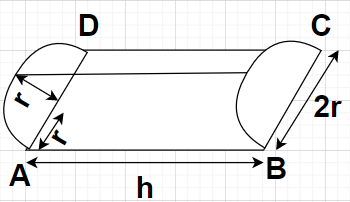
Let us consider a cylinder of length (or height) h having a rectangular base and semi-circular ends of radius r as shown in the figure.
As we know that the formula for the area of the semicircle with radius r is given by
Area of the semicircle = $\dfrac{{\pi {r^2}}}{2}$
Also, the curved surface area of half cylinder having radius r and length h is given by
Curved surface area of half cylinder = $\pi rh$
Also, the area of any rectangle is given by
Area of the rectangle = (Length of the rectangle)$ \times $(Breadth of the rectangle)
Using the above formula, we can write
Area of the rectangular base ABCD = (AB) $ \times $(BC) = h$ \times $2r = 2rh
Total surface area of the half cylinder = Area of two semi-circular ends + Curved surface area of half cylinder + Area of the rectangular base ABCD
$ \Rightarrow $ TSA = $2\left( {\dfrac{{\pi {r^2}}}{2}} \right) + \pi rh + 2rh$
$ \Rightarrow $ TSA = $\pi {r^2} + \pi rh + 2rh$
$ \Rightarrow $ TSA = $\pi {r^2} + \left( {\pi + 2} \right)rh{\text{ }} \to {\text{(1)}}$
As we know that volume of the half cylinder having radius as r and length as h is given by
$
{\text{V}} = \dfrac{{\pi {r^2}h}}{2} \\
\Rightarrow h = \dfrac{{2{\text{V}}}}{{\pi {r^2}}}{\text{ }} \to {\text{(2)}} \\
$
By substituting equation (2) in equation (1), we get
$ \Rightarrow $ TSA = $\pi {r^2} + \left( {\pi + 2} \right)r\left( {\dfrac{{2{\text{V}}}}{{\pi {r^2}}}} \right)$
$ \Rightarrow $ TSA = $\pi {r^2} + \left( {\pi + 2} \right)\left( {\dfrac{{2{\text{V}}}}{{\pi r}}} \right)$
By differentiating the above equation on both sides with respect to r, we get
\[
\Rightarrow \dfrac{d}{{dr}}\left( {{\text{TSA}}} \right) = \dfrac{d}{{dr}}\left[ {\pi {r^2} + \left( {\pi + 2} \right)\left( {\dfrac{{2{\text{V}}}}{{\pi r}}} \right)} \right] \\
\Rightarrow \dfrac{d}{{dr}}\left( {{\text{TSA}}} \right) = \dfrac{d}{{dr}}\left( {\pi {r^2}} \right) + \dfrac{d}{{dr}}\left[ {\left( {\pi + 2} \right)\left( {\dfrac{{2{\text{V}}}}{{\pi r}}} \right)} \right] \\
\Rightarrow \dfrac{d}{{dr}}\left( {{\text{TSA}}} \right) = \pi \dfrac{d}{{dr}}\left( {{r^2}} \right) + \left( {\pi + 2} \right)\left( {\dfrac{{2{\text{V}}}}{\pi }} \right)\dfrac{d}{{dr}}\left( {{r^{ - 1}}} \right) \\
\Rightarrow \dfrac{d}{{dr}}\left( {{\text{TSA}}} \right) = \pi \left( {2r} \right) + \left( {\pi + 2} \right)\left( {\dfrac{{2{\text{V}}}}{\pi }} \right)\left( { - {r^{ - 2}}} \right) \\
\Rightarrow \dfrac{d}{{dr}}\left( {{\text{TSA}}} \right) = 2\pi r + \left( {\pi + 2} \right)\left( {\dfrac{{2{\text{V}}}}{\pi }} \right)\left( { - \dfrac{1}{{{r^2}}}} \right) \\
\Rightarrow \dfrac{d}{{dr}}\left( {{\text{TSA}}} \right) = 2\pi r - \left( {\pi + 2} \right)\left( {\dfrac{{2{\text{V}}}}{{\pi {r^2}}}} \right){\text{ }} \to {\text{(3)}} \\
\]
In order to have minimum surface area of the half cylinder we will put \[\dfrac{d}{{dr}}\left( {{\text{TSA}}} \right) = 0\] in the above equation, we get
\[
\Rightarrow 0 = 2\pi r - \left( {\pi + 2} \right)\left( {\dfrac{{2{\text{V}}}}{{\pi {r^2}}}} \right) \\
\Rightarrow 2\pi r = \left( {\pi + 2} \right)\left( {\dfrac{{2{\text{V}}}}{{\pi {r^2}}}} \right) \\
\Rightarrow {r^3} = \left( {\dfrac{{\pi + 2}}{{2\pi }}} \right)\left( {\dfrac{{2{\text{V}}}}{\pi }} \right) \\
\Rightarrow {r^3} = \left( {\dfrac{{\pi + 2}}{{{\pi ^2}}}} \right){\text{V }} \to {\text{(4)}} \\
\]
Here, if \[\dfrac{{{d^2}}}{{d{r^2}}}\left( {{\text{TSA}}} \right) \geqslant 0\] then it means that the total surface area of the given half cylinder will be minimum whereas if \[\dfrac{{{d^2}}}{{d{r^2}}}\left( {{\text{TSA}}} \right) \leqslant 0\] then it means that the total surface area of the given half cylinder will be maximum.
By differentiating equation (3) with respect to r on both sides, we get
\[
\Rightarrow \dfrac{{{d^2}}}{{d{r^2}}}\left( {{\text{TSA}}} \right) = \dfrac{d}{{dr}}\left[ {2\pi r - \left( {\pi + 2} \right)\left( {\dfrac{{2{\text{V}}}}{{\pi {r^2}}}} \right)} \right] \\
\Rightarrow \dfrac{{{d^2}}}{{d{r^2}}}\left( {{\text{TSA}}} \right) = \dfrac{d}{{dr}}\left( {2\pi r} \right) - \dfrac{d}{{dr}}\left[ {\left( {\pi + 2} \right)\left( {\dfrac{{2{\text{V}}}}{{\pi {r^2}}}} \right)} \right] \\
\Rightarrow \dfrac{{{d^2}}}{{d{r^2}}}\left( {{\text{TSA}}} \right) = 2\pi \dfrac{{dr}}{{dr}} - \dfrac{{2\left( {\pi + 2} \right){\text{V}}}}{\pi }\dfrac{d}{{dr}}\left( {{r^{ - 2}}} \right) \\
\Rightarrow \dfrac{{{d^2}}}{{d{r^2}}}\left( {{\text{TSA}}} \right) = 2\pi - \dfrac{{2\left( {\pi + 2} \right){\text{V}}}}{\pi }\left( { - 2{r^{ - 3}}} \right) \\
\Rightarrow \dfrac{{{d^2}}}{{d{r^2}}}\left( {{\text{TSA}}} \right) = 2\pi + \dfrac{{4\left( {\pi + 2} \right){\text{V}}}}{{\pi {r^3}}} \\
\]
By putting \[{r^3} = \left( {\dfrac{{\pi + 2}}{{{\pi ^2}}}} \right){\text{V}}\] in the above equation, we get
\[ \Rightarrow \dfrac{{{d^2}}}{{d{r^2}}}\left( {{\text{TSA}}} \right) = 2\pi + \dfrac{{4\left( {\pi + 2} \right){\text{V}}}}{{\pi \left( {\dfrac{{\pi + 2}}{{{\pi ^2}}}} \right){\text{V}}}} = 2\pi + \dfrac{4}{{\left( {\dfrac{1}{\pi }} \right)}} = 2\pi + 4\pi = 6\pi > 0\]
Clearly, from the above equation we can see that \[\dfrac{{{d^2}}}{{d{r^2}}}\left( {{\text{TSA}}} \right)\] comes out to be positive so the total surface area of the given half cylinder will be minimum.
By substituting ${\text{V}} = \dfrac{{\pi {r^2}h}}{2}$ in equation (4), we get
\[
\Rightarrow {r^3} = \left( {\dfrac{{\pi + 2}}{{{\pi ^2}}}} \right)\left( {\dfrac{{\pi {r^2}h}}{2}} \right) = \dfrac{{\left( {\pi + 2} \right){r^2}h}}{{2\pi }} \\
\Rightarrow \left[ {\dfrac{{2\pi }}{{\left( {\pi + 2} \right)}}} \right]\dfrac{{{r^3}}}{{{r^2}}} = h \\
\Rightarrow h = \dfrac{{2\pi }}{{\left( {\pi + 2} \right)}}r \\
\Rightarrow \dfrac{h}{{2r}} = \dfrac{\pi }{{\left( {\pi + 2} \right)}} \\
\]
Since, Diameter of semi-circular ends (with radius r) = 2r and length of the half cylinder = h
\[ \Rightarrow \dfrac{{{\text{Length of the half cylinder}}}}{{{\text{Diameter of its semi - circular ends}}}} = \dfrac{\pi }{{\left( {\pi + 2} \right)}}\]
Therefore, the ratio of the length of the cylinder to the diameter of its semi-circular ends is $\pi :\left( {\pi + 2} \right)$.
Note- The curved surface area of half cylinder having radius r and length h is equal to half the curved surface area of the cylinder having radius r and length h i.e., $\dfrac{{2\pi rh}}{2} = \pi rh$. In this particular problem, volume of the half cylinder (V) is constant because it is given that a given (fixed) quantity of metal is casted to make this half cylinder.
To show: Ratio of the length of the cylinder to the diameter of its semi-circular ends is $\pi :\left( {\pi + 2} \right)$ or $\dfrac{{{\text{Length of the cylinder}}}}{{{\text{Diameter of its semi - circular ends}}}} = \dfrac{\pi }{{\pi + 2}}$
Complete step by step answer:
So, we have to prove the above equation
Let us consider a cylinder of length (or height) h having a rectangular base and semi-circular ends of radius r as shown in the figure.
As we know that the formula for the area of the semicircle with radius r is given by
Area of the semicircle = $\dfrac{{\pi {r^2}}}{2}$
Also, the curved surface area of half cylinder having radius r and length h is given by
Curved surface area of half cylinder = $\pi rh$
Also, the area of any rectangle is given by
Area of the rectangle = (Length of the rectangle)$ \times $(Breadth of the rectangle)
Using the above formula, we can write
Area of the rectangular base ABCD = (AB) $ \times $(BC) = h$ \times $2r = 2rh
Total surface area of the half cylinder = Area of two semi-circular ends + Curved surface area of half cylinder + Area of the rectangular base ABCD
$ \Rightarrow $ TSA = $2\left( {\dfrac{{\pi {r^2}}}{2}} \right) + \pi rh + 2rh$
$ \Rightarrow $ TSA = $\pi {r^2} + \pi rh + 2rh$
$ \Rightarrow $ TSA = $\pi {r^2} + \left( {\pi + 2} \right)rh{\text{ }} \to {\text{(1)}}$
As we know that volume of the half cylinder having radius as r and length as h is given by
$
{\text{V}} = \dfrac{{\pi {r^2}h}}{2} \\
\Rightarrow h = \dfrac{{2{\text{V}}}}{{\pi {r^2}}}{\text{ }} \to {\text{(2)}} \\
$
By substituting equation (2) in equation (1), we get
$ \Rightarrow $ TSA = $\pi {r^2} + \left( {\pi + 2} \right)r\left( {\dfrac{{2{\text{V}}}}{{\pi {r^2}}}} \right)$
$ \Rightarrow $ TSA = $\pi {r^2} + \left( {\pi + 2} \right)\left( {\dfrac{{2{\text{V}}}}{{\pi r}}} \right)$
By differentiating the above equation on both sides with respect to r, we get
\[
\Rightarrow \dfrac{d}{{dr}}\left( {{\text{TSA}}} \right) = \dfrac{d}{{dr}}\left[ {\pi {r^2} + \left( {\pi + 2} \right)\left( {\dfrac{{2{\text{V}}}}{{\pi r}}} \right)} \right] \\
\Rightarrow \dfrac{d}{{dr}}\left( {{\text{TSA}}} \right) = \dfrac{d}{{dr}}\left( {\pi {r^2}} \right) + \dfrac{d}{{dr}}\left[ {\left( {\pi + 2} \right)\left( {\dfrac{{2{\text{V}}}}{{\pi r}}} \right)} \right] \\
\Rightarrow \dfrac{d}{{dr}}\left( {{\text{TSA}}} \right) = \pi \dfrac{d}{{dr}}\left( {{r^2}} \right) + \left( {\pi + 2} \right)\left( {\dfrac{{2{\text{V}}}}{\pi }} \right)\dfrac{d}{{dr}}\left( {{r^{ - 1}}} \right) \\
\Rightarrow \dfrac{d}{{dr}}\left( {{\text{TSA}}} \right) = \pi \left( {2r} \right) + \left( {\pi + 2} \right)\left( {\dfrac{{2{\text{V}}}}{\pi }} \right)\left( { - {r^{ - 2}}} \right) \\
\Rightarrow \dfrac{d}{{dr}}\left( {{\text{TSA}}} \right) = 2\pi r + \left( {\pi + 2} \right)\left( {\dfrac{{2{\text{V}}}}{\pi }} \right)\left( { - \dfrac{1}{{{r^2}}}} \right) \\
\Rightarrow \dfrac{d}{{dr}}\left( {{\text{TSA}}} \right) = 2\pi r - \left( {\pi + 2} \right)\left( {\dfrac{{2{\text{V}}}}{{\pi {r^2}}}} \right){\text{ }} \to {\text{(3)}} \\
\]
In order to have minimum surface area of the half cylinder we will put \[\dfrac{d}{{dr}}\left( {{\text{TSA}}} \right) = 0\] in the above equation, we get
\[
\Rightarrow 0 = 2\pi r - \left( {\pi + 2} \right)\left( {\dfrac{{2{\text{V}}}}{{\pi {r^2}}}} \right) \\
\Rightarrow 2\pi r = \left( {\pi + 2} \right)\left( {\dfrac{{2{\text{V}}}}{{\pi {r^2}}}} \right) \\
\Rightarrow {r^3} = \left( {\dfrac{{\pi + 2}}{{2\pi }}} \right)\left( {\dfrac{{2{\text{V}}}}{\pi }} \right) \\
\Rightarrow {r^3} = \left( {\dfrac{{\pi + 2}}{{{\pi ^2}}}} \right){\text{V }} \to {\text{(4)}} \\
\]
Here, if \[\dfrac{{{d^2}}}{{d{r^2}}}\left( {{\text{TSA}}} \right) \geqslant 0\] then it means that the total surface area of the given half cylinder will be minimum whereas if \[\dfrac{{{d^2}}}{{d{r^2}}}\left( {{\text{TSA}}} \right) \leqslant 0\] then it means that the total surface area of the given half cylinder will be maximum.
By differentiating equation (3) with respect to r on both sides, we get
\[
\Rightarrow \dfrac{{{d^2}}}{{d{r^2}}}\left( {{\text{TSA}}} \right) = \dfrac{d}{{dr}}\left[ {2\pi r - \left( {\pi + 2} \right)\left( {\dfrac{{2{\text{V}}}}{{\pi {r^2}}}} \right)} \right] \\
\Rightarrow \dfrac{{{d^2}}}{{d{r^2}}}\left( {{\text{TSA}}} \right) = \dfrac{d}{{dr}}\left( {2\pi r} \right) - \dfrac{d}{{dr}}\left[ {\left( {\pi + 2} \right)\left( {\dfrac{{2{\text{V}}}}{{\pi {r^2}}}} \right)} \right] \\
\Rightarrow \dfrac{{{d^2}}}{{d{r^2}}}\left( {{\text{TSA}}} \right) = 2\pi \dfrac{{dr}}{{dr}} - \dfrac{{2\left( {\pi + 2} \right){\text{V}}}}{\pi }\dfrac{d}{{dr}}\left( {{r^{ - 2}}} \right) \\
\Rightarrow \dfrac{{{d^2}}}{{d{r^2}}}\left( {{\text{TSA}}} \right) = 2\pi - \dfrac{{2\left( {\pi + 2} \right){\text{V}}}}{\pi }\left( { - 2{r^{ - 3}}} \right) \\
\Rightarrow \dfrac{{{d^2}}}{{d{r^2}}}\left( {{\text{TSA}}} \right) = 2\pi + \dfrac{{4\left( {\pi + 2} \right){\text{V}}}}{{\pi {r^3}}} \\
\]
By putting \[{r^3} = \left( {\dfrac{{\pi + 2}}{{{\pi ^2}}}} \right){\text{V}}\] in the above equation, we get
\[ \Rightarrow \dfrac{{{d^2}}}{{d{r^2}}}\left( {{\text{TSA}}} \right) = 2\pi + \dfrac{{4\left( {\pi + 2} \right){\text{V}}}}{{\pi \left( {\dfrac{{\pi + 2}}{{{\pi ^2}}}} \right){\text{V}}}} = 2\pi + \dfrac{4}{{\left( {\dfrac{1}{\pi }} \right)}} = 2\pi + 4\pi = 6\pi > 0\]
Clearly, from the above equation we can see that \[\dfrac{{{d^2}}}{{d{r^2}}}\left( {{\text{TSA}}} \right)\] comes out to be positive so the total surface area of the given half cylinder will be minimum.
By substituting ${\text{V}} = \dfrac{{\pi {r^2}h}}{2}$ in equation (4), we get
\[
\Rightarrow {r^3} = \left( {\dfrac{{\pi + 2}}{{{\pi ^2}}}} \right)\left( {\dfrac{{\pi {r^2}h}}{2}} \right) = \dfrac{{\left( {\pi + 2} \right){r^2}h}}{{2\pi }} \\
\Rightarrow \left[ {\dfrac{{2\pi }}{{\left( {\pi + 2} \right)}}} \right]\dfrac{{{r^3}}}{{{r^2}}} = h \\
\Rightarrow h = \dfrac{{2\pi }}{{\left( {\pi + 2} \right)}}r \\
\Rightarrow \dfrac{h}{{2r}} = \dfrac{\pi }{{\left( {\pi + 2} \right)}} \\
\]
Since, Diameter of semi-circular ends (with radius r) = 2r and length of the half cylinder = h
\[ \Rightarrow \dfrac{{{\text{Length of the half cylinder}}}}{{{\text{Diameter of its semi - circular ends}}}} = \dfrac{\pi }{{\left( {\pi + 2} \right)}}\]
Therefore, the ratio of the length of the cylinder to the diameter of its semi-circular ends is $\pi :\left( {\pi + 2} \right)$.
Note- The curved surface area of half cylinder having radius r and length h is equal to half the curved surface area of the cylinder having radius r and length h i.e., $\dfrac{{2\pi rh}}{2} = \pi rh$. In this particular problem, volume of the half cylinder (V) is constant because it is given that a given (fixed) quantity of metal is casted to make this half cylinder.
Recently Updated Pages
Master Class 12 Business Studies: Engaging Questions & Answers for Success

Master Class 12 Biology: Engaging Questions & Answers for Success
Master Class 12 Chemistry: Engaging Questions & Answers for Success
Class 12 Question and Answer - Your Ultimate Solutions Guide
Master Class 11 Social Science: Engaging Questions & Answers for Success
Master Class 11 English: Engaging Questions & Answers for Success
Trending doubts
Explain the Treaty of Vienna of 1815 class 10 social science CBSE
Which Indian city is known as the "City of Victory"?
Which instrument is used to measure the Blood Pressure?
Who Won 36 Oscar Awards? Record Holder Revealed
What is the median of the first 10 natural numbers class 10 maths CBSE
Why is it 530 pm in india when it is 1200 afternoon class 10 social science CBSE