




A given function $y=f\left( x \right)$ satisfies (i) $f\left( 0 \right)=0$ (ii) ${{f}^{''}}\left( x \right)={{f}^{'}}\left( x \right)$ (iii) ${{f}^{'}}\left( 0 \right)=1$. Then find the area bounded by the graph $y=f\left( x \right)$ and the lines $x=0,x-1=0$ and $y+1=0$.
A. $e$ B. $e-2$ C. $e-1$ D. $e+1$
Answer
 Verified
586.5k+ views
Hint: We use the given value to try to find out the function. Using methods of integration, we find out the values of constant parts in the integration. After we find y we put all the given functions in the graph to find out the area bounded by those graphs. Then we find the area of the curve using the intersecting points. Breaking the area into parts we find the area.
Complete step by step answer:
First, we need to find out the curve of $y=f\left( x \right)$.
We are given that $f\left( 0 \right)=0$, ${{f}^{''}}\left( x \right)={{f}^{'}}\left( x \right)$, ${{f}^{'}}\left( 0 \right)=1$.
We take the relation ${{f}^{''}}\left( x \right)={{f}^{'}}\left( x \right)$. We know that ${{f}^{''}}\left( x \right)=\dfrac{d}{dx}\left[ {{f}^{'}}\left( x \right) \right]$.
So, changing the equation we get ${{f}^{''}}\left( x \right)=\dfrac{d}{dx}\left[ {{f}^{'}}\left( x \right) \right]={{f}^{'}}\left( x \right)$.
We rearrange the equation to get the differential form
$\begin{align}
& \dfrac{d}{dx}\left[ {{f}^{'}}\left( x \right) \right]={{f}^{'}}\left( x \right) \\
& \Rightarrow \dfrac{d\left( {{f}^{'}}\left( x \right) \right)}{{{f}^{'}}\left( x \right)}=dx \\
\end{align}$
Now, we integrate both sides w.r.t. to get $\int{\dfrac{d\left( {{f}^{'}}\left( x \right) \right)}{{{f}^{'}}\left( x \right)}}=\int{dx}+c$.
The solution of the integration is $\log \left| {{f}^{'}}\left( x \right) \right|=x+c$.
In the equation we put x = 0. We get $\log \left| {{f}^{'}}\left( 0 \right) \right|=0+c=c$.
We know ${{f}^{'}}\left( 0 \right)=1$. So, $c=\log \left| 1 \right|=0$.
The equation becomes $\log \left| {{f}^{'}}\left( x \right) \right|=x$ which implies ${{f}^{'}}\left( x \right)={{e}^{x}}$.
We know ${{f}^{'}}\left( x \right)={{e}^{x}}\Rightarrow \dfrac{d\left( f\left( x \right) \right)}{dx}={{e}^{x}}$.
Now we integrate the equation ${{f}^{'}}\left( x \right)={{e}^{x}}$ w.r.t x again.
So, \[\int{d\left( f\left( x \right) \right)}=\int{d\left( {{e}^{x}} \right)}+C\] which means \[f\left( x \right)={{e}^{x}}+C\].
We have $f\left( 0 \right)=0$. Putting the value, x = 0 we get \[f\left( 0 \right)={{e}^{0}}+C\Rightarrow 0=1+C\Rightarrow C=-1\].
The equation becomes \[y=f\left( x \right)={{e}^{x}}-1\].
Now, we need to find the area bounded by the graph $y=f\left( x \right)={{e}^{x}}-1$ and the lines $x=0,x-1=0$ and $y+1=0$.
We draw all the given graphs to find the area which is marked.
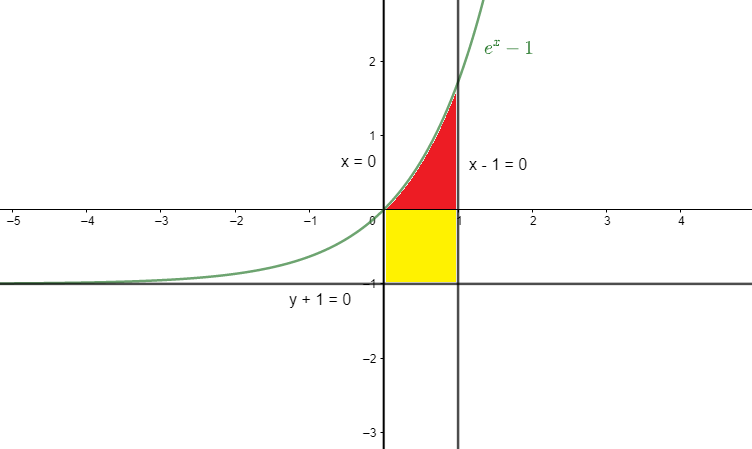
We first find the yellow marked area as it is a square part with side length 1 unit.
So, area will be $1\times 1=1$ sq. unit.
Now we find the red marked area with the help of integration.
The area is under the curve $y=f\left( x \right)={{e}^{x}}-1$ from x = 0 to x = 1.
So, the integration becomes $\int\limits_{0}^{1}{ydx}$. We put the function to get $\int\limits_{0}^{1}{\left( {{e}^{x}}-1 \right)dx}$.
The area is \[\int\limits_{0}^{1}{\left( {{e}^{x}}-1 \right)dx}=\left[ {{e}^{x}}-x \right]_{0}^{1}=\left[ {{e}^{1}}-{{e}^{0}} \right]-\left[ 1-0 \right]=e-1-1=e-2\] sq. unit.
Total area becomes $e-2+1=e-1$ sq. unit. Correct option is (C).
Note:
We can’t take the whole area covered by the curve as it has to be bounded by $x=0,x-1=0$. Although the yellow marked area is under the curve, it is on the negative side of the x-axis. So, if we integrate the whole thing it will cancel out the positive part’s area because of its sign. The area can’t be negative. so, we have to find out the areas separately.
Complete step by step answer:
First, we need to find out the curve of $y=f\left( x \right)$.
We are given that $f\left( 0 \right)=0$, ${{f}^{''}}\left( x \right)={{f}^{'}}\left( x \right)$, ${{f}^{'}}\left( 0 \right)=1$.
We take the relation ${{f}^{''}}\left( x \right)={{f}^{'}}\left( x \right)$. We know that ${{f}^{''}}\left( x \right)=\dfrac{d}{dx}\left[ {{f}^{'}}\left( x \right) \right]$.
So, changing the equation we get ${{f}^{''}}\left( x \right)=\dfrac{d}{dx}\left[ {{f}^{'}}\left( x \right) \right]={{f}^{'}}\left( x \right)$.
We rearrange the equation to get the differential form
$\begin{align}
& \dfrac{d}{dx}\left[ {{f}^{'}}\left( x \right) \right]={{f}^{'}}\left( x \right) \\
& \Rightarrow \dfrac{d\left( {{f}^{'}}\left( x \right) \right)}{{{f}^{'}}\left( x \right)}=dx \\
\end{align}$
Now, we integrate both sides w.r.t. to get $\int{\dfrac{d\left( {{f}^{'}}\left( x \right) \right)}{{{f}^{'}}\left( x \right)}}=\int{dx}+c$.
The solution of the integration is $\log \left| {{f}^{'}}\left( x \right) \right|=x+c$.
In the equation we put x = 0. We get $\log \left| {{f}^{'}}\left( 0 \right) \right|=0+c=c$.
We know ${{f}^{'}}\left( 0 \right)=1$. So, $c=\log \left| 1 \right|=0$.
The equation becomes $\log \left| {{f}^{'}}\left( x \right) \right|=x$ which implies ${{f}^{'}}\left( x \right)={{e}^{x}}$.
We know ${{f}^{'}}\left( x \right)={{e}^{x}}\Rightarrow \dfrac{d\left( f\left( x \right) \right)}{dx}={{e}^{x}}$.
Now we integrate the equation ${{f}^{'}}\left( x \right)={{e}^{x}}$ w.r.t x again.
So, \[\int{d\left( f\left( x \right) \right)}=\int{d\left( {{e}^{x}} \right)}+C\] which means \[f\left( x \right)={{e}^{x}}+C\].
We have $f\left( 0 \right)=0$. Putting the value, x = 0 we get \[f\left( 0 \right)={{e}^{0}}+C\Rightarrow 0=1+C\Rightarrow C=-1\].
The equation becomes \[y=f\left( x \right)={{e}^{x}}-1\].
Now, we need to find the area bounded by the graph $y=f\left( x \right)={{e}^{x}}-1$ and the lines $x=0,x-1=0$ and $y+1=0$.
We draw all the given graphs to find the area which is marked.
We first find the yellow marked area as it is a square part with side length 1 unit.
So, area will be $1\times 1=1$ sq. unit.
Now we find the red marked area with the help of integration.
The area is under the curve $y=f\left( x \right)={{e}^{x}}-1$ from x = 0 to x = 1.
So, the integration becomes $\int\limits_{0}^{1}{ydx}$. We put the function to get $\int\limits_{0}^{1}{\left( {{e}^{x}}-1 \right)dx}$.
The area is \[\int\limits_{0}^{1}{\left( {{e}^{x}}-1 \right)dx}=\left[ {{e}^{x}}-x \right]_{0}^{1}=\left[ {{e}^{1}}-{{e}^{0}} \right]-\left[ 1-0 \right]=e-1-1=e-2\] sq. unit.
Total area becomes $e-2+1=e-1$ sq. unit. Correct option is (C).
Note:
We can’t take the whole area covered by the curve as it has to be bounded by $x=0,x-1=0$. Although the yellow marked area is under the curve, it is on the negative side of the x-axis. So, if we integrate the whole thing it will cancel out the positive part’s area because of its sign. The area can’t be negative. so, we have to find out the areas separately.
Recently Updated Pages
Master Class 10 Computer Science: Engaging Questions & Answers for Success

Master Class 10 General Knowledge: Engaging Questions & Answers for Success
Master Class 10 English: Engaging Questions & Answers for Success
Master Class 10 Social Science: Engaging Questions & Answers for Success
Master Class 10 Maths: Engaging Questions & Answers for Success
Master Class 10 Science: Engaging Questions & Answers for Success
Trending doubts
What is the median of the first 10 natural numbers class 10 maths CBSE
Which women's tennis player has 24 Grand Slam singles titles?
Who is the Brand Ambassador of Incredible India?
Why is there a time difference of about 5 hours between class 10 social science CBSE
Write a letter to the principal requesting him to grant class 10 english CBSE
A moving boat is observed from the top of a 150 m high class 10 maths CBSE