




(a) Give three reasons why modulation of a message signal is necessary for long distance transmission.
(b) Show graphically an audio signal, a carrier wave and an amplitude modulated wave.
Answer
 Verified
657.9k+ views
Hint: In communication, we need to send signals from one place to another over large distances. But a simple transverse wave signal can get a lot of distortions due to the obstacles in the path of the communication due to which need some ways to ensure efficient signal transmission from one place to another.
Complete step by step answer:
(a). In communication, we use electromagnetic waves which are transverse in nature. They are used to transmit a signal from a sending antenna to a receiving antenna.
The message signal cannot be sent directly in its original form from one place to another because that way the signal dies out very quickly and long distance communication is not possible.
Modulation allows a number of benefits for communication.
It allows us to transmit a signal over a range of frequencies called bandwidth of the channel.
The modulated signals do not interfere with each other.
Lower the frequency of a signal, larger is the antenna required to transmit that signal. But through modulation, we can send signals by modulating it to a higher frequency and be able to use a smaller antenna.
We have different ways in which we can modulate our message signal and then transmit it safely without excessive distortion from one place to another. These methods are amplitude modulation (AM), frequency modulation (FM) and phase modulation (PM).
(b). Following diagram represents an audio signal, a carrier wave and an amplitude modulated wave.
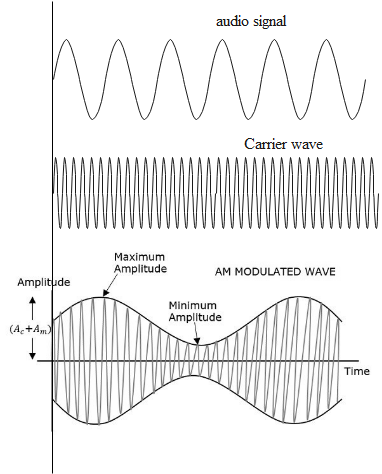
Note: A signal must not be modulated beyond a certain limit. This limit is defined by the modulation index which, for amplitude modulation, is equal to ratio of amplitude of the modulated wave to the amplitude of the carrier wave. Its value should not exceed one which can lead to over modulation.
Complete step by step answer:
(a). In communication, we use electromagnetic waves which are transverse in nature. They are used to transmit a signal from a sending antenna to a receiving antenna.
The message signal cannot be sent directly in its original form from one place to another because that way the signal dies out very quickly and long distance communication is not possible.
Modulation allows a number of benefits for communication.
It allows us to transmit a signal over a range of frequencies called bandwidth of the channel.
The modulated signals do not interfere with each other.
Lower the frequency of a signal, larger is the antenna required to transmit that signal. But through modulation, we can send signals by modulating it to a higher frequency and be able to use a smaller antenna.
We have different ways in which we can modulate our message signal and then transmit it safely without excessive distortion from one place to another. These methods are amplitude modulation (AM), frequency modulation (FM) and phase modulation (PM).
(b). Following diagram represents an audio signal, a carrier wave and an amplitude modulated wave.
Note: A signal must not be modulated beyond a certain limit. This limit is defined by the modulation index which, for amplitude modulation, is equal to ratio of amplitude of the modulated wave to the amplitude of the carrier wave. Its value should not exceed one which can lead to over modulation.
Recently Updated Pages
Master Class 12 Economics: Engaging Questions & Answers for Success

Master Class 12 Social Science: Engaging Questions & Answers for Success
Master Class 12 English: Engaging Questions & Answers for Success
Master Class 12 Maths: Engaging Questions & Answers for Success
Master Class 12 Physics: Engaging Questions & Answers for Success
Master Class 12 Biology: Engaging Questions & Answers for Success
Trending doubts
Draw a labelled sketch of the human eye class 12 physics CBSE
Which are the Top 10 Largest Countries of the World?
Draw ray diagrams each showing i myopic eye and ii class 12 physics CBSE
Which is the correct genotypic ratio of mendel dihybrid class 12 biology CBSE
Differentiate between homogeneous and heterogeneous class 12 chemistry CBSE
Which animal never drinks water in its entire life class 12 biology CBSE