




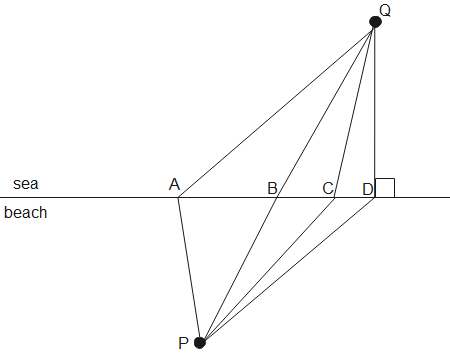
A girl standing at point P on a beach wishes to reach a point Q in the sea as quickly as possible. She runs at 6km/hr on the beach and swims at 4km/hr in the sea. She should take the path
(A). PAQ
(B). PBQ
(C). PCQ
(D). PDQ
Answer
 Verified
576.9k+ views
Hint: In optics, Snell’s law is defined as the relationship between the path taken by the ray of light while crossing the boundary or the surface of separation between the two contacting substances and the refractive index of each.
Complete step by step solution:
When light travels from one medium to the other it changes its path, this phenomenon is known as refraction.
So whenever light goes from one medium to the other, it tends to take the smallest path, through which minimum time will be covered. This is the fact which led to the derivation of Snell’s law.
Snell’s law states that the refractive index is the ratio of velocity of light in air to the velocity of light in medium.
When refraction occurs, the light bends towards the normal in denser medium but bends away from the normal in rarer medium. At the beach the velocity of a girl is greater but will decrease as it goes into the sea. So the path at the sea should be more towards the normal.
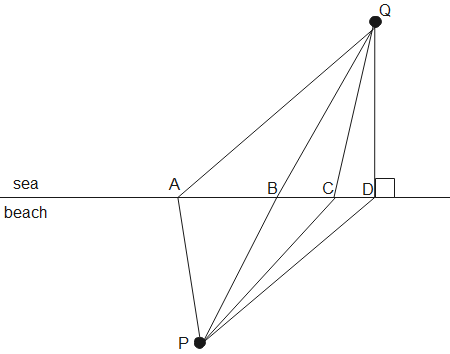
In the figure, the path PCQ should take the least time to travel between points P and Q.
Therefore, the shortest path is PCQ, hence the correct option is (C).
Note: Snell's law in terms of angles is the ratio of angle of incidence to the angel of refraction. When light travels from rarer to denser medium, after a certain limiting angle, called the critical angle total internal reflection occurs. The speed of light is slower in denser mediums and faster in rarer mediums.
Complete step by step solution:
When light travels from one medium to the other it changes its path, this phenomenon is known as refraction.
So whenever light goes from one medium to the other, it tends to take the smallest path, through which minimum time will be covered. This is the fact which led to the derivation of Snell’s law.
Snell’s law states that the refractive index is the ratio of velocity of light in air to the velocity of light in medium.
When refraction occurs, the light bends towards the normal in denser medium but bends away from the normal in rarer medium. At the beach the velocity of a girl is greater but will decrease as it goes into the sea. So the path at the sea should be more towards the normal.
In the figure, the path PCQ should take the least time to travel between points P and Q.
Therefore, the shortest path is PCQ, hence the correct option is (C).
Note: Snell's law in terms of angles is the ratio of angle of incidence to the angel of refraction. When light travels from rarer to denser medium, after a certain limiting angle, called the critical angle total internal reflection occurs. The speed of light is slower in denser mediums and faster in rarer mediums.
Recently Updated Pages
Three beakers labelled as A B and C each containing 25 mL of water were taken A small amount of NaOH anhydrous CuSO4 and NaCl were added to the beakers A B and C respectively It was observed that there was an increase in the temperature of the solutions contained in beakers A and B whereas in case of beaker C the temperature of the solution falls Which one of the following statements isarecorrect i In beakers A and B exothermic process has occurred ii In beakers A and B endothermic process has occurred iii In beaker C exothermic process has occurred iv In beaker C endothermic process has occurred

Master Class 11 Social Science: Engaging Questions & Answers for Success
Master Class 11 Physics: Engaging Questions & Answers for Success
Master Class 11 Maths: Engaging Questions & Answers for Success
Master Class 11 Economics: Engaging Questions & Answers for Success
Master Class 11 Computer Science: Engaging Questions & Answers for Success
Three beakers labelled as A B and C each containing 25 mL of water were taken A small amount of NaOH anhydrous CuSO4 and NaCl were added to the beakers A B and C respectively It was observed that there was an increase in the temperature of the solutions contained in beakers A and B whereas in case of beaker C the temperature of the solution falls Which one of the following statements isarecorrect i In beakers A and B exothermic process has occurred ii In beakers A and B endothermic process has occurred iii In beaker C exothermic process has occurred iv In beaker C endothermic process has occurred
Master Class 11 Social Science: Engaging Questions & Answers for Success
Master Class 11 Physics: Engaging Questions & Answers for Success
Trending doubts
One Metric ton is equal to kg A 10000 B 1000 C 100 class 11 physics CBSE
There are 720 permutations of the digits 1 2 3 4 5 class 11 maths CBSE
State and prove Bernoullis theorem class 11 physics CBSE
Difference Between Prokaryotic Cells and Eukaryotic Cells
1 Quintal is equal to a 110 kg b 10 kg c 100kg d 1000 class 11 physics CBSE
Discuss the various forms of bacteria class 11 biology CBSE