




A girl presses her physics textbook against a rough vertical wall with her hand. The direction of the frictional force on the book exerted by the wall is:
A. Downwards
B. Upwards.
C. Out from the wall
D. Into the wall
Answer
 Verified
576.3k+ views
Hint:Use the concept of Newton’s second law of motion. Determine all the forces acting on the physics textbook. Draw the free body diagram of the physics textbook and determine what should be the direction of the frictional force for the textbook to be in a steady state.
Complete step by step answer:
We have given that a girl is pressing a book against a vertical rough wall.Since the wall is rough, there must be a frictional force between the surface of the wall and the physics textbook.The frictional force between any two surfaces always acts along the line parallel to the surfaces of the object and the surface in contact with each other.Hence, the frictional force between the rough wall and the textbook cannot act out from the wall or into the wall.Hence, the options C and D are incorrect.Let use draw the free-body diagram of the physics textbook as follows:
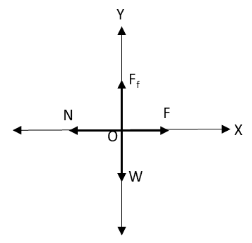
The Y-axis shown in the above diagram represents the vertical rough wall and the physics textbook is pressed at point O.The force \[F\] is the force applied by the girl on the textbook against the wall in a direction into the wall. The force applied by the girl is balanced by the normal force \[N\] exerted by the wall on the textbook along a direction out from the wall.The weight \[W\] of the textbook acts in the vertically downward direction. There must be some force balancing the weight of the textbook in the vertically upward direction.This weight of the book is balanced by the frictional force \[{F_f}\] on the book exerted by the rough wall.
Therefore, the frictional force must be in the upward direction.Hence, the correct option is B.
Note:One can also determine the direction of the frictional force between the physics textbook and the rough wall by considering that the gravitational force of the Earth pulls the textbook in downward direction. Hence, the frictional fore should be in the upward direction to oppose the gravitational pull. This reduces the effort of drawing the free body diagram of the textbook.
Complete step by step answer:
We have given that a girl is pressing a book against a vertical rough wall.Since the wall is rough, there must be a frictional force between the surface of the wall and the physics textbook.The frictional force between any two surfaces always acts along the line parallel to the surfaces of the object and the surface in contact with each other.Hence, the frictional force between the rough wall and the textbook cannot act out from the wall or into the wall.Hence, the options C and D are incorrect.Let use draw the free-body diagram of the physics textbook as follows:
The Y-axis shown in the above diagram represents the vertical rough wall and the physics textbook is pressed at point O.The force \[F\] is the force applied by the girl on the textbook against the wall in a direction into the wall. The force applied by the girl is balanced by the normal force \[N\] exerted by the wall on the textbook along a direction out from the wall.The weight \[W\] of the textbook acts in the vertically downward direction. There must be some force balancing the weight of the textbook in the vertically upward direction.This weight of the book is balanced by the frictional force \[{F_f}\] on the book exerted by the rough wall.
Therefore, the frictional force must be in the upward direction.Hence, the correct option is B.
Note:One can also determine the direction of the frictional force between the physics textbook and the rough wall by considering that the gravitational force of the Earth pulls the textbook in downward direction. Hence, the frictional fore should be in the upward direction to oppose the gravitational pull. This reduces the effort of drawing the free body diagram of the textbook.
Recently Updated Pages
Master Class 11 Computer Science: Engaging Questions & Answers for Success

Master Class 11 Business Studies: Engaging Questions & Answers for Success
Master Class 11 Economics: Engaging Questions & Answers for Success
Master Class 11 English: Engaging Questions & Answers for Success
Master Class 11 Maths: Engaging Questions & Answers for Success
Master Class 11 Biology: Engaging Questions & Answers for Success
Trending doubts
One Metric ton is equal to kg A 10000 B 1000 C 100 class 11 physics CBSE
There are 720 permutations of the digits 1 2 3 4 5 class 11 maths CBSE
Discuss the various forms of bacteria class 11 biology CBSE
Draw a diagram of a plant cell and label at least eight class 11 biology CBSE
State the laws of reflection of light
Explain zero factorial class 11 maths CBSE