




A girl is long-sighted. Which statement is correct?
A. She sees close objects less clearly than a person with normal vision.
B. She sees distant objects more clearly than a person with normal vision.
Answer
 Verified
479.4k+ views
Hint: Long-sightedness is a condition in which the picture of a close object forms behind the retina of the eyes. The light is concentrated behind the retina rather than on it in this case. As a result, adjacent objects are blurred.
Complete answer:
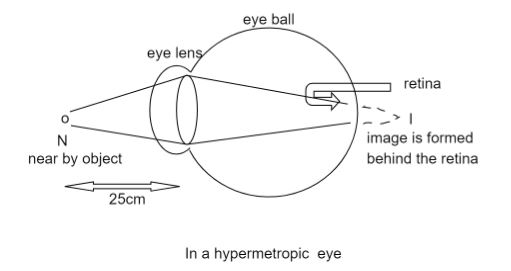
In long-sightedness or hypermetropia, the image of a nearby object lying at a distance of normal near the point $N$ at $25\,cm$ is formed behind the retina. This is due to her lens that is too flat or not curved enough, causing light from a close object (that will be diverging from a point) to be refracted excessively or short eyeball, leading it to converge behind the retina rather than on it.
This means the image isn't in focus. As a result, if a person has long-sightedness, surrounding objects will appear hazy.Because the light beams for a distant object are almost parallel, the light does not need to be as refracted, and she can easily focus the light onto her retina even with a less curved lens. As a result, she can clearly see faraway objects.
Hence option A is the correct answer.
Note: The least distance of distinct vision is the shortest distance at which objects may be viewed clearly without exertion. $25\,cm$ is the least distance of distinct vision for a young adult with normal vision. The image of an object is formed on the retina of the human eye.
Complete answer:
In long-sightedness or hypermetropia, the image of a nearby object lying at a distance of normal near the point $N$ at $25\,cm$ is formed behind the retina. This is due to her lens that is too flat or not curved enough, causing light from a close object (that will be diverging from a point) to be refracted excessively or short eyeball, leading it to converge behind the retina rather than on it.
This means the image isn't in focus. As a result, if a person has long-sightedness, surrounding objects will appear hazy.Because the light beams for a distant object are almost parallel, the light does not need to be as refracted, and she can easily focus the light onto her retina even with a less curved lens. As a result, she can clearly see faraway objects.
Hence option A is the correct answer.
Note: The least distance of distinct vision is the shortest distance at which objects may be viewed clearly without exertion. $25\,cm$ is the least distance of distinct vision for a young adult with normal vision. The image of an object is formed on the retina of the human eye.
Recently Updated Pages
Master Class 10 Computer Science: Engaging Questions & Answers for Success

Master Class 10 General Knowledge: Engaging Questions & Answers for Success
Master Class 10 English: Engaging Questions & Answers for Success
Master Class 10 Social Science: Engaging Questions & Answers for Success
Master Class 10 Maths: Engaging Questions & Answers for Success
Master Class 10 Science: Engaging Questions & Answers for Success
Trending doubts
What is the median of the first 10 natural numbers class 10 maths CBSE
Which women's tennis player has 24 Grand Slam singles titles?
Who is the Brand Ambassador of Incredible India?
Why is there a time difference of about 5 hours between class 10 social science CBSE
Write a letter to the principal requesting him to grant class 10 english CBSE
State and prove converse of BPT Basic Proportionality class 10 maths CBSE