




A frequency distribution of number of children in $50$ families of a region is as under:
Number of Children $\left( x \right)$ $0$ $1$ $2$ $3$ Total Number of families $\left( f \right)$ $10$ $25$ $12$ $3$ $50$
Obtain ‘less than’ type and ‘more than’ type cumulative frequency distribution for these data.
| Number of Children $\left( x \right)$ | $0$ | $1$ | $2$ | $3$ | Total |
| Number of families $\left( f \right)$ | $10$ | $25$ | $12$ | $3$ | $50$ |
Answer
 Verified
506.7k+ views
Hint: In this question we have been given with the frequency distribution table for the number of children in $50$ families. We have to Obtain ‘less than’ type and ‘more than’ type cumulative frequency distribution. We will solve this question by making the distribution with an upper-class limit and a lower-class limit. We will also find the cumulative frequency and plot the graph to get the required solution.
Complete step-by-step solution:
We have the distribution given to us as:
Now consider the more-than type cumulative frequency. To get the values for the more than type graph, we will find all the values in the table as more than. We will consider the class as more than $0$, more than $1$, more than $2$ and more than $3$.
We will also add the frequency of all the succeeding terms in the cumulative frequency of the terms.
We get the distribution as:
Now to find the more than type graph, we will plot the limits with the cumulative frequency. Therefore, we get the coordinates as:
$\left( 0,50 \right),\left( 1,40 \right),\left( 2,15 \right),\left( 3,3 \right)$
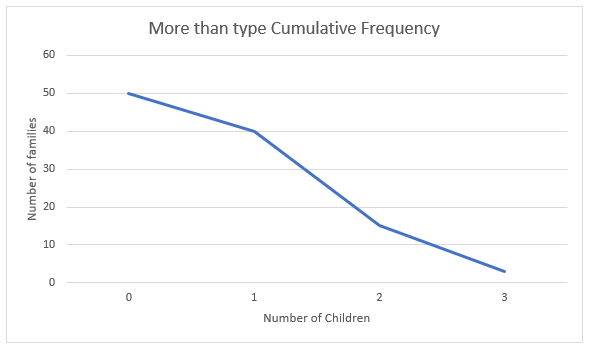
Now consider the less-than type cumulative frequency. To get the values for the less than type graph, we will find all the values in the table as less than. We will consider the class as less than $0$, less than $1$, less than $2$ and less than $3$.
We will also add the frequency of all the preceding terms in the cumulative frequency of the terms.
We get the distribution as:
Now to find the more than type graph, we will plot the limits with the cumulative frequency. Therefore, we get the coordinates as:
$\left( 0,10 \right),\left( 1,35 \right),\left( 2,47 \right),\left( 3,50 \right)$
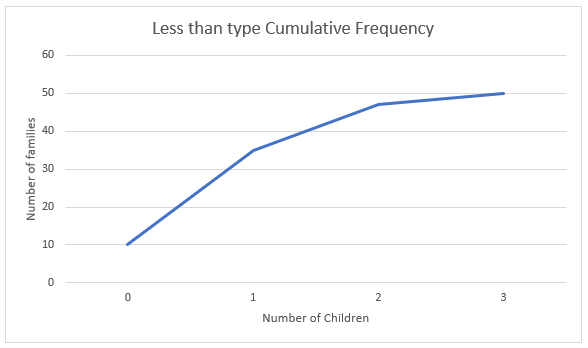
Which is the required solution for the less than and more than type cumulative frequency graphs.
Note: It is to be remembered that the cumulative frequency should always be plotted on the Y-axis to get a correct ogive. It is to be that a cumulative frequency curve is also called an ogive. And it should be made using a free hand curve after plotting all the points on the graph. the cumulative frequency is to be added correctly for the correct ogive.
Complete step-by-step solution:
We have the distribution given to us as:
| Number of Children $\left( x \right)$ | Number of families $\left( f \right)$ |
| $0$ | $10$ |
| $1$ | $25$ |
| $2$ | $12$ |
| $3$ | $3$ |
| Total | $50$ |
Now consider the more-than type cumulative frequency. To get the values for the more than type graph, we will find all the values in the table as more than. We will consider the class as more than $0$, more than $1$, more than $2$ and more than $3$.
We will also add the frequency of all the succeeding terms in the cumulative frequency of the terms.
We get the distribution as:
| Number of Children $\left( x \right)$ | Cumulative frequency |
| More than $0$ | $50$ |
| More than $1$ | $40$ |
| More than $2$ | $15$ |
| More than $3$ | $3$ |
Now to find the more than type graph, we will plot the limits with the cumulative frequency. Therefore, we get the coordinates as:
$\left( 0,50 \right),\left( 1,40 \right),\left( 2,15 \right),\left( 3,3 \right)$
Now consider the less-than type cumulative frequency. To get the values for the less than type graph, we will find all the values in the table as less than. We will consider the class as less than $0$, less than $1$, less than $2$ and less than $3$.
We will also add the frequency of all the preceding terms in the cumulative frequency of the terms.
We get the distribution as:
| Number of Children $\left( x \right)$ | Cumulative frequency |
| Less than $0$ | $10$ |
| Less than $1$ | $35$ |
| Less than $2$ | $47$ |
| Less than $3$ | $50$ |
Now to find the more than type graph, we will plot the limits with the cumulative frequency. Therefore, we get the coordinates as:
$\left( 0,10 \right),\left( 1,35 \right),\left( 2,47 \right),\left( 3,50 \right)$
Which is the required solution for the less than and more than type cumulative frequency graphs.
Note: It is to be remembered that the cumulative frequency should always be plotted on the Y-axis to get a correct ogive. It is to be that a cumulative frequency curve is also called an ogive. And it should be made using a free hand curve after plotting all the points on the graph. the cumulative frequency is to be added correctly for the correct ogive.
Recently Updated Pages
Master Class 11 English: Engaging Questions & Answers for Success

Master Class 11 Maths: Engaging Questions & Answers for Success
Master Class 11 Biology: Engaging Questions & Answers for Success
Master Class 11 Social Science: Engaging Questions & Answers for Success
Master Class 11 Physics: Engaging Questions & Answers for Success
Master Class 11 Accountancy: Engaging Questions & Answers for Success
Trending doubts
One Metric ton is equal to kg A 10000 B 1000 C 100 class 11 physics CBSE
There are 720 permutations of the digits 1 2 3 4 5 class 11 maths CBSE
Discuss the various forms of bacteria class 11 biology CBSE
Draw a diagram of a plant cell and label at least eight class 11 biology CBSE
State the laws of reflection of light
Explain zero factorial class 11 maths CBSE