




A force of 5 N gives a mass m1 an acceleration of 10m/${s^2}$, and a mass ${m_2}$ an acceleration of 20m/${s^2}$. What acceleration would it give if both the masses were tied together?
Answer
 Verified
583.6k+ views
Hint: In the problem, they’ve given us that two masses are initially subjected to force of 5N, individually. They’ve asked for how much acceleration would the same force produce if the masses were tied up. In order to know this we need to find the individual masses. From this, we can calculate the acceleration using Newton’s 2nd Law.
Formula used:
$F = ma$
Complete step by step answer:
If we drew a simple sketch from the data given in the diagram, it would look something like this.
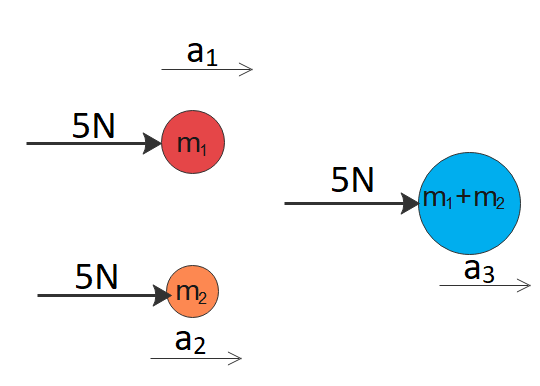
If we consider that m1 is the mass of the first object and a1 is the acceleration due to the application of an external force of 5N, from Newton’s 2nd law, we’ll have
$\eqalign{
& F = {m_1}{a_1} \cr
& \Rightarrow {m_1} = \dfrac{F}{{{a_1}}} \cr
& \Rightarrow {m_1} = \dfrac{{5N}}{{10m{s^{ - 2}}}} \cr
& \Rightarrow {m_1} = 0.5kg \cr} $
Similarly, if we consider that the second mass is m2 and a2 as the acceleration, we’ll have
$\eqalign{
& F = {m_2}{a_2} \cr
& \Rightarrow {m_2} = \dfrac{F}{{{a_2}}} \cr
& \Rightarrow {m_2} = \dfrac{{5N}}{{20m{s^{ - 2}}}} \cr
& \Rightarrow {m_2} = 0.25kg \cr} $
So, if both the masses are tied up, we’ll have an object whose mass is equal to the sum of these masses. In that case, the acceleration of this object, say a3 will be
$\eqalign{
& F = \left( {{m_1} + {m_2}} \right){a_3} \cr
& \Rightarrow {a_3} = \dfrac{F}{{\left( {{m_1} + {m_2}} \right)}} \cr
& \Rightarrow {a_3} = \dfrac{{5N}}{{0.5kg + 0.25kg}} = \dfrac{{5N}}{{0.75kg}} \cr
& \Rightarrow {a_3} = 6.67m{s^{ - 2}} \cr} $
Therefore, the acceleration of the body if both were tied together would be $6.67m{s^{ - 2}}$.
Note:
In the question, they’ve not given us anything related to the shape of the mass. So, we have assumed them to be point objects. This will do the job in most of the problems in mechanics as you’re mostly considering that force is acting on a point mass. Drawing a free body diagram will ensure that you’ve included all the forces acting on the object and it will give you the course of the action of the object due to the forces.
Formula used:
$F = ma$
Complete step by step answer:
If we drew a simple sketch from the data given in the diagram, it would look something like this.
If we consider that m1 is the mass of the first object and a1 is the acceleration due to the application of an external force of 5N, from Newton’s 2nd law, we’ll have
$\eqalign{
& F = {m_1}{a_1} \cr
& \Rightarrow {m_1} = \dfrac{F}{{{a_1}}} \cr
& \Rightarrow {m_1} = \dfrac{{5N}}{{10m{s^{ - 2}}}} \cr
& \Rightarrow {m_1} = 0.5kg \cr} $
Similarly, if we consider that the second mass is m2 and a2 as the acceleration, we’ll have
$\eqalign{
& F = {m_2}{a_2} \cr
& \Rightarrow {m_2} = \dfrac{F}{{{a_2}}} \cr
& \Rightarrow {m_2} = \dfrac{{5N}}{{20m{s^{ - 2}}}} \cr
& \Rightarrow {m_2} = 0.25kg \cr} $
So, if both the masses are tied up, we’ll have an object whose mass is equal to the sum of these masses. In that case, the acceleration of this object, say a3 will be
$\eqalign{
& F = \left( {{m_1} + {m_2}} \right){a_3} \cr
& \Rightarrow {a_3} = \dfrac{F}{{\left( {{m_1} + {m_2}} \right)}} \cr
& \Rightarrow {a_3} = \dfrac{{5N}}{{0.5kg + 0.25kg}} = \dfrac{{5N}}{{0.75kg}} \cr
& \Rightarrow {a_3} = 6.67m{s^{ - 2}} \cr} $
Therefore, the acceleration of the body if both were tied together would be $6.67m{s^{ - 2}}$.
Note:
In the question, they’ve not given us anything related to the shape of the mass. So, we have assumed them to be point objects. This will do the job in most of the problems in mechanics as you’re mostly considering that force is acting on a point mass. Drawing a free body diagram will ensure that you’ve included all the forces acting on the object and it will give you the course of the action of the object due to the forces.
Recently Updated Pages
Master Class 11 Social Science: Engaging Questions & Answers for Success

Master Class 11 English: Engaging Questions & Answers for Success
Master Class 11 Accountancy: Engaging Questions & Answers for Success
Master Class 11 Physics: Engaging Questions & Answers for Success
Master Class 11 Computer Science: Engaging Questions & Answers for Success
Master Class 11 Business Studies: Engaging Questions & Answers for Success
Trending doubts
Find the value of the expression given below sin 30circ class 11 maths CBSE
One Metric ton is equal to kg A 10000 B 1000 C 100 class 11 physics CBSE
Draw a diagram of nephron and explain its structur class 11 biology CBSE
10 examples of friction in our daily life
Proton was discovered by A Thomson B Rutherford C Chadwick class 11 chemistry CBSE
The teeth used for biting and cutting food are called class 11 biology CBSE