




A force of \[19.6\,N\] when applied parallel to the surface just moves a body of mass \[10\,kg\] kept on a horizontal surface. If a \[5\,kg\] mass is kept on the first mass, the force applied parallel to the surface to just move the combined body is
A. \[39.2\,N\]
B. \[29.4\,N\]
C. \[18.6\,N\]
D. \[42.6\,N\]
Answer
 Verified
487.2k+ views
Hint: We start by drawing an appropriate diagram with respect to the question. We write down all the given information and the appropriate formulas. Initially, we find the friction and the force for the block to just move. We proceed to find the coefficient of frictional force and from there, we use it to find the force to move the combined mass of the two blocks.
Formulas used:
The formula to find the total force is given by,
\[f = F - \mu \left( {mg} \right)\]
where the second part of the equation is the static frictional force and the first is, the frictional force due to the first block.
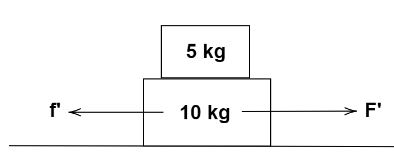
The following information is given that the force required to just move the first block is,
\[F = 19.6\,N\]
This means that the frictional force will be the same value, \[F = 19.6N\].
The total force acting can be found out using,
\[f = F - \mu \left( {mg} \right)\]
The equation above gives us the value of coefficient of static friction as,
\[\mu = \dfrac{{19.6}}{{10}}\]
Now that we have the value of coefficient of static friction, we find the value of the force needed to just move the blocks by using the formula,
\[F' = f' = \mu \left( {10 + 5} \right)\]
We add the values of mass so as to get the combined mass of the blocks and treat it like one object.After substituting the value in the equation given above, we get
\[F' = f' \\
\Rightarrow F' = \mu \left( {10 + 5} \right) \\
\therefore F' = 29.4\,N\]
Therefore, the correct answer is option B.
Complete step by step answer:
Note: The frictional force depends on the mass of the object and the coefficient of sliding friction between the object and the surface in contact. Frictional force always opposes the tendency of motion. So, we will apply the frictional force in the opposite direction of the moving object. Then, we have to subtract the frictional force from the external applied force to find the magnitude and direction of net force on the object. Then, we divide it by mass to find the acceleration of the object.
Formulas used:
The formula to find the total force is given by,
\[f = F - \mu \left( {mg} \right)\]
where the second part of the equation is the static frictional force and the first is, the frictional force due to the first block.
The following information is given that the force required to just move the first block is,
\[F = 19.6\,N\]
This means that the frictional force will be the same value, \[F = 19.6N\].
The total force acting can be found out using,
\[f = F - \mu \left( {mg} \right)\]
The equation above gives us the value of coefficient of static friction as,
\[\mu = \dfrac{{19.6}}{{10}}\]
Now that we have the value of coefficient of static friction, we find the value of the force needed to just move the blocks by using the formula,
\[F' = f' = \mu \left( {10 + 5} \right)\]
We add the values of mass so as to get the combined mass of the blocks and treat it like one object.After substituting the value in the equation given above, we get
\[F' = f' \\
\Rightarrow F' = \mu \left( {10 + 5} \right) \\
\therefore F' = 29.4\,N\]
Therefore, the correct answer is option B.
Complete step by step answer:
Note: The frictional force depends on the mass of the object and the coefficient of sliding friction between the object and the surface in contact. Frictional force always opposes the tendency of motion. So, we will apply the frictional force in the opposite direction of the moving object. Then, we have to subtract the frictional force from the external applied force to find the magnitude and direction of net force on the object. Then, we divide it by mass to find the acceleration of the object.
Recently Updated Pages
Master Class 11 Computer Science: Engaging Questions & Answers for Success

Master Class 11 Business Studies: Engaging Questions & Answers for Success
Master Class 11 Economics: Engaging Questions & Answers for Success
Master Class 11 English: Engaging Questions & Answers for Success
Master Class 11 Maths: Engaging Questions & Answers for Success
Master Class 11 Biology: Engaging Questions & Answers for Success
Trending doubts
One Metric ton is equal to kg A 10000 B 1000 C 100 class 11 physics CBSE
There are 720 permutations of the digits 1 2 3 4 5 class 11 maths CBSE
Discuss the various forms of bacteria class 11 biology CBSE
Draw a diagram of a plant cell and label at least eight class 11 biology CBSE
State the laws of reflection of light
Explain zero factorial class 11 maths CBSE