




A force $F=k{{x}^{2}}$ acts on a particle at an angle of ${{60}^{\circ }}$ with the X-axis the work done in displacing the particle from ${{X}_{1}}$ to ${{X}_{2}}$will be-
Answer
 Verified
610.2k+ views
Hint: given force is given by $F=k{{x}^{2}}$ so we can see that force is variable in terms of displacement of a particle so we need to integrate F over a small section of displacement dx from ${{X}_{1}}$ to ${{X}_{2}}$ to calculate total work done.
Formula used:
$W=\int_{{{x}_{1}}}^{{{x}_{2}}}{F.ds}$
Complete Step by step solution:
In the question the force is acting on the particle with an angle of ${{60}^{\circ }}$ so we have to its horizontal component by which particle is moving towards X-axis and it is given by,
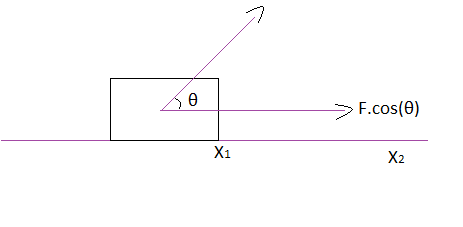
Given,$F=k{{x}^{2}}^{{}}$
Now total horizontal component of force is given by,
${{F}_{H}}=F\cdot \cos (\theta )=k{{x}^{2}}\cdot \cos ({{60}^{\circ }})=\dfrac{1}{2}k{{x}^{2}}$
$\cos ({{60}^{\circ }})=\dfrac{1}{2}$|
Now, work done = $\int\limits_{{{X}_{1}}}^{{{X}_{2}}}{{{F}_{H}}\cdot dx}=\dfrac{1}{2}\int\limits_{{{X}_{1}}}^{{{X}_{2}}}{k{{x}^{2}}\cdot dx}$, from the above comment $\cos ({{60}^{\circ }})=\dfrac{1}{2}$,
since integration of ${{x}^{2}}$ is given by$\int{{{x}^{2}}.dx=\dfrac{{{x}^{3}}}{3}}$|
Now by putting limit form ${{X}_{1}}$to${{X}_{2}}$
$\dfrac{1}{2}\left[ \dfrac{k{{x}^{3}}}{3} \right]\begin{matrix}
{{X}_{2}} \\
{{X}_{1}} \\
\end{matrix}=\dfrac{k}{6}\left[ {{X}_{2}}^{3}-{{X}_{1}}^{3} \right]$
So, $W=\dfrac{k}{6}\left[ {{X}_{2}}^{3}-{{X}_{1}}^{3} \right]$
So to displace an object from ${{X}_{1}}$to${{X}_{2}}$ work done will be equal to,
$W=\dfrac{k}{6}\left[ {{X}_{2}}^{3}-{{X}_{1}}^{3} \right]$.M
Additional information:
we solved this question by assuming our surface is smooth and there are no external resistance or frictional forces are there to oppose the motion of an object.
Work done is a scalar quantity, which means that it has no direction associated with it and only magnitude. Hence Work done is a quantity achieved by the dot product.
Note:
Work done is defined as a product of component of force in the direction of displacement and total displacement of a body, and dimension is same as the energy and is given by $\left[ M{{L}^{2}}{{T}^{-2}} \right]$ and the SI unit of work is joule which is defined as a work done by a force of 1 newton to displace an object by 1 metre in the direction of force.
Formula used:
$W=\int_{{{x}_{1}}}^{{{x}_{2}}}{F.ds}$
Complete Step by step solution:
In the question the force is acting on the particle with an angle of ${{60}^{\circ }}$ so we have to its horizontal component by which particle is moving towards X-axis and it is given by,
Given,$F=k{{x}^{2}}^{{}}$
Now total horizontal component of force is given by,
${{F}_{H}}=F\cdot \cos (\theta )=k{{x}^{2}}\cdot \cos ({{60}^{\circ }})=\dfrac{1}{2}k{{x}^{2}}$
$\cos ({{60}^{\circ }})=\dfrac{1}{2}$|
Now, work done = $\int\limits_{{{X}_{1}}}^{{{X}_{2}}}{{{F}_{H}}\cdot dx}=\dfrac{1}{2}\int\limits_{{{X}_{1}}}^{{{X}_{2}}}{k{{x}^{2}}\cdot dx}$, from the above comment $\cos ({{60}^{\circ }})=\dfrac{1}{2}$,
since integration of ${{x}^{2}}$ is given by$\int{{{x}^{2}}.dx=\dfrac{{{x}^{3}}}{3}}$|
Now by putting limit form ${{X}_{1}}$to${{X}_{2}}$
$\dfrac{1}{2}\left[ \dfrac{k{{x}^{3}}}{3} \right]\begin{matrix}
{{X}_{2}} \\
{{X}_{1}} \\
\end{matrix}=\dfrac{k}{6}\left[ {{X}_{2}}^{3}-{{X}_{1}}^{3} \right]$
So, $W=\dfrac{k}{6}\left[ {{X}_{2}}^{3}-{{X}_{1}}^{3} \right]$
So to displace an object from ${{X}_{1}}$to${{X}_{2}}$ work done will be equal to,
$W=\dfrac{k}{6}\left[ {{X}_{2}}^{3}-{{X}_{1}}^{3} \right]$.M
Additional information:
we solved this question by assuming our surface is smooth and there are no external resistance or frictional forces are there to oppose the motion of an object.
Work done is a scalar quantity, which means that it has no direction associated with it and only magnitude. Hence Work done is a quantity achieved by the dot product.
Note:
Work done is defined as a product of component of force in the direction of displacement and total displacement of a body, and dimension is same as the energy and is given by $\left[ M{{L}^{2}}{{T}^{-2}} \right]$ and the SI unit of work is joule which is defined as a work done by a force of 1 newton to displace an object by 1 metre in the direction of force.
Recently Updated Pages
Basicity of sulphurous acid and sulphuric acid are

Master Class 12 Economics: Engaging Questions & Answers for Success
Master Class 12 Biology: Engaging Questions & Answers for Success
Master Class 11 English: Engaging Questions & Answers for Success
Master Class 11 Physics: Engaging Questions & Answers for Success
Master Class 11 Computer Science: Engaging Questions & Answers for Success
Trending doubts
Draw a labelled sketch of the human eye class 12 physics CBSE
The chemical formula of tear gas is A CO Cl 2 B C 10 class 12 chemistry CBSE
Draw ray diagrams each showing i myopic eye and ii class 12 physics CBSE
Which are the Top 10 Largest Countries of the World?
Differentiate between homogeneous and heterogeneous class 12 chemistry CBSE
Which is the correct genotypic ratio of mendel dihybrid class 12 biology CBSE