




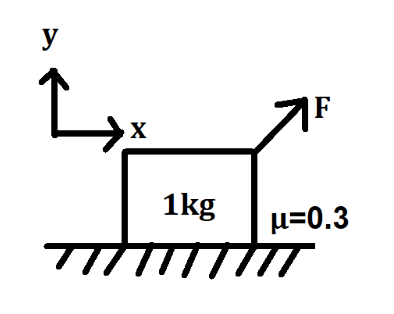
A force $ {\text{F}} = {\text{i}} + 4{\text{j}} $ acts on the block shown. The force of friction acting on the block is:
(A) $ - i $
(B) $ - 18i $
(C) $ - 2.4i $
(D) $ - 3i $
Answer
 Verified
577.8k+ views
Hint: A vector of force is a representation of a force which has both magnitude and direction. This is opposed to simply giving the force magnitude, which is referred to as a scalar quantity. A vector is typically represented in the direction of the force by an arrow and with a length proportional to the magnitude of the force.
Formula used:
We will use the following formula to solve this question:
$ {f_s} = \mu N $
Where
$ {f_s} $ is the maximum frictional force that can happen of a force $ F $ is applied
$ \mu $ is the coefficient of friction
$ N $ is the normal force
Complete step by step answer:
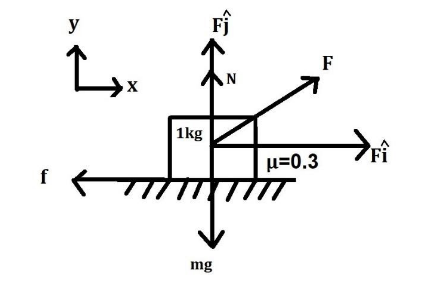
According to the question, the mass of the body is $ 1kg $
Let us suppose $ g = 10m/{s^2} $
Then the weight of the system will be $ mg = 1 \times 10 = 10N $
We can breakdown all the forces acting on the body as per the figure above
Force in the X-axis is $ F\hat i = 1N\hat i $
Force in the Y-axis is $ F\hat j = 4N\hat j $
We can see that along Y-axis, the system is in equilibrium
Now we will balance all the forces action along the Y-axis
So, we get
$ F\hat j + N = mg $
$ \Rightarrow N = mg - F\hat j $
Now we will put the values in the equation above to get,
$ \therefore N = 10 - 4 = 6N $
Then the maximum frictional force that can be applied if a force $ F $ is applied,
$ {f_s} = \mu \times N $
$ \Rightarrow {f_s} = 0.3 \times 6 $
So, we get
$ \therefore {f_s} = 1.8N $
Also, force in X-axis is $ 1N $
And the maximum frictional force that can be applied is $ 1.8N $
Therefore, the force is not enough to overcome the frictional force
So, the frictional force will be equal but opposite to the applied force
Hence, $ {f_s} = - i $ Correct option is (A.)
Note:
A major feature of force vectors is that, according to the application of the force, they can be broken into components. Vector components are generally perpendicular to each other, although a parallelogram configuration can also be used.
Formula used:
We will use the following formula to solve this question:
$ {f_s} = \mu N $
Where
$ {f_s} $ is the maximum frictional force that can happen of a force $ F $ is applied
$ \mu $ is the coefficient of friction
$ N $ is the normal force
Complete step by step answer:
According to the question, the mass of the body is $ 1kg $
Let us suppose $ g = 10m/{s^2} $
Then the weight of the system will be $ mg = 1 \times 10 = 10N $
We can breakdown all the forces acting on the body as per the figure above
Force in the X-axis is $ F\hat i = 1N\hat i $
Force in the Y-axis is $ F\hat j = 4N\hat j $
We can see that along Y-axis, the system is in equilibrium
Now we will balance all the forces action along the Y-axis
So, we get
$ F\hat j + N = mg $
$ \Rightarrow N = mg - F\hat j $
Now we will put the values in the equation above to get,
$ \therefore N = 10 - 4 = 6N $
Then the maximum frictional force that can be applied if a force $ F $ is applied,
$ {f_s} = \mu \times N $
$ \Rightarrow {f_s} = 0.3 \times 6 $
So, we get
$ \therefore {f_s} = 1.8N $
Also, force in X-axis is $ 1N $
And the maximum frictional force that can be applied is $ 1.8N $
Therefore, the force is not enough to overcome the frictional force
So, the frictional force will be equal but opposite to the applied force
Hence, $ {f_s} = - i $ Correct option is (A.)
Note:
A major feature of force vectors is that, according to the application of the force, they can be broken into components. Vector components are generally perpendicular to each other, although a parallelogram configuration can also be used.
Recently Updated Pages
Master Class 11 Social Science: Engaging Questions & Answers for Success

Master Class 11 Physics: Engaging Questions & Answers for Success
Master Class 11 Maths: Engaging Questions & Answers for Success
Master Class 11 Economics: Engaging Questions & Answers for Success
Master Class 11 Computer Science: Engaging Questions & Answers for Success
Master Class 11 Chemistry: Engaging Questions & Answers for Success
Trending doubts
One Metric ton is equal to kg A 10000 B 1000 C 100 class 11 physics CBSE
There are 720 permutations of the digits 1 2 3 4 5 class 11 maths CBSE
1 Quintal is equal to a 110 kg b 10 kg c 100kg d 1000 class 11 physics CBSE
State and prove Bernoullis theorem class 11 physics CBSE
Difference Between Prokaryotic Cells and Eukaryotic Cells
Which among the following are examples of coming together class 11 social science CBSE