




A force \[2\hat i + \hat j - \hat k\] newton acts on a body which is initially at rest. If the velocity of the body at the end of 20 seconds is \[4\hat i + 2\hat j + 2\hat k\]m/s, the mass of the body
A) 20 kg
B) 15 kg
C) 10 kg
D) 5 kg
Answer
 Verified
652.8k+ views
Hint: Any physical quantity having magnitude as well as direction is known as vector quantity. For example, Force, velocity etc. It is denoted by \[\vec v\]the arrow sign on the head defines it as vector quantity.
Any physical quantity having only magnitude is known as scalar quantity. For example, mass, speed etc.
Force is defined as any push or pull experienced by a body. It is also defined as the change in momentum per unit time. Its S.I unit is Newton (N).
\[\vec F = \dfrac{{md\vec v}}{{dt}} = m\vec a\]
Where Acceleration (a) = \[ = \dfrac{{d\vec v}}{{dt}}\]
\[\hat i,\hat j\;and\;\hat k\]are the unit vectors in x, y and z coordinates respectively.
Magnitude of any vector quantity \[\vec V = a\hat i + b\hat j + c\hat k\] is given by,
\[|\vec V| = \sqrt {({a^2} + {b^2} + {c^2})} \]
Complete step by step solution:
Given, initially body is at rest that is \[{V_1} = 0m/s\] (at time \[{t_1}\]= 0 )
Aso Force applied, \[\vec F = 2\hat i + \hat j - \hat k\]
As we know that magnitude is given by the formula \[|\vec V| = \sqrt {({a^2} + {b^2} + {c^2})} \]
Thus, magnitude of the Force applied will be
\[|\vec F| = \sqrt {{2^2} + {1^2} + {{( - 1)}^2}} = \sqrt 6 \]
Now the change in velocity after 20 seconds ( \[{t_2}\]) = \[4\hat i + 2\hat j + 2\hat k\]
That is \[{\vec V_2} = 4\hat i + 2\hat j + 2\hat k\],
Thus magnitude of the velocity will be,
\[|{\vec V_2}| = \sqrt {{4^2} + {2^2} + {2^2}} = \sqrt {24} = 2\sqrt 6 \]
As we know that \[\vec F = \dfrac{{md\vec v}}{{dt}}\]
\[ \Rightarrow \vec Fdt = md\vec v\]
Integrating both sides we get,
\[\begin{gathered}
\int\limits_{{t_1}}^{{t_2}} {\vec Fdt = \int\limits_{{V_1}}^{{V_2}} {md\vec v} } \\
\Rightarrow \vec F[t]_{{t_1}}^{{t_2}} = m[\vec V]_{{V_1}}^{{V_2}} \\
\Rightarrow \vec F({t_2} - {t_1}) = m({{\vec V}_2} - {{\vec V}_1}) \\
\end{gathered} \]
Putting all the values and taking mod in both sides we get,
\[\begin{gathered}
|\vec F|(20 - 0) = m|({{\vec V}_2} - 0)| \\
i.e.\sqrt 6 \times 20 = m \times 2\sqrt 6 \\
\end{gathered} \]
Hence, \[m = 10kg\]
Clearly option ( C ) is the correct answer i.e mass of the body is10 kg .
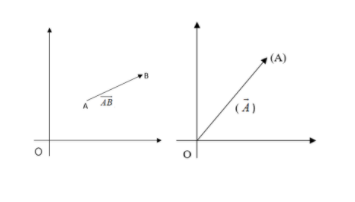
Note: If any vector is denoted by \[\overrightarrow {AB} \] then its direction is from point A to point B.
And if it is denoted by \[\overrightarrow A \]then it is pointed to point A from the origin O when represented in the Cartesian coordinate system.
Any physical quantity having only magnitude is known as scalar quantity. For example, mass, speed etc.
Force is defined as any push or pull experienced by a body. It is also defined as the change in momentum per unit time. Its S.I unit is Newton (N).
\[\vec F = \dfrac{{md\vec v}}{{dt}} = m\vec a\]
Where Acceleration (a) = \[ = \dfrac{{d\vec v}}{{dt}}\]
\[\hat i,\hat j\;and\;\hat k\]are the unit vectors in x, y and z coordinates respectively.
Magnitude of any vector quantity \[\vec V = a\hat i + b\hat j + c\hat k\] is given by,
\[|\vec V| = \sqrt {({a^2} + {b^2} + {c^2})} \]
Complete step by step solution:
Given, initially body is at rest that is \[{V_1} = 0m/s\] (at time \[{t_1}\]= 0 )
Aso Force applied, \[\vec F = 2\hat i + \hat j - \hat k\]
As we know that magnitude is given by the formula \[|\vec V| = \sqrt {({a^2} + {b^2} + {c^2})} \]
Thus, magnitude of the Force applied will be
\[|\vec F| = \sqrt {{2^2} + {1^2} + {{( - 1)}^2}} = \sqrt 6 \]
Now the change in velocity after 20 seconds ( \[{t_2}\]) = \[4\hat i + 2\hat j + 2\hat k\]
That is \[{\vec V_2} = 4\hat i + 2\hat j + 2\hat k\],
Thus magnitude of the velocity will be,
\[|{\vec V_2}| = \sqrt {{4^2} + {2^2} + {2^2}} = \sqrt {24} = 2\sqrt 6 \]
As we know that \[\vec F = \dfrac{{md\vec v}}{{dt}}\]
\[ \Rightarrow \vec Fdt = md\vec v\]
Integrating both sides we get,
\[\begin{gathered}
\int\limits_{{t_1}}^{{t_2}} {\vec Fdt = \int\limits_{{V_1}}^{{V_2}} {md\vec v} } \\
\Rightarrow \vec F[t]_{{t_1}}^{{t_2}} = m[\vec V]_{{V_1}}^{{V_2}} \\
\Rightarrow \vec F({t_2} - {t_1}) = m({{\vec V}_2} - {{\vec V}_1}) \\
\end{gathered} \]
Putting all the values and taking mod in both sides we get,
\[\begin{gathered}
|\vec F|(20 - 0) = m|({{\vec V}_2} - 0)| \\
i.e.\sqrt 6 \times 20 = m \times 2\sqrt 6 \\
\end{gathered} \]
Hence, \[m = 10kg\]
Clearly option ( C ) is the correct answer i.e mass of the body is10 kg .
Note: If any vector is denoted by \[\overrightarrow {AB} \] then its direction is from point A to point B.
And if it is denoted by \[\overrightarrow A \]then it is pointed to point A from the origin O when represented in the Cartesian coordinate system.
Recently Updated Pages
Master Class 11 Social Science: Engaging Questions & Answers for Success

Master Class 11 English: Engaging Questions & Answers for Success
Master Class 11 Accountancy: Engaging Questions & Answers for Success
Master Class 11 Physics: Engaging Questions & Answers for Success
Master Class 11 Computer Science: Engaging Questions & Answers for Success
Master Class 11 Business Studies: Engaging Questions & Answers for Success
Trending doubts
Find the value of the expression given below sin 30circ class 11 maths CBSE
One Metric ton is equal to kg A 10000 B 1000 C 100 class 11 physics CBSE
Draw a diagram of nephron and explain its structur class 11 biology CBSE
10 examples of friction in our daily life
Proton was discovered by A Thomson B Rutherford C Chadwick class 11 chemistry CBSE
The teeth used for biting and cutting food are called class 11 biology CBSE