



A football is kicked into the air vertically upwards. What is the acceleration and velocity of football at the highest point?
Answer
 Verified
525.5k+ views
Hint: We are given a football which is kicked into the air vertically upwards. This is a case when a body is moving against gravity. Hence we all know that after a particular point the ball will lose its velocity and move along the gravity.
Complete answer:
In the question we are told that a football is kicked in vertically upwards in the air.
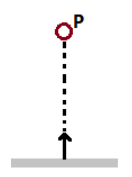
Consider the figure above. The figure shows the given situation.
Let ‘P’ be the highest point of the ball in the air.
We know that when we throw anybody into the air or when a body is falling free in the air the acceleration of that body will always be acceleration due to gravity.
In this case the ball is moving upwards and therefore the acceleration of the body, the acceleration due to gravity is acting vertically downwards.
Thus we have acceleration, a = g.
Now we know that when a body is kicked into air, the body will have some initial velocity. But as the body moves upward the velocity will decrease. Thus at the highest point of the body the velocity will become zero and the body starts to fall down.
Therefore we have velocity of the football at the highest point as zero, i.e. v = 0.
Hence the acceleration of the football at highest point is acceleration due to gravity (g) and velocity of the football at highest point is zero.
Note:
When a body falls from a height to the earth’s surface, there will be an increase in the velocity of that body with respect to time. This change of velocity of the body causes acceleration in the body. This acceleration is known as acceleration due to gravity of earth.
The value of acceleration due to gravity on the surface of earth is given as, $g=9.8m/{{s}^{2}}$.
Complete answer:
In the question we are told that a football is kicked in vertically upwards in the air.
Consider the figure above. The figure shows the given situation.
Let ‘P’ be the highest point of the ball in the air.
We know that when we throw anybody into the air or when a body is falling free in the air the acceleration of that body will always be acceleration due to gravity.
In this case the ball is moving upwards and therefore the acceleration of the body, the acceleration due to gravity is acting vertically downwards.
Thus we have acceleration, a = g.
Now we know that when a body is kicked into air, the body will have some initial velocity. But as the body moves upward the velocity will decrease. Thus at the highest point of the body the velocity will become zero and the body starts to fall down.
Therefore we have velocity of the football at the highest point as zero, i.e. v = 0.
Hence the acceleration of the football at highest point is acceleration due to gravity (g) and velocity of the football at highest point is zero.
Note:
When a body falls from a height to the earth’s surface, there will be an increase in the velocity of that body with respect to time. This change of velocity of the body causes acceleration in the body. This acceleration is known as acceleration due to gravity of earth.
The value of acceleration due to gravity on the surface of earth is given as, $g=9.8m/{{s}^{2}}$.
Recently Updated Pages
Master Class 11 Computer Science: Engaging Questions & Answers for Success

Master Class 11 Business Studies: Engaging Questions & Answers for Success
Master Class 11 Economics: Engaging Questions & Answers for Success
Master Class 11 English: Engaging Questions & Answers for Success
Master Class 11 Maths: Engaging Questions & Answers for Success
Master Class 11 Biology: Engaging Questions & Answers for Success
Trending doubts
One Metric ton is equal to kg A 10000 B 1000 C 100 class 11 physics CBSE
There are 720 permutations of the digits 1 2 3 4 5 class 11 maths CBSE
Discuss the various forms of bacteria class 11 biology CBSE
Draw a diagram of a plant cell and label at least eight class 11 biology CBSE
State the laws of reflection of light
10 examples of friction in our daily life