




A food chain starts with
a. Nitrogen fixation organisms
b. Photosynthesising organisms
c. Respiration
d. Decomposers
Answer
 Verified
639.6k+ views
Hint: Food chain includes all organisms such as plants and animals which depend on one another for their food, among all producers are plants.
Complete answer:
Food chain forms a linear network, where the source of the food is produced by plants by photosynthesis, this food transfers energy from one organism to another.
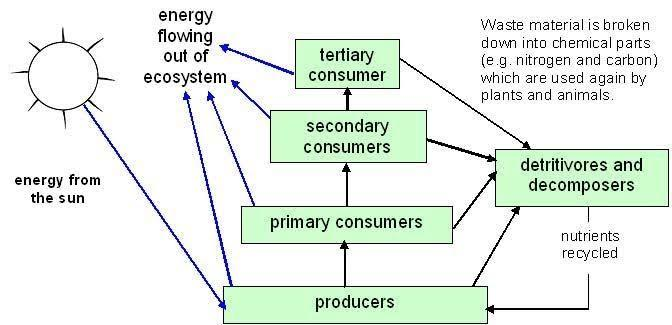
- For plants the energy is obtained from the sun, this energy will be utilized by plants for production of food by the process called photosynthesis. Hence plants are called producers. They prepare food by themselves and they won’t depend on other organisms for food. So they are placed in the first trophic level of the food chain.
- The animals which depend on plants are said to be primary consumers and they are also called herbivores, this comes under the second trophic level. Some of the examples of herbivores are cows, goats etc.
- The animals which consume herbivores as their food are said to be secondary consumers and they are also called carnivores, this comes under third trophic level.
- The animals which consume plants, herbivores, and carnivores are said to be tertiary consumers, they come under fourth trophic level. The apex of the food chain is occupied by decomposers, they prey on all organisms but there are no predators for decomposers. During this process the energy is transferred from one level to another and some energy is lost and it will never be reused by plants.
Correct option: B. Photosynthesising organisms
Note: Always remember the food chain starts with producers or plants. These are the sources of energy for all organisms.
Complete answer:
Food chain forms a linear network, where the source of the food is produced by plants by photosynthesis, this food transfers energy from one organism to another.
- For plants the energy is obtained from the sun, this energy will be utilized by plants for production of food by the process called photosynthesis. Hence plants are called producers. They prepare food by themselves and they won’t depend on other organisms for food. So they are placed in the first trophic level of the food chain.
- The animals which depend on plants are said to be primary consumers and they are also called herbivores, this comes under the second trophic level. Some of the examples of herbivores are cows, goats etc.
- The animals which consume herbivores as their food are said to be secondary consumers and they are also called carnivores, this comes under third trophic level.
- The animals which consume plants, herbivores, and carnivores are said to be tertiary consumers, they come under fourth trophic level. The apex of the food chain is occupied by decomposers, they prey on all organisms but there are no predators for decomposers. During this process the energy is transferred from one level to another and some energy is lost and it will never be reused by plants.
Correct option: B. Photosynthesising organisms
Note: Always remember the food chain starts with producers or plants. These are the sources of energy for all organisms.
Recently Updated Pages
Master Class 11 English: Engaging Questions & Answers for Success

Master Class 11 Social Science: Engaging Questions & Answers for Success
Master Class 11 Maths: Engaging Questions & Answers for Success
Master Class 11 Biology: Engaging Questions & Answers for Success
Master Class 11 Physics: Engaging Questions & Answers for Success
Master Class 11 Chemistry: Engaging Questions & Answers for Success
Trending doubts
Explain the Treaty of Vienna of 1815 class 10 social science CBSE
What is the Total Duration of Football Match?
First Cotton Mill of India
In which year voting age was reduced from 21 to 18?
10 examples of evaporation in daily life with explanations
What planets have no moons Which one has only one moon class 10 physics CBSE