




A food chain can have trophic levels
(a) Three or four
(b) Three
(c) Two
(d) One
Answer
 Verified
630.3k+ views
Hint: In an ecosystem, a series of organisms each organism dependent on the feeding of the next as a source of food is known as a food chain. It shows how the organisms are related to each other and each level of a food chain signifies a divergent trophic level.
Complete answer:
One of the ways for an ecosystem to work at its fullest is that there has to be a flow of energy. The energy is achieved in the form of food in the ecosystem. The topmost source of this energy is the sun and producers like green plants trap solar energy to convert it into the chemical energy for getting their food. A part of this energy is passed on to producers now. The primary producer is then eaten by the primary consumer; this is again eaten by a secondary consumer. This secondary consumer may be eaten by a tertiary consumer, and so on. The energy gets carried from one consumer to the next higher level of consumer. The food chain is made up of this link from producers and ending at apex predator species or decomposer species. In an ecosystem, food is passed from one trophic level to the next higher trophic level. This transfer results in the passage of energy through these trophic levels and some energy is always lost as heat in each step to the atmosphere and never goes back to the sun. For example, let’s take the food chain in a grassland ecosystem which starts with grass being the primary producer by trapping energy from sunlight. Insects like grasshoppers are primary consumers because they directly depend on the green plant for their food. The frog is the secondary consumer because it eats insects. The snake is a tertiary consumer and feeds on frogs for its food.
So, the correct answer is 'Three or four'.
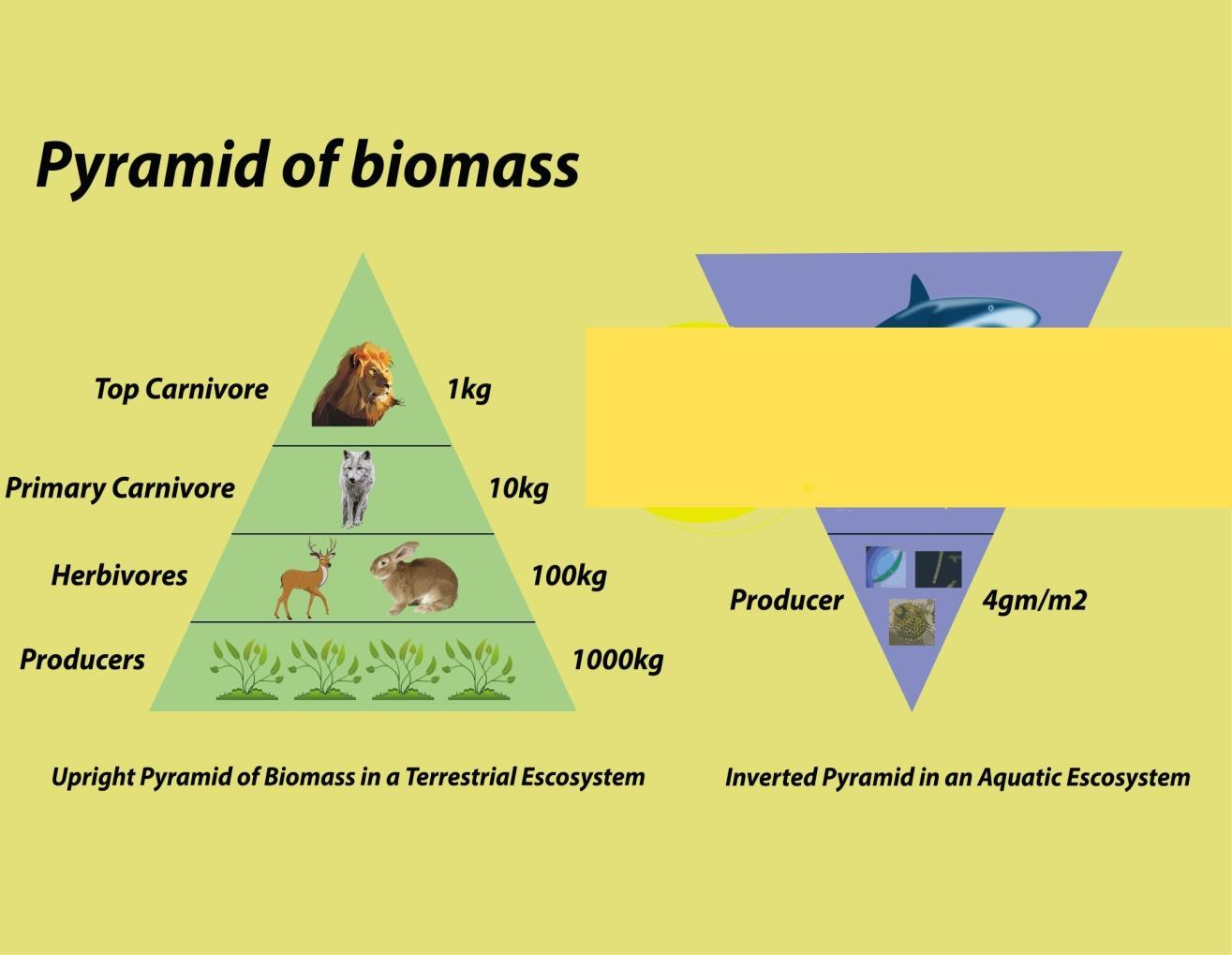
Note: An ecological pyramid is used as a graphical figure to show the relation of different organisms in an ecosystem with each of the bars of the pyramid representing a different trophic level. Ecological pyramids are generally of three types: the pyramid of the number, pyramid of biomass, and pyramid of energy (showing the rate of energy flow).
Complete answer:
One of the ways for an ecosystem to work at its fullest is that there has to be a flow of energy. The energy is achieved in the form of food in the ecosystem. The topmost source of this energy is the sun and producers like green plants trap solar energy to convert it into the chemical energy for getting their food. A part of this energy is passed on to producers now. The primary producer is then eaten by the primary consumer; this is again eaten by a secondary consumer. This secondary consumer may be eaten by a tertiary consumer, and so on. The energy gets carried from one consumer to the next higher level of consumer. The food chain is made up of this link from producers and ending at apex predator species or decomposer species. In an ecosystem, food is passed from one trophic level to the next higher trophic level. This transfer results in the passage of energy through these trophic levels and some energy is always lost as heat in each step to the atmosphere and never goes back to the sun. For example, let’s take the food chain in a grassland ecosystem which starts with grass being the primary producer by trapping energy from sunlight. Insects like grasshoppers are primary consumers because they directly depend on the green plant for their food. The frog is the secondary consumer because it eats insects. The snake is a tertiary consumer and feeds on frogs for its food.
So, the correct answer is 'Three or four'.
Note: An ecological pyramid is used as a graphical figure to show the relation of different organisms in an ecosystem with each of the bars of the pyramid representing a different trophic level. Ecological pyramids are generally of three types: the pyramid of the number, pyramid of biomass, and pyramid of energy (showing the rate of energy flow).
Recently Updated Pages
Master Class 12 Business Studies: Engaging Questions & Answers for Success

Master Class 12 Chemistry: Engaging Questions & Answers for Success
Master Class 12 Biology: Engaging Questions & Answers for Success
Class 12 Question and Answer - Your Ultimate Solutions Guide
Master Class 11 English: Engaging Questions & Answers for Success
Master Class 11 Social Science: Engaging Questions & Answers for Success
Trending doubts
Which are the Top 10 Largest Countries of the World?
Draw a labelled sketch of the human eye class 12 physics CBSE
Differentiate between homogeneous and heterogeneous class 12 chemistry CBSE
Differentiate between Pyramid of energy and pyramid class 12 biology CBSE
Why is the cell called the structural and functional class 12 biology CBSE
Draw the diagram of the pyramid of energy Explain In class 12 biology CBSE