




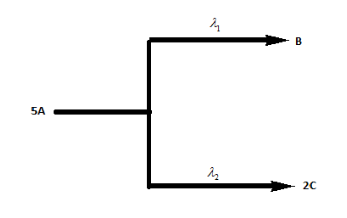
A follows parallel path first order reactions giving B and C as, if the initial concentration of A is $0.25{\text{ M}}$ , the concentration of C after 5 hours of reaction is:
$\left[ {{\lambda _1} = 1.5 \times {{10}^{ - 5}}{{\text{s}}^{ - 1}},{\lambda _2} = 5 \times
{{10}^{ - 6}}{{\text{s}}^{ - 1}}} \right]$
A.$7.56 \times {10^{ - 3}}{\text{ M}}$
B.$6.62 \times {10^{ - 3}}{\text{ M}}$
C.$9.36 \times {10^{ - 3}}{\text{ M}}$
D.None of these
Answer
 Verified
585k+ views
Hint: In this question, we shall first calculate the amount of A left in the mixture after 5 hours. The rate constant of decomposition of A will be the sum of both the rate constants. Then, we shall calculate the amount of A decomposed during the given time. At the end, we shall calculate the concentration of C formed using stoichiometric ratios of the reaction.
Formula used: Integrated rate of reaction of first order:
$2.303\log \dfrac{{{{\left[ {\text{A}} \right]}_0}}}{{{{\left[ {\text{A}} \right]}_{\text{t}}}}} = \lambda \times {\text{t}}$ where ${\left[ {\text{A}} \right]_0}$ is the initial concentration, ${\left[ {\text{A}} \right]_{\text{t}}}$ is the concentration at time t, $\lambda $ is the rate constant and t is the time completed.
Complete step by step answer:
As we know that, the reaction is occurring in two parallel paths with different rate constants of formation of both the compounds. But, with respect to A, the rate constant will be the sum of the both the rate constants.
${\lambda _{\text{T}}} = {\lambda _1} + {\lambda _2}$
${\lambda _{\text{T}}} = 15 \times {10^{ - 6}} + 5 \times {10^{ - 6}} = 20 \times {10^{ - 6}}$
Substituting the appropriate values in their correct units in the integrated rate equation we get:
$2.303\log \dfrac{{0.25}}{{{{\left[ {\text{A}} \right]}_{\text{t}}}}} = 20 \times {10^{ - 6}} \times 5 \times 60 \times 60$
Solving this for ${\left[ {\text{A}} \right]_{\text{t}}}$ , we get:
$\log \dfrac{{0.25}}{{{{\left[ {\text{A}} \right]}_{\text{t}}}}} = \dfrac{{0.36}}{{2.303}}$
\[ \Rightarrow \log {\left[ {\text{A}} \right]_{\text{t}}} = \log 0.25 - 0.156\]
Solving this, we get:
\[{\left[ {\text{A}} \right]_{\text{t}}} = 0.1744{\text{ M}}\]
So, from here, we shall calculate the amount of A which was decomposed during the reaction:
${\left[ {\text{A}} \right]_{{\text{decomp}}}} = {\left[ {\text{A}} \right]_0} - {\left[ {\text{A}} \right]_{\text{t}}}$
${\left[ {\text{A}} \right]_{{\text{decomp}}}} = 0.25 - 0.1744 = 0.0756{\text{ M}}$
The rate equation of A to C will be:
$5\left[ {\text{A}} \right]\xrightarrow{{{\lambda _1}}}2\left[ {\text{C}} \right]$
Now, according to the reaction, 5 moles of A will decompose to form 2 moles of C at a rate constant of ${\lambda _2}$ . So, the amount of C formed shall be:
$\left[ {\text{C}} \right] = \left[ {\dfrac{{{\lambda _2}}}{{{\lambda _1} + {\lambda _2}}}} \right] \times {\left[ {\text{A}} \right]_{{\text{decomp}}}} \times \dfrac{2}{5}$ (Eq. 1)
$ \Rightarrow \left[ {\text{C}} \right] = \left[ {\dfrac{{5 \times {{10}^{ - 6}}}}{{20 \times {{10}^{ - 6}}}}} \right] \times 0.0756 \times \dfrac{2}{5}$
Solving this, we shall get:
$\left[ {\text{C}} \right] = 7.56 \times {10^{ - 3}}{\text{ M}}$
$\therefore $ The correct option is option A, i.e. $7.56 \times {10^{ - 3}}{\text{ M}}$
Note:
In this question, in Eq. 1 as 5 moles of A forms 2 moles of C, this means that 1 mole of A will form $\dfrac{2}{5}$ moles of C. As the total rate of decomposition of A is ${\lambda _{\text{T}}}$ , so for the formation of only C, the rate constant ${\lambda _2}$ is divided by ${\lambda _{\text{T}}}$ .
Formula used: Integrated rate of reaction of first order:
$2.303\log \dfrac{{{{\left[ {\text{A}} \right]}_0}}}{{{{\left[ {\text{A}} \right]}_{\text{t}}}}} = \lambda \times {\text{t}}$ where ${\left[ {\text{A}} \right]_0}$ is the initial concentration, ${\left[ {\text{A}} \right]_{\text{t}}}$ is the concentration at time t, $\lambda $ is the rate constant and t is the time completed.
Complete step by step answer:
As we know that, the reaction is occurring in two parallel paths with different rate constants of formation of both the compounds. But, with respect to A, the rate constant will be the sum of the both the rate constants.
${\lambda _{\text{T}}} = {\lambda _1} + {\lambda _2}$
${\lambda _{\text{T}}} = 15 \times {10^{ - 6}} + 5 \times {10^{ - 6}} = 20 \times {10^{ - 6}}$
Substituting the appropriate values in their correct units in the integrated rate equation we get:
$2.303\log \dfrac{{0.25}}{{{{\left[ {\text{A}} \right]}_{\text{t}}}}} = 20 \times {10^{ - 6}} \times 5 \times 60 \times 60$
Solving this for ${\left[ {\text{A}} \right]_{\text{t}}}$ , we get:
$\log \dfrac{{0.25}}{{{{\left[ {\text{A}} \right]}_{\text{t}}}}} = \dfrac{{0.36}}{{2.303}}$
\[ \Rightarrow \log {\left[ {\text{A}} \right]_{\text{t}}} = \log 0.25 - 0.156\]
Solving this, we get:
\[{\left[ {\text{A}} \right]_{\text{t}}} = 0.1744{\text{ M}}\]
So, from here, we shall calculate the amount of A which was decomposed during the reaction:
${\left[ {\text{A}} \right]_{{\text{decomp}}}} = {\left[ {\text{A}} \right]_0} - {\left[ {\text{A}} \right]_{\text{t}}}$
${\left[ {\text{A}} \right]_{{\text{decomp}}}} = 0.25 - 0.1744 = 0.0756{\text{ M}}$
The rate equation of A to C will be:
$5\left[ {\text{A}} \right]\xrightarrow{{{\lambda _1}}}2\left[ {\text{C}} \right]$
Now, according to the reaction, 5 moles of A will decompose to form 2 moles of C at a rate constant of ${\lambda _2}$ . So, the amount of C formed shall be:
$\left[ {\text{C}} \right] = \left[ {\dfrac{{{\lambda _2}}}{{{\lambda _1} + {\lambda _2}}}} \right] \times {\left[ {\text{A}} \right]_{{\text{decomp}}}} \times \dfrac{2}{5}$ (Eq. 1)
$ \Rightarrow \left[ {\text{C}} \right] = \left[ {\dfrac{{5 \times {{10}^{ - 6}}}}{{20 \times {{10}^{ - 6}}}}} \right] \times 0.0756 \times \dfrac{2}{5}$
Solving this, we shall get:
$\left[ {\text{C}} \right] = 7.56 \times {10^{ - 3}}{\text{ M}}$
$\therefore $ The correct option is option A, i.e. $7.56 \times {10^{ - 3}}{\text{ M}}$
Note:
In this question, in Eq. 1 as 5 moles of A forms 2 moles of C, this means that 1 mole of A will form $\dfrac{2}{5}$ moles of C. As the total rate of decomposition of A is ${\lambda _{\text{T}}}$ , so for the formation of only C, the rate constant ${\lambda _2}$ is divided by ${\lambda _{\text{T}}}$ .
Recently Updated Pages
Master Class 11 English: Engaging Questions & Answers for Success

Master Class 11 Maths: Engaging Questions & Answers for Success
Master Class 11 Biology: Engaging Questions & Answers for Success
Master Class 11 Social Science: Engaging Questions & Answers for Success
Master Class 11 Physics: Engaging Questions & Answers for Success
Master Class 11 Accountancy: Engaging Questions & Answers for Success
Trending doubts
One Metric ton is equal to kg A 10000 B 1000 C 100 class 11 physics CBSE
There are 720 permutations of the digits 1 2 3 4 5 class 11 maths CBSE
Discuss the various forms of bacteria class 11 biology CBSE
Draw a diagram of a plant cell and label at least eight class 11 biology CBSE
State the laws of reflection of light
Explain zero factorial class 11 maths CBSE