




What is a floral diagram? Give a brief account of the floral diagram and mention its importance.
Answer
 Verified
411.3k+ views
Hint: Hint: Observe the word Floral and diagram carefully. Here, floral refers to flowers, and diagram as we know refers to a detailed structure represented graphically. It represents the arrangement of floral structures i.e. stamen, anther, sepals, and petals with respect to their counts.
Complete step-by-step answer:
The floral diagram is a graphic representation that describes a flower’s detailed structure. It usually represents the schematic cross-section of a flower. It shows the number of floral organs present in the flower, their size, shape, types of arrangement, and fusion. Different parts of the flower are assigned specific symbols to identify them and these parts are represented by their respective symbols. Floral diagrams are useful for flower identification and provide a great deal of understanding of the angiosperm evolution.
Floral diagrams are generally accompanied by a floral formula which represents the information provided in the diagram in a written manner.
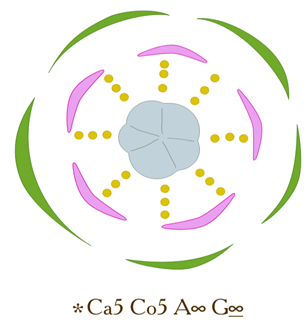
Image: Rosa Floral diagram
The characteristics of the Rosa flower, as observed in the floral diagram are:
Calyx- 5 sepals, episepalous condition
Corolla- 5 petals, epipetalous condition
Androecium- many stamens, probably more than 12
Gynoecium- many carpels, more than 12
Additional information:
Floral diagrams were first introduced methodologically in the late 19th century. The creation of floral diagrams is often attributed to A. W. Eichler.
In the floral formula, K stands for calyx, C stands for corolla, P stands for perianth, A for androecium, and G for Gynoecium.
The number of parts of a whorl is represented by the symbol for a whorl, which stands for a large and indefinite number of whorls. If the members are present in more than one and different whorls, each different whorl is written separately with a + sign in between them.
Superior or inferior Androecium or Gynoecium is represented symbolically by a small dash above or below their symbol.
Note: It is important to note that floral diagrams and floral formulas are often used with each other. A study of a floral diagram provides enough information to make a floral formula and vice-versa.
Complete step-by-step answer:
The floral diagram is a graphic representation that describes a flower’s detailed structure. It usually represents the schematic cross-section of a flower. It shows the number of floral organs present in the flower, their size, shape, types of arrangement, and fusion. Different parts of the flower are assigned specific symbols to identify them and these parts are represented by their respective symbols. Floral diagrams are useful for flower identification and provide a great deal of understanding of the angiosperm evolution.
Floral diagrams are generally accompanied by a floral formula which represents the information provided in the diagram in a written manner.
Image: Rosa Floral diagram
The characteristics of the Rosa flower, as observed in the floral diagram are:
Calyx- 5 sepals, episepalous condition
Corolla- 5 petals, epipetalous condition
Androecium- many stamens, probably more than 12
Gynoecium- many carpels, more than 12
Additional information:
Floral diagrams were first introduced methodologically in the late 19th century. The creation of floral diagrams is often attributed to A. W. Eichler.
In the floral formula, K stands for calyx, C stands for corolla, P stands for perianth, A for androecium, and G for Gynoecium.
The number of parts of a whorl is represented by the symbol for a whorl, which stands for a large and indefinite number of whorls. If the members are present in more than one and different whorls, each different whorl is written separately with a + sign in between them.
Superior or inferior Androecium or Gynoecium is represented symbolically by a small dash above or below their symbol.
Note: It is important to note that floral diagrams and floral formulas are often used with each other. A study of a floral diagram provides enough information to make a floral formula and vice-versa.
Recently Updated Pages
Three beakers labelled as A B and C each containing 25 mL of water were taken A small amount of NaOH anhydrous CuSO4 and NaCl were added to the beakers A B and C respectively It was observed that there was an increase in the temperature of the solutions contained in beakers A and B whereas in case of beaker C the temperature of the solution falls Which one of the following statements isarecorrect i In beakers A and B exothermic process has occurred ii In beakers A and B endothermic process has occurred iii In beaker C exothermic process has occurred iv In beaker C endothermic process has occurred

Master Class 9 Social Science: Engaging Questions & Answers for Success
Master Class 9 Science: Engaging Questions & Answers for Success
Master Class 9 Maths: Engaging Questions & Answers for Success
Master Class 9 General Knowledge: Engaging Questions & Answers for Success
Class 9 Question and Answer - Your Ultimate Solutions Guide
Three beakers labelled as A B and C each containing 25 mL of water were taken A small amount of NaOH anhydrous CuSO4 and NaCl were added to the beakers A B and C respectively It was observed that there was an increase in the temperature of the solutions contained in beakers A and B whereas in case of beaker C the temperature of the solution falls Which one of the following statements isarecorrect i In beakers A and B exothermic process has occurred ii In beakers A and B endothermic process has occurred iii In beaker C exothermic process has occurred iv In beaker C endothermic process has occurred
Master Class 9 Social Science: Engaging Questions & Answers for Success
Master Class 9 Science: Engaging Questions & Answers for Success
Trending doubts
Cornea transplant in humans is almost never rejected class 11 biology NEET_UG
The common characteristics between tomato and potato class 11 biology NEET_UG
Which are the Top 10 Largest Countries of the World?
One Metric ton is equal to kg A 10000 B 1000 C 100 class 11 physics CBSE
Explain the Treaty of Vienna of 1815 class 10 social science CBSE
Draw a labelled sketch of the human eye class 12 physics CBSE