




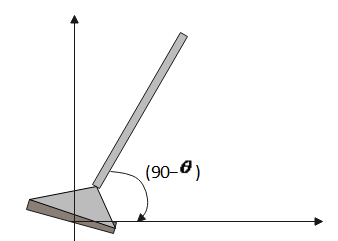
A floor wiper makes an angle (90−$\theta $) with horizontal floor ${\mu _n}$and ${\mu _k}$are coefficients of static and kinetic frictions between the wiper and the floor. The wiper cannot be used to wipe the floor for $\theta $>${\theta _0}$ even if a large force directed along the handle aiming towards the center is applied. Angle ${\theta _0}$ is given by:-
Answer
 Verified
602.7k+ views
Hint: In this question, we will use the relation between forces applied. Further, by solving this equation, for the given angle, we will get the required result. Further, we will study the basics of friction force and its types, for our better understanding.
Formula used:
$mg + F\cos \theta = R$
$F\sin \theta - \mu R \geqslant 0$
Complete step-by-step solution
As we know, there are different forces acting on an object, as shown in the free body diagram below:
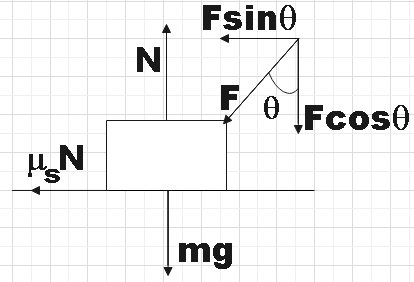
We could now balance the forces acting in the vertical directions considering the fact that there is no vertical displacement.
\[mg+F\cos \theta =N\]………………………………………… (1)
Here, m is the mass of the given wiper, F is the applied force on the wiper towards the centre and N is the normal reaction of ground upward.
The condition for the motion to occur could be given by,
\[F\sin \theta -{{\mu }_{s}}N\ge 0\]
Now, substituting the value of N from (1), we get:
\[F\sin \theta -{{\mu }_{s}}(mg+F\cos \theta )\ge 0\]
\[\Rightarrow \sin \theta -{{\mu }_{s}}\cos \theta \ge \dfrac{{{\mu }_{s}}mg}{F}\]
We see that all the quantities on the right hand side of the inequality sign are positive, so, we could rewrite the equation as,
\[\Rightarrow \sin \theta -{{\mu }_{s}}\cos \theta \ge 0\]
\[\Rightarrow -{{\mu }_{s}}\cos \theta \ge -\sin \theta \]
\[\Rightarrow \tan \theta \ge {{\mu }_{s}}\]
For the limiting case we have:
\[\tan {{\theta }_{0}}\ge {{\mu }_{0}}\]
\[\therefore {{\theta }_{0}}\ge {{\tan }^{-1}}{{\mu }_{0}}\]
Therefore, we got the required angle.
Additional information:
As we know, the frictional force can be defined as the force exerted by a surface when an object moves across it or even when the object makes an effort to move across the surface. Also, there are generally three types of frictional force, namely- static friction, sliding friction, and rolling friction. So, we can say that the friction force often opposes the motion of an object.
Now, sliding friction is the friction that comes into action when any object is sliding over another surface. Here, we know that the sliding friction is weaker than the static friction.
Note: We should remember that frictional force is a force that opposes the motion of any object or body. We should also remember one important point that there are various kinds of lubricants that are used to overcome the frictional force for example- grease, oil etc.
Formula used:
$mg + F\cos \theta = R$
$F\sin \theta - \mu R \geqslant 0$
Complete step-by-step solution
As we know, there are different forces acting on an object, as shown in the free body diagram below:
We could now balance the forces acting in the vertical directions considering the fact that there is no vertical displacement.
\[mg+F\cos \theta =N\]………………………………………… (1)
Here, m is the mass of the given wiper, F is the applied force on the wiper towards the centre and N is the normal reaction of ground upward.
The condition for the motion to occur could be given by,
\[F\sin \theta -{{\mu }_{s}}N\ge 0\]
Now, substituting the value of N from (1), we get:
\[F\sin \theta -{{\mu }_{s}}(mg+F\cos \theta )\ge 0\]
\[\Rightarrow \sin \theta -{{\mu }_{s}}\cos \theta \ge \dfrac{{{\mu }_{s}}mg}{F}\]
We see that all the quantities on the right hand side of the inequality sign are positive, so, we could rewrite the equation as,
\[\Rightarrow \sin \theta -{{\mu }_{s}}\cos \theta \ge 0\]
\[\Rightarrow -{{\mu }_{s}}\cos \theta \ge -\sin \theta \]
\[\Rightarrow \tan \theta \ge {{\mu }_{s}}\]
For the limiting case we have:
\[\tan {{\theta }_{0}}\ge {{\mu }_{0}}\]
\[\therefore {{\theta }_{0}}\ge {{\tan }^{-1}}{{\mu }_{0}}\]
Therefore, we got the required angle.
Additional information:
As we know, the frictional force can be defined as the force exerted by a surface when an object moves across it or even when the object makes an effort to move across the surface. Also, there are generally three types of frictional force, namely- static friction, sliding friction, and rolling friction. So, we can say that the friction force often opposes the motion of an object.
Now, sliding friction is the friction that comes into action when any object is sliding over another surface. Here, we know that the sliding friction is weaker than the static friction.
Note: We should remember that frictional force is a force that opposes the motion of any object or body. We should also remember one important point that there are various kinds of lubricants that are used to overcome the frictional force for example- grease, oil etc.
Recently Updated Pages
Basicity of sulphurous acid and sulphuric acid are

Master Class 11 English: Engaging Questions & Answers for Success
Master Class 11 Physics: Engaging Questions & Answers for Success
Master Class 11 Computer Science: Engaging Questions & Answers for Success
Master Class 11 Chemistry: Engaging Questions & Answers for Success
Master Class 11 Social Science: Engaging Questions & Answers for Success
Trending doubts
Difference Between Prokaryotic Cells and Eukaryotic Cells
Two of the body parts which do not appear in MRI are class 11 biology CBSE
One Metric ton is equal to kg A 10000 B 1000 C 100 class 11 physics CBSE
10 examples of friction in our daily life
Draw a diagram of nephron and explain its structur class 11 biology CBSE
What will happen if the mucus is not secreted by the class 11 biology CBSE