




A fixed volume of iron is drawn into a wire of length l. The extension produced in this wire by a constant force F is proportional to then:
$A)\dfrac{1}{{{l^2}}} \\
B)\dfrac{1}{l} \\
C){{\text{l}}^2} \\
D)l \\ $
Answer
 Verified
611.4k+ views
Hint- Here we will proceed by applying the concept of Young’s modulus related to elasticity where tensile stress will be the ratio of force to area and tensile strain will be the ratio of change in dimension to original dimension. Then we will substitute the values of area, force and dimension to get the required answer.
Complete step-by-step solution -
Formula used-
1. $E = \dfrac{{tensile{\text{ stress}}}}{{tensile{\text{ strain}}}}$
2. $Tensile\;stress = \dfrac{F}{A}$
3. $Tensile{\text{ strain = }}\dfrac{{\Delta l}}{l}$
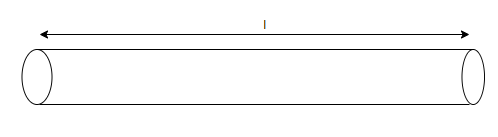
Let us assume the area of the cross section of iron wire be A and volume of iron be V And we are given that length of wire as l and constant force as F. Here we will apply the concept of Young’s modulus related to elasticity as the question is about extension produced in the wire,
The formula of young’s modulus is $E = \dfrac{{tensile{\text{ stress}}}}{{tensile{\text{ strain}}}}$
Where tensile stress will be ratio of force (F) to area (A)
And tensile strain will be ratio of change in dimension (l) to original dimension (l)
Now using this formula of young’s modulus,
We get-
$E = \dfrac{{\dfrac{F}{A}}}{{\dfrac{{\Delta l}}{l}}}$
$ \Rightarrow \Delta l = \dfrac{{Fl}}{{AE}}$
Multiplying numerator and denominator by l,
We get-
$ = \dfrac{{F{l^2}}}{{\left( {Al} \right)E}}$
But we know that area multiplied by length is volume,
So we get-
$\Delta l = \dfrac{{F{l^2}}}{{VE}}$
And if volume is fixed (given)
then,
$\Delta l\alpha {l^2}$
Which means the extension produced in this wire by a constant force F is proportional to ${l^2}$.
Hence, option C is right.
Note- While solving this question, we must know that the E used for young’s modulus formula can be replaced with abbreviation Y. Also we know that area multiplied by length is volume. Hence we will get our desired result.
Complete step-by-step solution -
Formula used-
1. $E = \dfrac{{tensile{\text{ stress}}}}{{tensile{\text{ strain}}}}$
2. $Tensile\;stress = \dfrac{F}{A}$
3. $Tensile{\text{ strain = }}\dfrac{{\Delta l}}{l}$
Let us assume the area of the cross section of iron wire be A and volume of iron be V And we are given that length of wire as l and constant force as F. Here we will apply the concept of Young’s modulus related to elasticity as the question is about extension produced in the wire,
The formula of young’s modulus is $E = \dfrac{{tensile{\text{ stress}}}}{{tensile{\text{ strain}}}}$
Where tensile stress will be ratio of force (F) to area (A)
And tensile strain will be ratio of change in dimension (l) to original dimension (l)
Now using this formula of young’s modulus,
We get-
$E = \dfrac{{\dfrac{F}{A}}}{{\dfrac{{\Delta l}}{l}}}$
$ \Rightarrow \Delta l = \dfrac{{Fl}}{{AE}}$
Multiplying numerator and denominator by l,
We get-
$ = \dfrac{{F{l^2}}}{{\left( {Al} \right)E}}$
But we know that area multiplied by length is volume,
So we get-
$\Delta l = \dfrac{{F{l^2}}}{{VE}}$
And if volume is fixed (given)
then,
$\Delta l\alpha {l^2}$
Which means the extension produced in this wire by a constant force F is proportional to ${l^2}$.
Hence, option C is right.
Note- While solving this question, we must know that the E used for young’s modulus formula can be replaced with abbreviation Y. Also we know that area multiplied by length is volume. Hence we will get our desired result.
Recently Updated Pages
Master Class 11 Computer Science: Engaging Questions & Answers for Success

Master Class 11 Business Studies: Engaging Questions & Answers for Success
Master Class 11 Economics: Engaging Questions & Answers for Success
Master Class 11 English: Engaging Questions & Answers for Success
Master Class 11 Maths: Engaging Questions & Answers for Success
Master Class 11 Biology: Engaging Questions & Answers for Success
Trending doubts
One Metric ton is equal to kg A 10000 B 1000 C 100 class 11 physics CBSE
There are 720 permutations of the digits 1 2 3 4 5 class 11 maths CBSE
Discuss the various forms of bacteria class 11 biology CBSE
Draw a diagram of a plant cell and label at least eight class 11 biology CBSE
State the laws of reflection of light
Explain zero factorial class 11 maths CBSE