




A field in the form of a parallelogram has sides 60m and 40m and one of the diagonal is 80m long. Find the area of the parallelogram.
Answer
 Verified
575.4k+ views
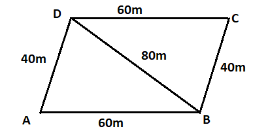
Hint: According to the question we have to determine the area of the parallelogram when a field in the form of a parallelogram has sides 60m and 40m and one of the diagonal is 80m long. So, first of all we have to consider the figure of the parallelogram as given below:
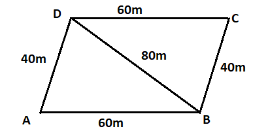
As, we know that in parallelogram ABCD,
AB = CD = 60m and AD = BC = 40m
Now, to find the area of the parallelogram first we have to find the area of triangle ABD with the help of the heron’s formula as mentioned below:
$ \Rightarrow s = \dfrac{{a + b + c}}{2}..................(A)$
Where, s is the semi-perimeter of triangle ABD.
Area id triangle = $\sqrt {s(s - a)(s - b)(s - c)} ....................(B)$
Hence with the help of the formula above we can determine the value of area of triangle ABD and to obtain area of parallelogram we have to multiply the obtained area of triangle ABD with 2.
Complete step-by-step answer:
Given,
A field in the form of a parallelogram has sides 60m and 40m,
Diagonal = 80m
Step 1: First of all we have to determine the semi-perimeter of triangle ABD with the help of the formula (A) as mentioned in the solution hint.
$
\Rightarrow s = \dfrac{{40 + 60 + 80}}{2} \\
\Rightarrow s = \dfrac{{180}}{2} \\
\Rightarrow s = 90m
$
Step 2: Now, to find the area of triangle ABD we have to use the formula (B) as mentioned in the solution hint.
$
= \sqrt {90(90 - 40)(90 - 60)(90 - 80)} \\
= \sqrt {90(50)(30)(10)} \\
= \sqrt {90000 \times 15} \\
= 300\sqrt {15} {m^2}
$
Step 3: Now, to find the area of parallelogram ABCD we have to multiply the area of triangle ABD with 2. Hence,
$
= 2 \times 300\sqrt {15} {m^2} \\
= 600\sqrt {15} {m^2}
$
Hence, with the help of formula (A) and formula (B) we have obtained the area of parallelogram ABCD $ = 600\sqrt {15} {m^2}$
Note: We can obtain the area of the given parallelogram ABCD by obtaining the sum of the area of triangle ABD and triangle BCD but as we know that for the parallelogram area of the triangle ABD is equal to the area of triangle BCD hence it is not necessary to find the area for both of the triangles.
A parallelogram is a quadrilateral with two pairs of parallel sides and the opposite sides of the parallelograms are equal in length and parallel.
As, we know that in parallelogram ABCD,
AB = CD = 60m and AD = BC = 40m
Now, to find the area of the parallelogram first we have to find the area of triangle ABD with the help of the heron’s formula as mentioned below:
$ \Rightarrow s = \dfrac{{a + b + c}}{2}..................(A)$
Where, s is the semi-perimeter of triangle ABD.
Area id triangle = $\sqrt {s(s - a)(s - b)(s - c)} ....................(B)$
Hence with the help of the formula above we can determine the value of area of triangle ABD and to obtain area of parallelogram we have to multiply the obtained area of triangle ABD with 2.
Complete step-by-step answer:
Given,
A field in the form of a parallelogram has sides 60m and 40m,
Diagonal = 80m
Step 1: First of all we have to determine the semi-perimeter of triangle ABD with the help of the formula (A) as mentioned in the solution hint.
$
\Rightarrow s = \dfrac{{40 + 60 + 80}}{2} \\
\Rightarrow s = \dfrac{{180}}{2} \\
\Rightarrow s = 90m
$
Step 2: Now, to find the area of triangle ABD we have to use the formula (B) as mentioned in the solution hint.
$
= \sqrt {90(90 - 40)(90 - 60)(90 - 80)} \\
= \sqrt {90(50)(30)(10)} \\
= \sqrt {90000 \times 15} \\
= 300\sqrt {15} {m^2}
$
Step 3: Now, to find the area of parallelogram ABCD we have to multiply the area of triangle ABD with 2. Hence,
$
= 2 \times 300\sqrt {15} {m^2} \\
= 600\sqrt {15} {m^2}
$
Hence, with the help of formula (A) and formula (B) we have obtained the area of parallelogram ABCD $ = 600\sqrt {15} {m^2}$
Note: We can obtain the area of the given parallelogram ABCD by obtaining the sum of the area of triangle ABD and triangle BCD but as we know that for the parallelogram area of the triangle ABD is equal to the area of triangle BCD hence it is not necessary to find the area for both of the triangles.
A parallelogram is a quadrilateral with two pairs of parallel sides and the opposite sides of the parallelograms are equal in length and parallel.
Recently Updated Pages
Master Class 9 General Knowledge: Engaging Questions & Answers for Success

Master Class 9 Social Science: Engaging Questions & Answers for Success
Master Class 9 English: Engaging Questions & Answers for Success
Master Class 9 Maths: Engaging Questions & Answers for Success
Master Class 9 Science: Engaging Questions & Answers for Success
Class 9 Question and Answer - Your Ultimate Solutions Guide
Trending doubts
Difference Between Plant Cell and Animal Cell
Fill the blanks with the suitable prepositions 1 The class 9 english CBSE
Who is eligible for RTE class 9 social science CBSE
Which places in India experience sunrise first and class 9 social science CBSE
What is pollution? How many types of pollution? Define it
Name 10 Living and Non living things class 9 biology CBSE