




A farmer connects a pipe of internal diameter 20 cm from a canal into a cylindrical tank in her field, which is 10 m in diameter and 2 m deep. If water flows through the pipe at the rate of 3km/hr, in how much time will the tank be filled?
Answer
 Verified
607.8k+ views
Hint: Use the property that the radius if half of the diameter and compute the radius of the cylinder and internal radius of the pipe. We know that \[1km=100m\] and \[1hr=3600\sec \] . Use this and convert the rate of flow of water through the pipe into meters per second. Use this rate as the height and compute the volume of the water flowing through the pipe per second by using the formula, \[\pi \times {{\left( radius \right)}^{2}}\times \left( height \right)\] . Using this formula, compute the volume of the cylindrical tank. Assume that the time taken by the pipe to fill the tank is \[x\] seconds. Now, compute the volume of the water flowed through the pipe in \[x\] seconds and make it equal to the volume of the cylindrical tank. At last, calculate the value of \[x\] and convert it into hours.
Complete step by step answer:
According to the question, we are given that a farmer has connected a pipe into a cylindrical tank. Water is flowing through the pipe and we are asked to find the time taken to fill the tank.
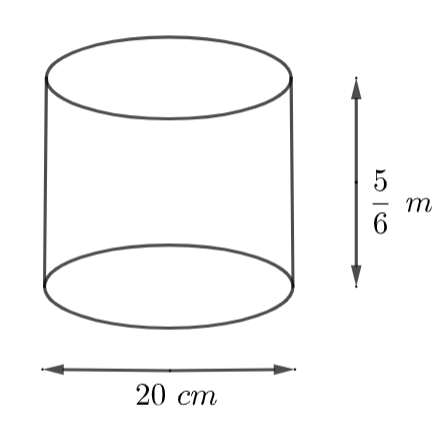
The internal diameter of the pipe = 20 cm ……………………………………(1)
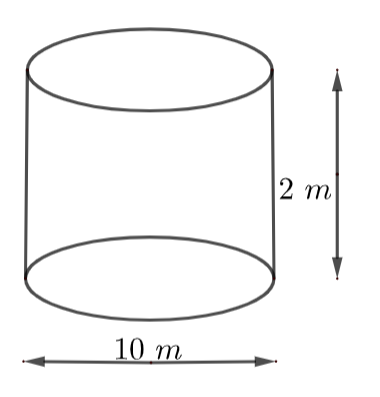
The diameter of the cylindrical tank = 10 m …………………………………………(2)
The depth of the cylindrical tank = 2 m …………………………………………….(3)
The rate at which the water is flowing through the pipe = 3 km/hr …………………………………(4)
We know the property that the radius is half of the diameter …………………………….(5)
Now, from equation (1) and equation (5), we get
The internal radius of the cylindrical pipe = \[\dfrac{20}{2}\] cm = 10 cm = \[\dfrac{10}{100}\] m …………………………………………(6)
Similarly, from equation (2) and equation (5), we get
The radius of the cylindrical tank = \[\dfrac{10}{2}\] m = 5 m …………………………………………(7)
We know that \[1km=100m\] and \[1hr=3600\sec \] ………………………………………(8)
Now, from equation (4) and equation (8), we get
The rate at which the water is flowing through the pipe = \[\dfrac{3\times 1000}{3600}\] m/sec = \[\dfrac{5}{6}\] m/sec ……………………………………….(9)
The length of the pipe occupied by the flowing water is \[\dfrac{5}{6}\] m per second and the shape of the pipe is same of the cylinder. Also, the length of the cylinder is same as of the height of the cylinder. So, we can take the length of the pipe occupied by the flowing water per second as the height of the cylinder …………………………………………(10)
We know the formula for the volume of the cylinder = \[\pi \times {{\left( radius \right)}^{2}}\times \left( height \right)\] ………………………………………….(11)
Now, from equation (6), equation (10), and equation (11), we get
The volume of water flowing through the pipe per second = \[\pi \times {{\left( \dfrac{10}{100} \right)}^{2}}\times \left( \dfrac{5}{6} \right)\] \[{{m}^{3}}\] ………………………………………(12)
Let us assume that the time taken by the pipe to fill the tank is \[x\] seconds ………………………………..(13)
Now, from equation (12) and equation (13), we get
The volume of water flowed through the pipe in \[x\] seconds = \[\pi \times {{\left( \dfrac{10}{100} \right)}^{2}}\times \left( \dfrac{5}{6} \right)x\,\,{{m}^{3}}\] ……………………………………(14)
Now, from equation (3), equation (7), and equation (11), we get
The volume of cylindrical tank = \[\pi \times {{\left( 5 \right)}^{2}}\times 2\,{{m}^{3}}\] ………………………………………(15)
When the tank will get filled, then the volume of cylindrical tank must be equal to the volume of water flowed through the pipe in \[x\] seconds ………………………………………..(16)
Now, from equation (14), equation (15), and equation (16), we get
\[\begin{align}
& \Rightarrow \pi \times {{\left( \dfrac{10}{100} \right)}^{2}}\times \left( \dfrac{5}{6} \right)x=\pi \times {{\left( 5 \right)}^{2}}\times 2\, \\
& \Rightarrow \dfrac{5}{600}x=25\times 2\, \\
& \Rightarrow x=\dfrac{25\times 2\times 600}{5} \\
\end{align}\]
\[\Rightarrow x=6000\] seconds ……………………………………(17)
Now, from equation (8) and equation (17), we get
\[x=\dfrac{6000}{3600}hr=\dfrac{10}{6}hr=\dfrac{5}{3}hr=1.67hr\]
Therefore, the time taken by the pipe to fill the tank is 1.67 hr.
Note:
For this question, we have to consider one point. The length of the pipe occupied by the flowing water per second and the shape of the pipe is the same as the cylinder. Also, the length of the cylinder is the same as of the height of the cylinder. So, we can take the length of the pipe occupied by the flowing water per second as the height of the cylinder.
Complete step by step answer:
According to the question, we are given that a farmer has connected a pipe into a cylindrical tank. Water is flowing through the pipe and we are asked to find the time taken to fill the tank.
The internal diameter of the pipe = 20 cm ……………………………………(1)
The diameter of the cylindrical tank = 10 m …………………………………………(2)
The depth of the cylindrical tank = 2 m …………………………………………….(3)
The rate at which the water is flowing through the pipe = 3 km/hr …………………………………(4)
We know the property that the radius is half of the diameter …………………………….(5)
Now, from equation (1) and equation (5), we get
The internal radius of the cylindrical pipe = \[\dfrac{20}{2}\] cm = 10 cm = \[\dfrac{10}{100}\] m …………………………………………(6)
Similarly, from equation (2) and equation (5), we get
The radius of the cylindrical tank = \[\dfrac{10}{2}\] m = 5 m …………………………………………(7)
We know that \[1km=100m\] and \[1hr=3600\sec \] ………………………………………(8)
Now, from equation (4) and equation (8), we get
The rate at which the water is flowing through the pipe = \[\dfrac{3\times 1000}{3600}\] m/sec = \[\dfrac{5}{6}\] m/sec ……………………………………….(9)
The length of the pipe occupied by the flowing water is \[\dfrac{5}{6}\] m per second and the shape of the pipe is same of the cylinder. Also, the length of the cylinder is same as of the height of the cylinder. So, we can take the length of the pipe occupied by the flowing water per second as the height of the cylinder …………………………………………(10)
We know the formula for the volume of the cylinder = \[\pi \times {{\left( radius \right)}^{2}}\times \left( height \right)\] ………………………………………….(11)
Now, from equation (6), equation (10), and equation (11), we get
The volume of water flowing through the pipe per second = \[\pi \times {{\left( \dfrac{10}{100} \right)}^{2}}\times \left( \dfrac{5}{6} \right)\] \[{{m}^{3}}\] ………………………………………(12)
Let us assume that the time taken by the pipe to fill the tank is \[x\] seconds ………………………………..(13)
Now, from equation (12) and equation (13), we get
The volume of water flowed through the pipe in \[x\] seconds = \[\pi \times {{\left( \dfrac{10}{100} \right)}^{2}}\times \left( \dfrac{5}{6} \right)x\,\,{{m}^{3}}\] ……………………………………(14)
Now, from equation (3), equation (7), and equation (11), we get
The volume of cylindrical tank = \[\pi \times {{\left( 5 \right)}^{2}}\times 2\,{{m}^{3}}\] ………………………………………(15)
When the tank will get filled, then the volume of cylindrical tank must be equal to the volume of water flowed through the pipe in \[x\] seconds ………………………………………..(16)
Now, from equation (14), equation (15), and equation (16), we get
\[\begin{align}
& \Rightarrow \pi \times {{\left( \dfrac{10}{100} \right)}^{2}}\times \left( \dfrac{5}{6} \right)x=\pi \times {{\left( 5 \right)}^{2}}\times 2\, \\
& \Rightarrow \dfrac{5}{600}x=25\times 2\, \\
& \Rightarrow x=\dfrac{25\times 2\times 600}{5} \\
\end{align}\]
\[\Rightarrow x=6000\] seconds ……………………………………(17)
Now, from equation (8) and equation (17), we get
\[x=\dfrac{6000}{3600}hr=\dfrac{10}{6}hr=\dfrac{5}{3}hr=1.67hr\]
Therefore, the time taken by the pipe to fill the tank is 1.67 hr.
Note:
For this question, we have to consider one point. The length of the pipe occupied by the flowing water per second and the shape of the pipe is the same as the cylinder. Also, the length of the cylinder is the same as of the height of the cylinder. So, we can take the length of the pipe occupied by the flowing water per second as the height of the cylinder.
Recently Updated Pages
Master Class 11 English: Engaging Questions & Answers for Success

Master Class 11 Social Science: Engaging Questions & Answers for Success
Master Class 11 Maths: Engaging Questions & Answers for Success
Master Class 11 Biology: Engaging Questions & Answers for Success
Master Class 11 Physics: Engaging Questions & Answers for Success
Master Class 11 Chemistry: Engaging Questions & Answers for Success
Trending doubts
Explain the Treaty of Vienna of 1815 class 10 social science CBSE
What is the Total Duration of Football Match?
First Cotton Mill of India
In which year voting age was reduced from 21 to 18?
10 examples of evaporation in daily life with explanations
What planets have no moons Which one has only one moon class 10 physics CBSE