




A. Explain with the help of a diagram, why the concave lens is also called a diverging lens.
B. Define the principal focus of a concave lens.
Answer
 Verified
514.2k+ views
Hint: We can deduce that the term diverging refers to incident rays diverging away from a point. As a result, we'll start by looking at how incident rays behave when they strike a concave lens. We'll also evaluate if the concave lens is a converging or diverging lens based on the behaviour of the refracted rays.
Complete answer:
A. To understand let us first draw the ray diagram first of a biconcave thin lens and when the incident rays coming from infinity and focused at the point $F$ focus on the principal axis, we see that:
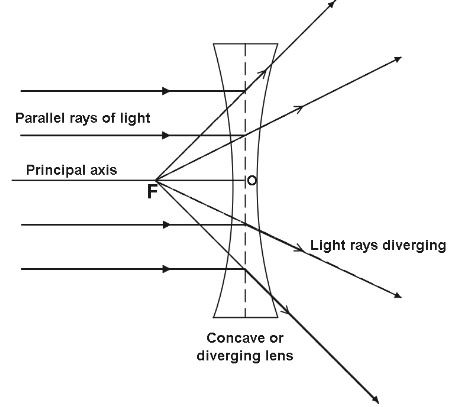
The incident rays diverge following refraction by the concave lens, as shown in the diagram above. These rays appear to originate from a point F, i.e., the concave lens's focus. Because of the geometry of the aforementioned lens, the rays diverge. We can deduce that the concave lens is a diverging lens since these rays diverge from a point on the primary axis, which is the focus of the concave lens.
B. A point on a concave lens's principal axis from which light rays that were previously parallel to the axis appear to deviate after passing through the lens is called the principal focus.
Note: Due to its feature, the concave lens has a wide range of applications. The image is created in front of the retina in those who suffer from myopia. As a result, the optician will advise the person to wear spectacles with a concave lens, which will diverge the rays from the image formation point to the retina of the eye. Because the focal length of a concave lens is negative, its power is always regarded as negative.
Complete answer:
A. To understand let us first draw the ray diagram first of a biconcave thin lens and when the incident rays coming from infinity and focused at the point $F$ focus on the principal axis, we see that:
The incident rays diverge following refraction by the concave lens, as shown in the diagram above. These rays appear to originate from a point F, i.e., the concave lens's focus. Because of the geometry of the aforementioned lens, the rays diverge. We can deduce that the concave lens is a diverging lens since these rays diverge from a point on the primary axis, which is the focus of the concave lens.
B. A point on a concave lens's principal axis from which light rays that were previously parallel to the axis appear to deviate after passing through the lens is called the principal focus.
Note: Due to its feature, the concave lens has a wide range of applications. The image is created in front of the retina in those who suffer from myopia. As a result, the optician will advise the person to wear spectacles with a concave lens, which will diverge the rays from the image formation point to the retina of the eye. Because the focal length of a concave lens is negative, its power is always regarded as negative.
Recently Updated Pages
Master Class 12 Business Studies: Engaging Questions & Answers for Success

Master Class 12 Chemistry: Engaging Questions & Answers for Success
Master Class 12 Biology: Engaging Questions & Answers for Success
Class 12 Question and Answer - Your Ultimate Solutions Guide
Master Class 11 English: Engaging Questions & Answers for Success
Master Class 11 Social Science: Engaging Questions & Answers for Success
Trending doubts
Explain the Treaty of Vienna of 1815 class 10 social science CBSE
What is the full form of CNG A Complete Natural Gas class 10 social science CBSE
In cricket, what is a "Yorker" designed to do?
What is the full form of POSCO class 10 social science CBSE
Define Potential, Developed, Stock and Reserved resources
What were the majoritarian measures taken in Sri Lanka class 10 social science CBSE