




A dynamometer $D$ is attached to two bodies of masses $M = 6kg$ and the force $f = 20N$ is applied to the masses. What will be the reading of the dynamometer?
Answer
 Verified
609.9k+ views
Hint:A dynamometer is a device that is used to measure force. In this question, we need to determine the reading of the dynamometer such that the force from both the ends of the masses attached with the dynamometer is applied. For this, we will use Newton's law of motion and free body diagram theory.
Complete step by step answer:
Let us consider a dynamometer, as shown in the figure below, connected to two masses each $M = 6kg$ and forces of $20N$ are applied to the masses.

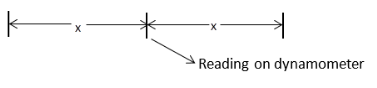
The averaged force is given as:
$
{F_{avg}} = \dfrac{{20 + 20}}{2} \\
= \dfrac{{40}}{2} \\
= 20N \\
$
Let the reading on dynamometers be ‘x’ Newton.
Now, as both the masses and forces are equal and act in the opposite direction, net reading on the dynamometer is due to both such that the two bodies produce equal and opposite acceleration due to the net force.
Now, following the Newton law: Force$ = $mass$ \times $acceleration
For the first block, net force$ = \left( {20 - x} \right)N$ in the right direction and mass$ = 6kg$
So, acceleration$ = \dfrac{{\left( {20 - x} \right)}}{6}$
Similarly, for the second body,
Acceleration$ = \dfrac{{\left( {20 - x} \right)}}{6}$
As both accelerations are equal, so the value of$x$will be half of the total forces as forces are also equal, so $x = F = 20N$
Therefore, the dynamometer reads $20N$ in the steady-state.
Note: The dynamometer reads the value between the given force and the lower force.Here, given force$ = 20N$ and the Lower force$ = 20N$.
So, it reads$20N$.
But in the case of different forces and masses, reading will be different.
Complete step by step answer:
Let us consider a dynamometer, as shown in the figure below, connected to two masses each $M = 6kg$ and forces of $20N$ are applied to the masses.
The averaged force is given as:
$
{F_{avg}} = \dfrac{{20 + 20}}{2} \\
= \dfrac{{40}}{2} \\
= 20N \\
$
Let the reading on dynamometers be ‘x’ Newton.
Now, as both the masses and forces are equal and act in the opposite direction, net reading on the dynamometer is due to both such that the two bodies produce equal and opposite acceleration due to the net force.
Now, following the Newton law: Force$ = $mass$ \times $acceleration
For the first block, net force$ = \left( {20 - x} \right)N$ in the right direction and mass$ = 6kg$
So, acceleration$ = \dfrac{{\left( {20 - x} \right)}}{6}$
Similarly, for the second body,
Acceleration$ = \dfrac{{\left( {20 - x} \right)}}{6}$
As both accelerations are equal, so the value of$x$will be half of the total forces as forces are also equal, so $x = F = 20N$
Therefore, the dynamometer reads $20N$ in the steady-state.
Note: The dynamometer reads the value between the given force and the lower force.Here, given force$ = 20N$ and the Lower force$ = 20N$.
So, it reads$20N$.
But in the case of different forces and masses, reading will be different.
Recently Updated Pages
Master Class 11 Social Science: Engaging Questions & Answers for Success

Master Class 11 English: Engaging Questions & Answers for Success
Master Class 11 Maths: Engaging Questions & Answers for Success
Master Class 11 Chemistry: Engaging Questions & Answers for Success
Master Class 11 Biology: Engaging Questions & Answers for Success
Master Class 11 Physics: Engaging Questions & Answers for Success
Trending doubts
One Metric ton is equal to kg A 10000 B 1000 C 100 class 11 physics CBSE
Difference Between Prokaryotic Cells and Eukaryotic Cells
How many of the following diseases can be studied with class 11 biology CBSE
Draw a diagram of a plant cell and label at least eight class 11 biology CBSE
Two of the body parts which do not appear in MRI are class 11 biology CBSE
Which gas is abundant in air class 11 chemistry CBSE