




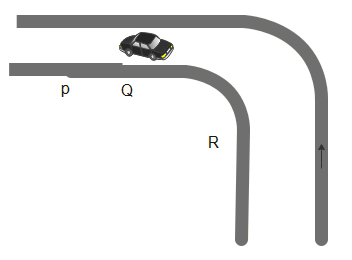
A Driver is driving his car along a road as shown in figure. The driver makes sure that the speedometer reads exactly 40 km/h. What happens to the speed of the car from P to Q?
A. Speed remains constant
B. Speed first increases then decreases
C. Speed first decreases then increases
D. Nothing can be decided.
Answer
 Verified
577.2k+ views
Hint: As we can see in figure, path from point P to point Q is straight and it is along the road. Speedometer reads the exact value of speed which is 40 km/h. We know that magnitude of velocity is a speed. Consider so even though direction of velocity is changing but magnitude of velocity will be the same, since the speedometer reads 40 km/h throughout point P to Q.
Complete step by step answer:
A driver is driving his car along the road. While driving, the driver makes sure that the speedometer reads exactly 40km/h. Now we need to find out the speed of the car from point P to point Q. We know that the velocity of a car is nothing but the rate of change of displacement with respect to time. In simple language, velocity shows that at what time, a car does displacement. Velocity has both magnitude and direction therefore velocity is a vector quantity. If we take magnitude of velocity, we get speed. That is, the magnitude of velocity is nothing but speed.
In this case a car is covering a 40 km distance within one hour time. The car driver also makes sure that the speedometer will not deflect i.e. will not change its reading other than 40 km/h. So no matter what is the direction of the car i.e. if velocity is changing its direction but between point P and point Q direction is always constant so speed as well as velocity both are constant.
So, the correct answer is “Option A”.
Additional Information: When a car is moving along A curved road, it is performing a circular motion, since the curved road seems like an arc of a circle. Centripetal force is necessary force for circular motion. In absence of centripetal force the car would move along a tangent and circular motion is not possible.
Note: In this path along the point P and point Q is straight but the path from P to point R is curved. So we need to use the concept of banking on the road. And velocity given in this case is given as $v=\sqrt{\mu rg}$. Consider If the velocity exceeds this then $v=\sqrt{\mu rg}$, the car will be thrown off. Therefore we can say this is a safety speed or velocity with which or will turn smoothly.
Complete step by step answer:
A driver is driving his car along the road. While driving, the driver makes sure that the speedometer reads exactly 40km/h. Now we need to find out the speed of the car from point P to point Q. We know that the velocity of a car is nothing but the rate of change of displacement with respect to time. In simple language, velocity shows that at what time, a car does displacement. Velocity has both magnitude and direction therefore velocity is a vector quantity. If we take magnitude of velocity, we get speed. That is, the magnitude of velocity is nothing but speed.
In this case a car is covering a 40 km distance within one hour time. The car driver also makes sure that the speedometer will not deflect i.e. will not change its reading other than 40 km/h. So no matter what is the direction of the car i.e. if velocity is changing its direction but between point P and point Q direction is always constant so speed as well as velocity both are constant.
So, the correct answer is “Option A”.
Additional Information: When a car is moving along A curved road, it is performing a circular motion, since the curved road seems like an arc of a circle. Centripetal force is necessary force for circular motion. In absence of centripetal force the car would move along a tangent and circular motion is not possible.
Note: In this path along the point P and point Q is straight but the path from P to point R is curved. So we need to use the concept of banking on the road. And velocity given in this case is given as $v=\sqrt{\mu rg}$. Consider If the velocity exceeds this then $v=\sqrt{\mu rg}$, the car will be thrown off. Therefore we can say this is a safety speed or velocity with which or will turn smoothly.
Recently Updated Pages
Master Class 11 Computer Science: Engaging Questions & Answers for Success

Master Class 11 Business Studies: Engaging Questions & Answers for Success
Master Class 11 Economics: Engaging Questions & Answers for Success
Master Class 11 English: Engaging Questions & Answers for Success
Master Class 11 Maths: Engaging Questions & Answers for Success
Master Class 11 Biology: Engaging Questions & Answers for Success
Trending doubts
There are 720 permutations of the digits 1 2 3 4 5 class 11 maths CBSE
Discuss the various forms of bacteria class 11 biology CBSE
Explain zero factorial class 11 maths CBSE
What organs are located on the left side of your body class 11 biology CBSE
Draw a diagram of nephron and explain its structur class 11 biology CBSE
How do I convert ms to kmh Give an example class 11 physics CBSE