




(a) Draw the structure of the following:
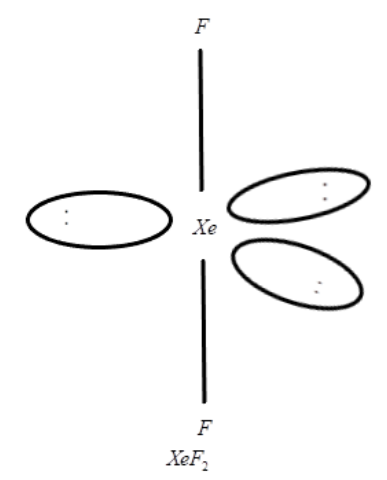
i. \[Xe{F_2}\]
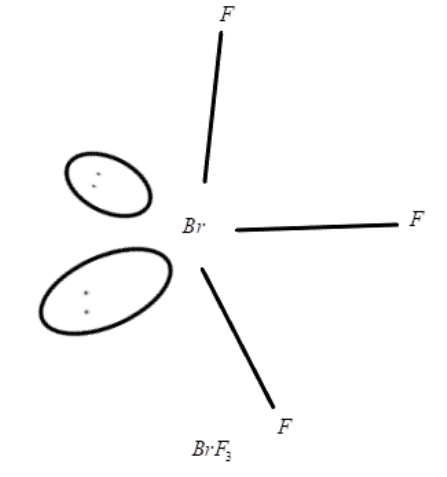
ii $Br{F_3}$
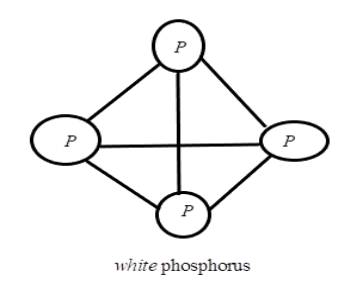
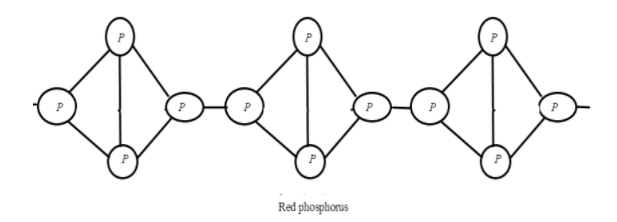
(b) Write the structure difference between white phosphorus and red phosphorus.
Answer
 Verified
594.3k+ views
Hint: As we know that the general electronic configuration of inert gases are $n{s^2}n{p^6}$ except helium. Among the noble gas compounds, Xenon is known to form a number of compounds with electronegative elements like Fluorine and Oxygen. Phosphorus possesses three allotropic forms namely red, black and white.
Complete step by step answer:
(a)Let us recall some of the basic chemical properties of the noble gases like they possess the completely filled valence shell, high ionization enthalpy and more positive electron gain enthalpy. Xenon along with members of the group like helium, krypton, argon, neon and radon are termed as noble gas compounds. Among these Xenon is known to form a number of compounds with electronegative elements like Fluorine and Oxygen. Krypton forms very few compounds and only $Kr{F_2}$ is known. Even there are no true compounds of Argon, helium and Neon yet known.
i. Now let us talk about the structure of \[Xe{F_2}\] which is a linear molecule and according to VSEPR theory, there are three non-bonding electrons pair around the equatorial region and also xenon prepared in $1:2$ ratio reacts with fluoride ions at $673K$ and $1bar$ of pressure and results in the preparation of \[Xe{F_2}\]. We can explain this with a chemical reaction and can also make the structure of it:
$Xe(g) + {F_2}\xrightarrow{{673K,1bar}}Xe{F_2}(s)$
ii. Now, let us talk about the structure of $Br{F_3}$(Bromine trifluoride) which is an interhalogen compound and is soluble in sulphuric acid and a very well known fluorinating agent. It is a T-shaped molecule and planar where the bromine center possesses two electron pairs. It is formed when Bromine reacts with fluorine at a temperature of ${20^ \circ }C$. We can explain it by the reaction:
$Br{F_3} + 3{F_2}\xrightarrow{{{{20}^ \circ }C}}2Br{F_3}$
(b) As we have discussed, phosphorus consists of three important allotropic forms which are Red phosphorous, White phosphorous and Black phosphorus. We will talk about White phosphorus which consists of discrete tetrahedral P4 molecules. When compared to other solid phases, it is more reactive due to the angular strain in P4 molecules with an angle of ${60^ \circ }$. White phosphorus dissolves in a boiling NaOH solution in an inert atmosphere giving phosphine, $P{H_3}$. The structure is as:
Whereas the Red phosphorus consisting of chains of P4 tetrahedra linked together is polymeric in nature. It is chemically much less reactive than white phosphorus and when it is heated under high pressure it results in a series of phases of Black phosphorus. The structure can be drawn as:
Note:
Try to remember the reagent in chemistry that is the basic need to be as good as anyone else in chemistry. And learn about the angles and configurations of the compound to make sure that if they have unpaired electrons or paired electrons which will be helpful in their bonding with other elements.
Complete step by step answer:
(a)Let us recall some of the basic chemical properties of the noble gases like they possess the completely filled valence shell, high ionization enthalpy and more positive electron gain enthalpy. Xenon along with members of the group like helium, krypton, argon, neon and radon are termed as noble gas compounds. Among these Xenon is known to form a number of compounds with electronegative elements like Fluorine and Oxygen. Krypton forms very few compounds and only $Kr{F_2}$ is known. Even there are no true compounds of Argon, helium and Neon yet known.
i. Now let us talk about the structure of \[Xe{F_2}\] which is a linear molecule and according to VSEPR theory, there are three non-bonding electrons pair around the equatorial region and also xenon prepared in $1:2$ ratio reacts with fluoride ions at $673K$ and $1bar$ of pressure and results in the preparation of \[Xe{F_2}\]. We can explain this with a chemical reaction and can also make the structure of it:
$Xe(g) + {F_2}\xrightarrow{{673K,1bar}}Xe{F_2}(s)$
ii. Now, let us talk about the structure of $Br{F_3}$(Bromine trifluoride) which is an interhalogen compound and is soluble in sulphuric acid and a very well known fluorinating agent. It is a T-shaped molecule and planar where the bromine center possesses two electron pairs. It is formed when Bromine reacts with fluorine at a temperature of ${20^ \circ }C$. We can explain it by the reaction:
$Br{F_3} + 3{F_2}\xrightarrow{{{{20}^ \circ }C}}2Br{F_3}$
(b) As we have discussed, phosphorus consists of three important allotropic forms which are Red phosphorous, White phosphorous and Black phosphorus. We will talk about White phosphorus which consists of discrete tetrahedral P4 molecules. When compared to other solid phases, it is more reactive due to the angular strain in P4 molecules with an angle of ${60^ \circ }$. White phosphorus dissolves in a boiling NaOH solution in an inert atmosphere giving phosphine, $P{H_3}$. The structure is as:
Whereas the Red phosphorus consisting of chains of P4 tetrahedra linked together is polymeric in nature. It is chemically much less reactive than white phosphorus and when it is heated under high pressure it results in a series of phases of Black phosphorus. The structure can be drawn as:
Note:
Try to remember the reagent in chemistry that is the basic need to be as good as anyone else in chemistry. And learn about the angles and configurations of the compound to make sure that if they have unpaired electrons or paired electrons which will be helpful in their bonding with other elements.
Recently Updated Pages
Master Class 12 Social Science: Engaging Questions & Answers for Success

Master Class 12 Physics: Engaging Questions & Answers for Success
Master Class 12 Maths: Engaging Questions & Answers for Success
Master Class 12 Economics: Engaging Questions & Answers for Success
Master Class 12 Chemistry: Engaging Questions & Answers for Success
Master Class 12 Business Studies: Engaging Questions & Answers for Success
Trending doubts
Which are the Top 10 Largest Countries of the World?
Draw a labelled sketch of the human eye class 12 physics CBSE
Explain the structure of megasporangium class 12 biology CBSE
What are the major means of transport Explain each class 12 social science CBSE
How many chromosomes are found in human ovum a 46 b class 12 biology CBSE
The diagram of the section of a maize grain is given class 12 biology CBSE