




(a) Draw ray – diagrams to show the formation of image when the object is placed in front of a concave mirror (converging mirror):
(i) Between its pole and focus
(ii) Between its centre of curvature and focus. Describe the nature, size and position of the image formed in each case.
(b) State the use of a concave mirror based on the formation of images as in case above.
Answer
 Verified
636.6k+ views
Hint:The image of the object placed between the focus and pole forms behind the mirror. The image of the object placed between curvature and focus forms on the same side of the object. When the image forms behind the mirror, the image is a virtual image and when the image forms on the same side of the object, the image is a real image.
Complete answer:
(a) (i) We have given that the object is placed in front of a concave mirror that is between the pole of the mirror and focus. In this case, the reflected rays from the concave mirror could not be focused at the same side of the mirror and to form the image, we have to back trace the reflected rays to form the image of the object. Let’s draw the ray – diagram for the formation of the image in this case.
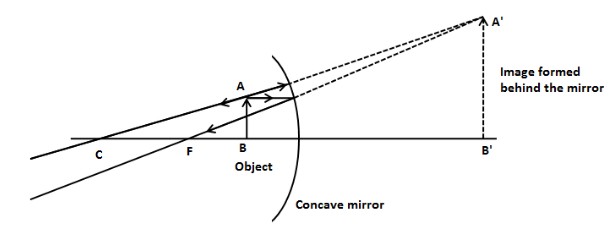
As we can see in the above figure, the image of the object is magnified, erect and virtual (since it is formed behind the mirror).
(a)(ii) We have given that the object is placed between the radius of curvature and focus of the concave mirror. In this case, the image of the object forms on the same side as the object. Let’s draw the ray-diagram for the formation of an image in this case.
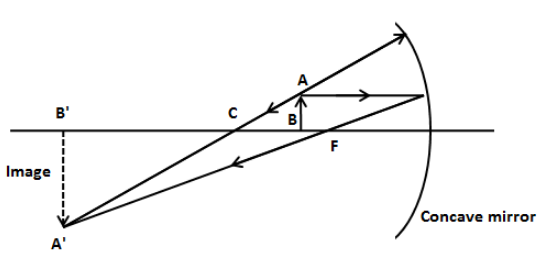
As we can see in the above figure, the image of the object is inverted, magnified and real.
(b) Let’s discuss the use of a concave mirror in the first case. In the first case, where the image forms behind the mirror, such a mirror is used as a shaving mirror. Also, the concave mirror is used in the base of a microscope as a condenser. In the headlights of vehicles, the concave mirrors are used since they collect the light coming from the bulb and emerges them as parallel rays.
Note:To draw the ray diagram for the image formation in a concave mirror, you need reflected rays to focus at a certain point. One ray from the object gets reflected from the concave mirror and goes through the focus and another ray from the object reflected from the concave mirror goes through the curvature of the mirror. The conditions for image formation are discussed in the solution. Students must remember the characteristics of the image formed by the concave mirror to draw the ray – diagram.
Complete answer:
(a) (i) We have given that the object is placed in front of a concave mirror that is between the pole of the mirror and focus. In this case, the reflected rays from the concave mirror could not be focused at the same side of the mirror and to form the image, we have to back trace the reflected rays to form the image of the object. Let’s draw the ray – diagram for the formation of the image in this case.
As we can see in the above figure, the image of the object is magnified, erect and virtual (since it is formed behind the mirror).
(a)(ii) We have given that the object is placed between the radius of curvature and focus of the concave mirror. In this case, the image of the object forms on the same side as the object. Let’s draw the ray-diagram for the formation of an image in this case.
As we can see in the above figure, the image of the object is inverted, magnified and real.
(b) Let’s discuss the use of a concave mirror in the first case. In the first case, where the image forms behind the mirror, such a mirror is used as a shaving mirror. Also, the concave mirror is used in the base of a microscope as a condenser. In the headlights of vehicles, the concave mirrors are used since they collect the light coming from the bulb and emerges them as parallel rays.
Note:To draw the ray diagram for the image formation in a concave mirror, you need reflected rays to focus at a certain point. One ray from the object gets reflected from the concave mirror and goes through the focus and another ray from the object reflected from the concave mirror goes through the curvature of the mirror. The conditions for image formation are discussed in the solution. Students must remember the characteristics of the image formed by the concave mirror to draw the ray – diagram.
Recently Updated Pages
Master Class 10 Computer Science: Engaging Questions & Answers for Success

Differentiate between voluntary action and reflex class 10 biology CBSE
The uses of bleaching powder are A It is used bleaching class 10 chemistry CBSE
Fill in the blanks with abstract nouns of the words class 10 english CBSE
How many threedigit numbers are there class 10 maths CBSE
What is a reflex arc class 10 biology CBSE
Trending doubts
Explain the Treaty of Vienna of 1815 class 10 social science CBSE
In basketball, how many quarters are played in an NBA game?
10 examples of evaporation in daily life with explanations
Which country is known as "The land of Fire and Ice"?
What is the full form of POSCO class 10 social science CBSE
In which year voting age was reduced from 21 to 18?