




(a) Draw a labelled diagram of the human heart.
(b) What is the use of platelets in the maintenance of human beings?
(c) Which respiratory pigment is found in red blood corpuscles found in human blood?
Answer
 Verified
670.2k+ views
Hint: If not for thrombocytes an organism may bleed to death. The respiratory pigment found in red blood corpuscles contains iron. Its average plasma content in a normal adult healthy human being is about 14 to 16 g/dl.
Complete answer:
a) Human heart
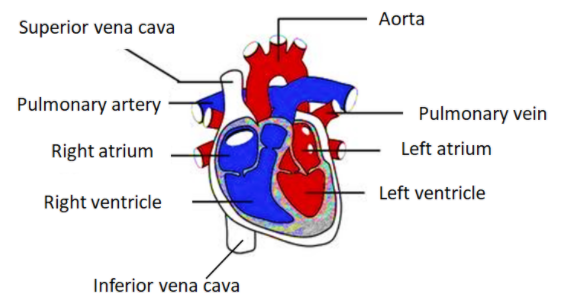
B) Platelets play an important role in blood clotting and
C) The respiratory pigment found in red blood corpuscles in human blood is haemoglobin.
Blood mainly consists of formed elements (blood cells) and plasma (liquid portion of blood). Plasma consists of serum and fibrinogen. The formed elements of blood cells are RBC ( erythrocytes), WBC (leukocytes) and platelets (thrombocytes).
Let's study in detail about platelets.
Platelets or thrombocytes are small, colourless and non-nucleated cells. They are believed to be fragments of the cytoplasm. Platelets have a lot of functions as we will study below.
- Platelets play a part in clot retraction.
- They accelerate haemostasis.
- Thrombocytes also play a vital role in the repair of ruptured blood vessels.
- Platelets also participate in the body’s defence mechanism.
Additional Information:
- Haemoglobin forms 95% of the dry weight of RBC and 30 to 34% of wet weight.
- The molecular weight of haemoglobin is 68,000.
Note:
-The average haemoglobin content in a normal healthy adult male is 15 g/dl.
- The average haemoglobin content in a normal healthy adult female is 14.5 g/dl.
- Hemostasis is a process of stopping blood loss.
Complete answer:
a) Human heart
B) Platelets play an important role in blood clotting and
C) The respiratory pigment found in red blood corpuscles in human blood is haemoglobin.
Blood mainly consists of formed elements (blood cells) and plasma (liquid portion of blood). Plasma consists of serum and fibrinogen. The formed elements of blood cells are RBC ( erythrocytes), WBC (leukocytes) and platelets (thrombocytes).
Let's study in detail about platelets.
Platelets or thrombocytes are small, colourless and non-nucleated cells. They are believed to be fragments of the cytoplasm. Platelets have a lot of functions as we will study below.
- Platelets play a part in clot retraction.
- They accelerate haemostasis.
- Thrombocytes also play a vital role in the repair of ruptured blood vessels.
- Platelets also participate in the body’s defence mechanism.
Additional Information:
- Haemoglobin forms 95% of the dry weight of RBC and 30 to 34% of wet weight.
- The molecular weight of haemoglobin is 68,000.
Note:
-The average haemoglobin content in a normal healthy adult male is 15 g/dl.
- The average haemoglobin content in a normal healthy adult female is 14.5 g/dl.
- Hemostasis is a process of stopping blood loss.
Recently Updated Pages
Which will be the least stable resonating structure class 11 chemistry CBSE

How many 5 digit telephone numbers can be construc-class-11-maths-CBSE
How do you find the angle of the resultant vector class 11 physics CBSE
Draw labelled diagram of the following i Gram seed class 11 biology CBSE
1 Quintal is equal to a 110 kg b 10 kg c 100kg d 1000 class 11 physics CBSE
What is the need and importance of classification class 11 biology CBSE
Trending doubts
Find the value of the expression given below sin 30circ class 11 maths CBSE
One Metric ton is equal to kg A 10000 B 1000 C 100 class 11 physics CBSE
10 examples of friction in our daily life
Draw a diagram of a plant cell and label at least eight class 11 biology CBSE
Difference between physical and chemical change class 11 chemistry CBSE
Proton was discovered by A Thomson B Rutherford C Chadwick class 11 chemistry CBSE