




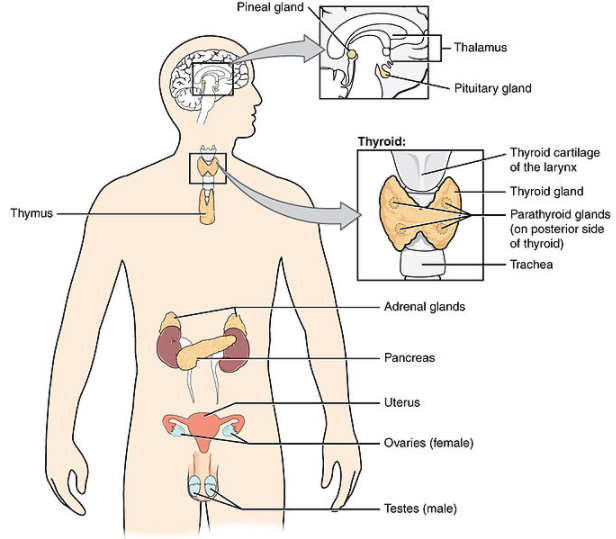
A. Draw a diagram indicating the position of four endocrine glands in human beings.
B. Write the function of insulin and thyroxine hormones in human beings.
Answer
 Verified
580.2k+ views
Hint: Hormones are the protein molecules acting as signal messengers, which are directly secreted into the bloodstream by the ducts of the glands to be carried to the site to action. Example: insulin, progesterone, prolactin and serotonin.
Complete answer:
A. Endocrine glands: It forms the regulatory system constituting ductless glands which secretes their secretion directly into the bloodstream.
The human body has various endocrine glands:
-Parathyroid.
-Adrenals.
-Pineal body.
-Pituitary.
-The ovaries.
-Hypothalamus.
-Thyroid.
-The testes.
Function of insulin:-
-Insulin is the hormone produced by the pancreas that has a number of important functions in the human body.
-Insulin stimulates the synthesis of glycogen in the liver in order to lower the blood sugar level.
-Insulin modifies the activity of enzyme reactions.
-It helps in uptake of amino acid and potassium in the cell.
-In the urine, it manages the excretion of sodium and fluid volume.
-Insulin manages breaking down of protein due to change in fat cells.
Function of thyroxine:-
-Thyroid gland is one of the gland forming endocrine systems, secreting a number of hormones. One of those hormones is Thyroxine also known as T4.
-The vital function is digestion, brain, heart, development and maintenance of bones.
-Play important role in maintaining internal temperature, weight, hair, nail and energy level regulation.
-It attaches to protein and prevents its entry in body tissue.
Note: Thyroxine and insulin have their major role in managing human body functions, if their functional property is lost, it leads to the diseased state of the body. If insulin does not function then the person suffers from diabetes and if thyroxine does not function, the person suffers from thyroid disease.
Complete answer:
A. Endocrine glands: It forms the regulatory system constituting ductless glands which secretes their secretion directly into the bloodstream.
The human body has various endocrine glands:
-Parathyroid.
-Adrenals.
-Pineal body.
-Pituitary.
-The ovaries.
-Hypothalamus.
-Thyroid.
-The testes.
Function of insulin:-
-Insulin is the hormone produced by the pancreas that has a number of important functions in the human body.
-Insulin stimulates the synthesis of glycogen in the liver in order to lower the blood sugar level.
-Insulin modifies the activity of enzyme reactions.
-It helps in uptake of amino acid and potassium in the cell.
-In the urine, it manages the excretion of sodium and fluid volume.
-Insulin manages breaking down of protein due to change in fat cells.
Function of thyroxine:-
-Thyroid gland is one of the gland forming endocrine systems, secreting a number of hormones. One of those hormones is Thyroxine also known as T4.
-The vital function is digestion, brain, heart, development and maintenance of bones.
-Play important role in maintaining internal temperature, weight, hair, nail and energy level regulation.
-It attaches to protein and prevents its entry in body tissue.
Note: Thyroxine and insulin have their major role in managing human body functions, if their functional property is lost, it leads to the diseased state of the body. If insulin does not function then the person suffers from diabetes and if thyroxine does not function, the person suffers from thyroid disease.
Recently Updated Pages
Three beakers labelled as A B and C each containing 25 mL of water were taken A small amount of NaOH anhydrous CuSO4 and NaCl were added to the beakers A B and C respectively It was observed that there was an increase in the temperature of the solutions contained in beakers A and B whereas in case of beaker C the temperature of the solution falls Which one of the following statements isarecorrect i In beakers A and B exothermic process has occurred ii In beakers A and B endothermic process has occurred iii In beaker C exothermic process has occurred iv In beaker C endothermic process has occurred

Master Class 11 Social Science: Engaging Questions & Answers for Success
Master Class 11 Physics: Engaging Questions & Answers for Success
Master Class 11 Maths: Engaging Questions & Answers for Success
Master Class 11 Economics: Engaging Questions & Answers for Success
Master Class 11 Computer Science: Engaging Questions & Answers for Success
Three beakers labelled as A B and C each containing 25 mL of water were taken A small amount of NaOH anhydrous CuSO4 and NaCl were added to the beakers A B and C respectively It was observed that there was an increase in the temperature of the solutions contained in beakers A and B whereas in case of beaker C the temperature of the solution falls Which one of the following statements isarecorrect i In beakers A and B exothermic process has occurred ii In beakers A and B endothermic process has occurred iii In beaker C exothermic process has occurred iv In beaker C endothermic process has occurred
Master Class 11 Social Science: Engaging Questions & Answers for Success
Master Class 11 Physics: Engaging Questions & Answers for Success
Trending doubts
There are 720 permutations of the digits 1 2 3 4 5 class 11 maths CBSE
State and prove Bernoullis theorem class 11 physics CBSE
1 Quintal is equal to a 110 kg b 10 kg c 100kg d 1000 class 11 physics CBSE
Discuss the various forms of bacteria class 11 biology CBSE
10 examples of friction in our daily life
1 ton equals to A 100 kg B 1000 kg C 10 kg D 10000 class 11 physics CBSE