




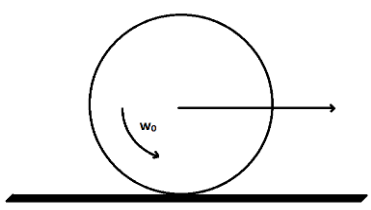
A disc of radius R is spun to an angular speed \[{\omega _0}\] about its axis and then imparted a horizontal velocity of magnitude \[\dfrac{{{\omega _{0}}R}}{4}\] The coefficient of friction is \[\mu \]. The sense of rotation and direction of linear velocity are shown in the figure. The disc will return to its initial position
A. If the value of \[\mu < 0.5\].
B. Irrespective of the value of \[\mu \].
C. If the value of \[0.5 < \mu < 1\].
D. If \[\mu > 1\].
Answer
 Verified
606.6k+ views
Hint:Here, we are asked to determine the value of coefficient of friction \[\mu \]for which the disc will return to its initial position. We know that only the bottom point of the disc is in the direct contact with the surface. Therefore, we will find the angular momentum at the most bottom point of the disc and by the help of this, we will reach our final answer.
Complete step by step answer:
Let $m$ be the mass of the disc and ${v_0}$ be the linear velocity of the disc.The angular momentum at the most bottom point can be given as:
\[L = {I_C}{\omega _0} - m{v_0}R\]
Where, ${I_C}$ is the moment of inertia of the disc about its center which is given by $\dfrac{1}{2}m{R^2}$.
Also, we are given that \[{v_0} = \dfrac{{{\omega _{0}}R}}{4}\].
Therefore, putting these values, the angular momentum of the disc is given by:
\[L = \dfrac{1}{2}m{R^2}{\omega _0} - m\left( {\dfrac{{{\omega _0}R}}{4}} \right)R \\
\Rightarrow L = \dfrac{1}{2}m{R^2}{\omega _0} - \dfrac{1}{4}m{R^2}{\omega _0} \\
\therefore L = \dfrac{1}{4}m{R^2}{\omega _0} \\ \]
Thus, the angular momentum of the disc is positive or we can say that it is in anticlockwise direction. We can say that during slip, the friction acts about the bottommost point.Therefore, its torque is zero. In other words, the direction of angular momentum remains anticlockwise in the case of pure rolling. Therefore, it can be concluded that the disc will return to its initial position irrespective of the value of \[\mu \].
Hence, option B is correct.
Note:In this question, we have concluded that the disc will return to its initial position irrespective to the value of \[\mu \].This means that the return of the disc to its original position does not depend on the type of the surface. We will get the same result whether the surface is smooth or rough.
Complete step by step answer:
Let $m$ be the mass of the disc and ${v_0}$ be the linear velocity of the disc.The angular momentum at the most bottom point can be given as:
\[L = {I_C}{\omega _0} - m{v_0}R\]
Where, ${I_C}$ is the moment of inertia of the disc about its center which is given by $\dfrac{1}{2}m{R^2}$.
Also, we are given that \[{v_0} = \dfrac{{{\omega _{0}}R}}{4}\].
Therefore, putting these values, the angular momentum of the disc is given by:
\[L = \dfrac{1}{2}m{R^2}{\omega _0} - m\left( {\dfrac{{{\omega _0}R}}{4}} \right)R \\
\Rightarrow L = \dfrac{1}{2}m{R^2}{\omega _0} - \dfrac{1}{4}m{R^2}{\omega _0} \\
\therefore L = \dfrac{1}{4}m{R^2}{\omega _0} \\ \]
Thus, the angular momentum of the disc is positive or we can say that it is in anticlockwise direction. We can say that during slip, the friction acts about the bottommost point.Therefore, its torque is zero. In other words, the direction of angular momentum remains anticlockwise in the case of pure rolling. Therefore, it can be concluded that the disc will return to its initial position irrespective of the value of \[\mu \].
Hence, option B is correct.
Note:In this question, we have concluded that the disc will return to its initial position irrespective to the value of \[\mu \].This means that the return of the disc to its original position does not depend on the type of the surface. We will get the same result whether the surface is smooth or rough.
Recently Updated Pages
Master Class 11 Social Science: Engaging Questions & Answers for Success

Master Class 11 English: Engaging Questions & Answers for Success
Master Class 11 Accountancy: Engaging Questions & Answers for Success
Master Class 11 Physics: Engaging Questions & Answers for Success
Master Class 11 Computer Science: Engaging Questions & Answers for Success
Master Class 11 Business Studies: Engaging Questions & Answers for Success
Trending doubts
Find the value of the expression given below sin 30circ class 11 maths CBSE
Draw a diagram of nephron and explain its structur class 11 biology CBSE
Proton was discovered by A Thomson B Rutherford C Chadwick class 11 chemistry CBSE
The teeth used for biting and cutting food are called class 11 biology CBSE
Frogs heart when taken out of the body continues to class 11 biology CBSE
10 examples of diffusion in everyday life