




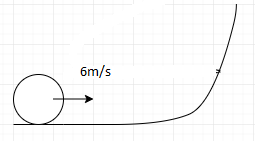
A disc of radius 0.1 m rolls without sliding on a horizontal surface with a velocity of 6 m/s. Then, it ascends a smooth continuous track as shown in the figure. Given, g= $ 10m/{{s}^{2}} $ , the height up to which it will ascend is (g= $ 10m/{{s}^{2}} $ )
A: 2.4m
B: 0.9m
C: 2.7m
D: 1.8m
Answer
 Verified
544.5k+ views
Hint :Here, we are given the rolling motion of a disc on a horizontal ground. In this scenario we can say that the body possesses both linear momentum as well as angular momentum. During the calculation of the kinetic energy of the motion, both these momentums should be considered during the calculation process.
Complete Step By Step Answer:
We are given that a disc of radius 0.1 m rolls without sliding on a horizontal surface with a velocity of 6 m/s. Further, it begins to ascend a smooth continuous track as pet the figure given to us.
We have to find the height up to which it will ascend.
In this case, there is only rolling motion and no sliding motion. Hence we can say that there is an absence of the influence of friction.
When the disc rolls without sliding motion, the kinetic energy of the disc can be found by
$ KE=\dfrac{1}{2}m{{v}^{2}}+\dfrac{1}{2}I{{\omega }^{2}}=\dfrac{1}{2}m{{v}^{2}}+\dfrac{1}{2}(\dfrac{1}{2}m{{r}^{2}})(\dfrac{{{v}^{2}}}{{{r}^{2}}})[\because v=rw] \\
\Rightarrow KE=\dfrac{1}{2}m{{v}^{2}}+\dfrac{1}{4}m{{v}^{2}}=\dfrac{3}{4}m{{v}^{2}} \\ $
At the maximum height, this transforms to potential energy. Thus we can write it as
$ mgh=\dfrac{3}{4}m{{v}^{2}} \\
\Rightarrow h=\dfrac{3{{v}^{2}}}{4g} \\ $
We are given that v=6m/s and g= $ 10m/{{s}^{2}} $
Thus, height is given by $ h=\dfrac{3{{(6)}^{2}}}{4(10)}=2.7m $
Hence, option C is the correct answer among the given options.
Note :
When such questions involve acceleration we have to note the point that in such cases, both linear and tangential acceleration occurs and both should be considered during the calculation process. The situation would have been different if there was a sliding motion top of the ball. Also, we have assumed that there is no frictional force present. This problem can also be done using the work energy theorem.
Complete Step By Step Answer:
We are given that a disc of radius 0.1 m rolls without sliding on a horizontal surface with a velocity of 6 m/s. Further, it begins to ascend a smooth continuous track as pet the figure given to us.
We have to find the height up to which it will ascend.
In this case, there is only rolling motion and no sliding motion. Hence we can say that there is an absence of the influence of friction.
When the disc rolls without sliding motion, the kinetic energy of the disc can be found by
$ KE=\dfrac{1}{2}m{{v}^{2}}+\dfrac{1}{2}I{{\omega }^{2}}=\dfrac{1}{2}m{{v}^{2}}+\dfrac{1}{2}(\dfrac{1}{2}m{{r}^{2}})(\dfrac{{{v}^{2}}}{{{r}^{2}}})[\because v=rw] \\
\Rightarrow KE=\dfrac{1}{2}m{{v}^{2}}+\dfrac{1}{4}m{{v}^{2}}=\dfrac{3}{4}m{{v}^{2}} \\ $
At the maximum height, this transforms to potential energy. Thus we can write it as
$ mgh=\dfrac{3}{4}m{{v}^{2}} \\
\Rightarrow h=\dfrac{3{{v}^{2}}}{4g} \\ $
We are given that v=6m/s and g= $ 10m/{{s}^{2}} $
Thus, height is given by $ h=\dfrac{3{{(6)}^{2}}}{4(10)}=2.7m $
Hence, option C is the correct answer among the given options.
Note :
When such questions involve acceleration we have to note the point that in such cases, both linear and tangential acceleration occurs and both should be considered during the calculation process. The situation would have been different if there was a sliding motion top of the ball. Also, we have assumed that there is no frictional force present. This problem can also be done using the work energy theorem.
Recently Updated Pages
Master Class 11 Computer Science: Engaging Questions & Answers for Success

Master Class 11 Business Studies: Engaging Questions & Answers for Success
Master Class 11 Economics: Engaging Questions & Answers for Success
Master Class 11 English: Engaging Questions & Answers for Success
Master Class 11 Maths: Engaging Questions & Answers for Success
Master Class 11 Biology: Engaging Questions & Answers for Success
Trending doubts
One Metric ton is equal to kg A 10000 B 1000 C 100 class 11 physics CBSE
There are 720 permutations of the digits 1 2 3 4 5 class 11 maths CBSE
Discuss the various forms of bacteria class 11 biology CBSE
Draw a diagram of a plant cell and label at least eight class 11 biology CBSE
State the laws of reflection of light
Explain zero factorial class 11 maths CBSE