




A disc of mass $1\,kg$ of radius $2\,m$ is moving with the velocity of ${\text{4 m}}{{\text{s}}^{ - 1}}$ What is the kinetic energy of the disc?
A. 12 J
B. 8 J
C. 20 J
D. 10 J
Answer
 Verified
559.8k+ views
Hint: In order to solve the question, we will first find the translational kinetic energy and then we will find the rotational kinetic energy for which we have to find the moment of inertia of disc and angular velocity and then we after finding both the kinetic energy we will use them to find the total kinetic energy of disc
Formula used:
Formula of translational kinetic energy
$K{E_T} = \dfrac{1}{2}m{v^2}$
Here, $m$ refers to mass and $v$ refers to velocity.
Formula of rotational kinetic energy
$K{E_R} = \dfrac{1}{2}I{\omega ^2}$
Here, $I$ refers to moment of inertia and $\omega $ refers to angular velocity.
Complete step by step answer:
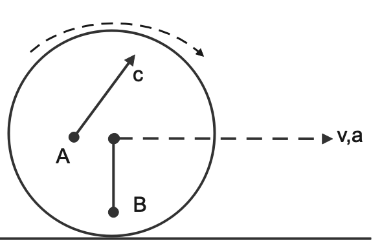
In the question we are given a disc which is rotating as well as moving in the forward direction and we have to find the kinetic energy
Mass of the disc = 1 kg
Radius of the disc = 2 m
Velocity of the disc = ${\text{4 m}}{{\text{s}}^{ - 1}}$
On the disc two kinetic energies are applied transition kinetic energy and rotational kinetic energy hence
Total kinetic energy = Transition kinetic energy + Rotational kinetic energy
To find the Translational kinetic energy we will use the formula
$K{E_T} = \dfrac{1}{2}m{v^2}$
We will substitute the value of mass and velocity in the equation
$K{E_T} = \dfrac{1}{2} \times 1 \times {4^2}$
$\Rightarrow K{E_T} = \dfrac{1}{2} \times 1 \times {4^2}$
Hence translation kinetic energy is
$K{E_T} = 8{\text{ J}}$
To find the Rotational kinetic energy we will use the formula
$K{E_R} = \dfrac{1}{2}I{\omega ^2}$
Now we have to find the moment of inertia of disc and the angular velocity of disc
Moment of inertia of disk = $\dfrac{{M{r^2}}}{2}$
Now we will substitute the value of radius and mass
$I = \dfrac{{1 \times {{(2)}^2}}}{2}$
Hence the moment of inertia is
\[I{\text{ }} = {\text{ }}2{\text{ }}Kg{\text{ }}{m^2}\]
Angular velocity of disk $\omega = \dfrac{v}{r}$
Now we will substitute the value of radius and velocity
$\omega = \dfrac{4}{2} = 2{s^{ - 1}}$
Now we will substitute the value of momentum and angular velocity in the equation
$K{E_R} = \dfrac{1}{2}I{\omega ^2}$
$\Rightarrow K{E_R} = \dfrac{1}{2} \times 2 \times {2^2}$
Hence Rotational kinetic energy is
$K{E_R} = 4{\text{ J}}$
Total kinetic energy = Transition kinetic energy + Rotational kinetic energy
Transition kinetic energy = 8 J
Rotational kinetic energy = 4 J
Total kinetic energy = 8 J + 4 J
Thus total kinetic energy = 12 J
Hence, the correct option is A.
Note: Many of the students will make the mistake by not considering rotational kinetic energy as in the question we are given velocity, mass and radius but in diagram curve shows that disc is rotating so it produces both rotational and translational kinetic energy.
Formula used:
Formula of translational kinetic energy
$K{E_T} = \dfrac{1}{2}m{v^2}$
Here, $m$ refers to mass and $v$ refers to velocity.
Formula of rotational kinetic energy
$K{E_R} = \dfrac{1}{2}I{\omega ^2}$
Here, $I$ refers to moment of inertia and $\omega $ refers to angular velocity.
Complete step by step answer:
In the question we are given a disc which is rotating as well as moving in the forward direction and we have to find the kinetic energy
Mass of the disc = 1 kg
Radius of the disc = 2 m
Velocity of the disc = ${\text{4 m}}{{\text{s}}^{ - 1}}$
On the disc two kinetic energies are applied transition kinetic energy and rotational kinetic energy hence
Total kinetic energy = Transition kinetic energy + Rotational kinetic energy
To find the Translational kinetic energy we will use the formula
$K{E_T} = \dfrac{1}{2}m{v^2}$
We will substitute the value of mass and velocity in the equation
$K{E_T} = \dfrac{1}{2} \times 1 \times {4^2}$
$\Rightarrow K{E_T} = \dfrac{1}{2} \times 1 \times {4^2}$
Hence translation kinetic energy is
$K{E_T} = 8{\text{ J}}$
To find the Rotational kinetic energy we will use the formula
$K{E_R} = \dfrac{1}{2}I{\omega ^2}$
Now we have to find the moment of inertia of disc and the angular velocity of disc
Moment of inertia of disk = $\dfrac{{M{r^2}}}{2}$
Now we will substitute the value of radius and mass
$I = \dfrac{{1 \times {{(2)}^2}}}{2}$
Hence the moment of inertia is
\[I{\text{ }} = {\text{ }}2{\text{ }}Kg{\text{ }}{m^2}\]
Angular velocity of disk $\omega = \dfrac{v}{r}$
Now we will substitute the value of radius and velocity
$\omega = \dfrac{4}{2} = 2{s^{ - 1}}$
Now we will substitute the value of momentum and angular velocity in the equation
$K{E_R} = \dfrac{1}{2}I{\omega ^2}$
$\Rightarrow K{E_R} = \dfrac{1}{2} \times 2 \times {2^2}$
Hence Rotational kinetic energy is
$K{E_R} = 4{\text{ J}}$
Total kinetic energy = Transition kinetic energy + Rotational kinetic energy
Transition kinetic energy = 8 J
Rotational kinetic energy = 4 J
Total kinetic energy = 8 J + 4 J
Thus total kinetic energy = 12 J
Hence, the correct option is A.
Note: Many of the students will make the mistake by not considering rotational kinetic energy as in the question we are given velocity, mass and radius but in diagram curve shows that disc is rotating so it produces both rotational and translational kinetic energy.
Recently Updated Pages
Lysosomes are known as suicidal bags of cell why class 11 biology CBSE

Father s age is three times the sum of the ages of-class-11-maths-CBSE
Give a comparative account of the classes of kingdom class 11 biology CBSE
The ceiling of a long hall is 25m high What is the class 11 physics CBSE
Name the Largest and the Smallest Cell in the Human Body ?
Draw a welllabelled diagram of a plant cell class 11 biology CBSE
Trending doubts
Find the value of the expression given below sin 30circ class 11 maths CBSE
One Metric ton is equal to kg A 10000 B 1000 C 100 class 11 physics CBSE
Two of the body parts which do not appear in MRI are class 11 biology CBSE
10 examples of friction in our daily life
Proton was discovered by A Thomson B Rutherford C Chadwick class 11 chemistry CBSE
10 examples of diffusion in everyday life