




A dioecious plant has
A. Bisexual flowers
B. Either male or female flowers
C. Both male and female flowers
- A. Bisexual and neutral flowers
- A. Bisexual and neutral flowers
Answer
 Verified
623.7k+ views
Hint: A dioecious plant in which either male (stamens) or female (gynoecium) reproductive structure is present in the flowers.
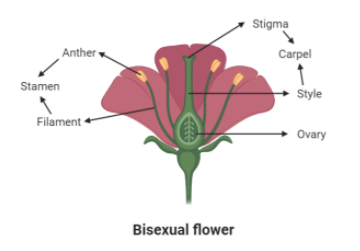
Step by step answer:In higher plants, there are very well-developed sex organs. There is also a clear distinction between the male and the female sex organs. The reproductive structures of the Angiospermic plants are known as the flowering plants. The male sex organs of a flower are known as the stamen. It consists of an anther and a filament. The female sex organs of a flower are known as the carpel or the pistil. The carpel consists of the style, stigma, and ovary. The ovary further contains the ovule. If a plant has unisexual flowers, then it is classified as Monoecious or Dioecious plant, based on the position of the flowers.
Monoecious – When the male flower and the female flower are present on the same plant body, then it is known as the monoecious plant. Examples – Cucurbits, Maize, Coconut, etc.
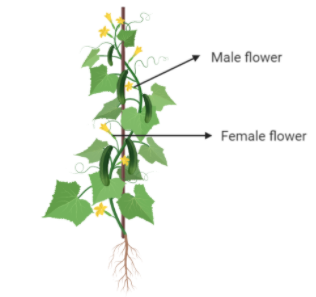
Dioecious – When the male and the female flowers are present on the different plant bodies, then it is known as the dioecious plant. Examples – Date palm, Papaya, etc.
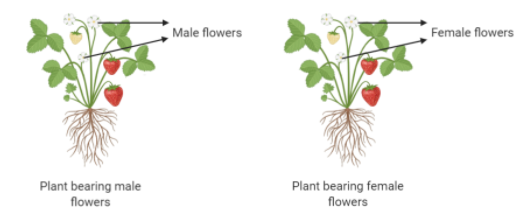
Hence, based on the definition of the dioecious plants, they have either male or female flowers on the plant.
Thus, the correct answer is option (B)
Additional Information:
The terms monoecious and dioecious are different from the unisexual and bisexual.
Unisexual – If the male sex organ i.e., the stamen and the female sex organ, i.e., the carpel, occur on different flowers, then, it is known as unisexual flower. These kinds of flowers undergo cross-pollination for fertilization. Example – Papaya, Mulberry, Watermelon, etc.

Bisexual – If the male sex organ i.e., the stamen and the female sex organ, i.e., the carpel, occur on the same flower, then, it is known as a bisexual flower. These kinds of flowers undergo self-pollination for fertilization. Example – China Rose, Rose, Mustard, etc.
Note: The two different conditions are monoecious (male flower and the female flower are present on the same plant body) while in dioecious (male and the female flowers are present on the different plant bodies).
Step by step answer:In higher plants, there are very well-developed sex organs. There is also a clear distinction between the male and the female sex organs. The reproductive structures of the Angiospermic plants are known as the flowering plants. The male sex organs of a flower are known as the stamen. It consists of an anther and a filament. The female sex organs of a flower are known as the carpel or the pistil. The carpel consists of the style, stigma, and ovary. The ovary further contains the ovule. If a plant has unisexual flowers, then it is classified as Monoecious or Dioecious plant, based on the position of the flowers.
Monoecious – When the male flower and the female flower are present on the same plant body, then it is known as the monoecious plant. Examples – Cucurbits, Maize, Coconut, etc.
Dioecious – When the male and the female flowers are present on the different plant bodies, then it is known as the dioecious plant. Examples – Date palm, Papaya, etc.
Hence, based on the definition of the dioecious plants, they have either male or female flowers on the plant.
Thus, the correct answer is option (B)
Additional Information:
The terms monoecious and dioecious are different from the unisexual and bisexual.
Unisexual – If the male sex organ i.e., the stamen and the female sex organ, i.e., the carpel, occur on different flowers, then, it is known as unisexual flower. These kinds of flowers undergo cross-pollination for fertilization. Example – Papaya, Mulberry, Watermelon, etc.
Bisexual – If the male sex organ i.e., the stamen and the female sex organ, i.e., the carpel, occur on the same flower, then, it is known as a bisexual flower. These kinds of flowers undergo self-pollination for fertilization. Example – China Rose, Rose, Mustard, etc.
Note: The two different conditions are monoecious (male flower and the female flower are present on the same plant body) while in dioecious (male and the female flowers are present on the different plant bodies).
Recently Updated Pages
Master Class 12 Business Studies: Engaging Questions & Answers for Success

Master Class 12 Chemistry: Engaging Questions & Answers for Success
Master Class 12 Biology: Engaging Questions & Answers for Success
Class 12 Question and Answer - Your Ultimate Solutions Guide
Master Class 11 English: Engaging Questions & Answers for Success
Master Class 11 Social Science: Engaging Questions & Answers for Success
Trending doubts
Which are the Top 10 Largest Countries of the World?
Draw a labelled sketch of the human eye class 12 physics CBSE
Differentiate between homogeneous and heterogeneous class 12 chemistry CBSE
Differentiate between Pyramid of energy and pyramid class 12 biology CBSE
Why is the cell called the structural and functional class 12 biology CBSE
Draw the diagram of the pyramid of energy Explain In class 12 biology CBSE