




(a) Deduce the expression for the potential energy of a system of two charges ${q_1}$ and ${q_2}$ located $\overrightarrow {{r_1}} $ and $\overrightarrow {{r_2}} $, respectively, in an external electric field.
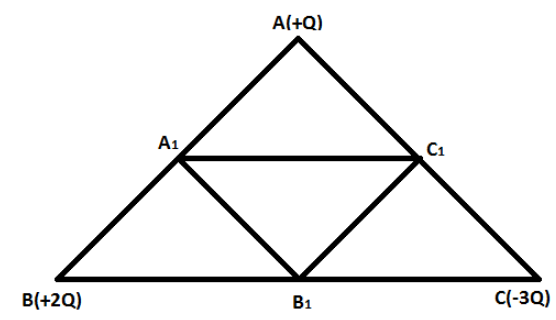
(b) Three point charges, $ + Q$ $ + 2Q$ and $ - 3Q$ are placed at the vertices of an equilateral triangle $ABC$ of side $I$. If these charges are displaced to the midpoint ${A_1}$, ${B_1}$ and ${C_1}$, respectively, find the amount of the work done in shifting the charges to the new locations.
Answer
 Verified
575.1k+ views
Hint: In this question, we need to first deduce the potential energy of a system which contains two charges of different magnitude and then, evaluate the amount of the work done in shifting the charges to the new locations such that three point charges moved from vertex to mid-point of an equilateral triangle. For this, we will use the generalised formula of the potential energy and substitute the value of the three different charges.
Complete step by step answer:
(a)Firstly, the work done to bring a charge $q$ in the electric field at a distance is given by ${r_1} = {q_1}V({r_1})$.
Similarly, the work done to bring a charge $q$ in the electric field at a distance is given by ${r_2} = {q_2}V({r_2})$.
Also, the work done on ${q_2}$ to move it against the force of ${q_1} = \dfrac{{K{q_1}{q_2}}}{{{r_{12}}}}$.
Therefore, we can conclude that the potential energy of the system can be given by
${q_1}V({r_1}) + {q_2}V({r_2}) + \dfrac{{K{q_1}{q_2}}}{{{r_{12}}}}$.
(b)The work done in moving the charges is equal to the difference between the potential of the initial position and the potential of the final position.
This can be technically written as,
Work done in moving charges $ = $ Potential of the Initial position $ - $ Potential of the Final position
Now, the potential of the initial system is equal to,
$
W = {V_{12}} + {V_{23}} + {V_{31}} \\
\Rightarrow W = 2K{Q^2} + ( - 3K{Q^2}) + ( - 6K{Q^2}) \\
\Rightarrow W = - 7K{Q^2}J \\ $
Now, let us calculate the final potential, that is, the potential after moving to the positions ${A_1}$, ${B_1}$ and ${C_1}$.
$
V = \dfrac{{K(2Q)(Q)}}{{\left( {\dfrac{1}{2}} \right)}} + \dfrac{{K(Q)( - 3Q)}}{{\left( {\dfrac{1}{2}} \right)}} + \dfrac{{K( - 3Q)(2Q)}}{{\left( {\dfrac{1}{2}} \right)}} \\
\Rightarrow V = 4K{Q^2} - 6K{Q^2} - 12K{Q^2} \\
\Rightarrow V = - 14K{Q^2}J \\ $
Therefore, the work done can be given by,
Work done $ = $ potential of the initial position $ - $ potential of the final position
$
W = - 7{Q^2}K - ( - 14K{Q^2}) \\
\therefore W = 7K{Q^2}J $
So, we can conclude that the amount of the work done in shifting the charges to the new locations is $7K{Q^2}J$.
Note:Students get confused when calculating the work done. Instead of finding the difference between the potential of the initial position and the potential of the final position, students tend to add these values. The work done in moving the charges is equal to the difference between the potential of the initial position and the potential of the final position.
Complete step by step answer:
(a)Firstly, the work done to bring a charge $q$ in the electric field at a distance is given by ${r_1} = {q_1}V({r_1})$.
Similarly, the work done to bring a charge $q$ in the electric field at a distance is given by ${r_2} = {q_2}V({r_2})$.
Also, the work done on ${q_2}$ to move it against the force of ${q_1} = \dfrac{{K{q_1}{q_2}}}{{{r_{12}}}}$.
Therefore, we can conclude that the potential energy of the system can be given by
${q_1}V({r_1}) + {q_2}V({r_2}) + \dfrac{{K{q_1}{q_2}}}{{{r_{12}}}}$.
(b)The work done in moving the charges is equal to the difference between the potential of the initial position and the potential of the final position.
This can be technically written as,
Work done in moving charges $ = $ Potential of the Initial position $ - $ Potential of the Final position
Now, the potential of the initial system is equal to,
$
W = {V_{12}} + {V_{23}} + {V_{31}} \\
\Rightarrow W = 2K{Q^2} + ( - 3K{Q^2}) + ( - 6K{Q^2}) \\
\Rightarrow W = - 7K{Q^2}J \\ $
Now, let us calculate the final potential, that is, the potential after moving to the positions ${A_1}$, ${B_1}$ and ${C_1}$.
$
V = \dfrac{{K(2Q)(Q)}}{{\left( {\dfrac{1}{2}} \right)}} + \dfrac{{K(Q)( - 3Q)}}{{\left( {\dfrac{1}{2}} \right)}} + \dfrac{{K( - 3Q)(2Q)}}{{\left( {\dfrac{1}{2}} \right)}} \\
\Rightarrow V = 4K{Q^2} - 6K{Q^2} - 12K{Q^2} \\
\Rightarrow V = - 14K{Q^2}J \\ $
Therefore, the work done can be given by,
Work done $ = $ potential of the initial position $ - $ potential of the final position
$
W = - 7{Q^2}K - ( - 14K{Q^2}) \\
\therefore W = 7K{Q^2}J $
So, we can conclude that the amount of the work done in shifting the charges to the new locations is $7K{Q^2}J$.
Note:Students get confused when calculating the work done. Instead of finding the difference between the potential of the initial position and the potential of the final position, students tend to add these values. The work done in moving the charges is equal to the difference between the potential of the initial position and the potential of the final position.
Recently Updated Pages
Basicity of sulphurous acid and sulphuric acid are

Master Class 12 English: Engaging Questions & Answers for Success
Master Class 12 Social Science: Engaging Questions & Answers for Success
Master Class 12 Maths: Engaging Questions & Answers for Success
Master Class 12 Economics: Engaging Questions & Answers for Success
Master Class 12 Physics: Engaging Questions & Answers for Success
Trending doubts
Which are the Top 10 Largest Countries of the World?
Draw a labelled sketch of the human eye class 12 physics CBSE
Draw ray diagrams each showing i myopic eye and ii class 12 physics CBSE
Give 10 examples of unisexual and bisexual flowers
Coming together federation is practiced in A India class 12 social science CBSE
Write the formula to find the shortest distance between class 12 maths CBSE