




A cylindrical vessel of cross sectional area, $s$ , is left out in the rain in which water is falling downward with the velocity, $v$ , in the still air. When the wind starts blowing in North- East direction with velocity, $v$ , the rate of collection of water in the vessel is
(A) $v.s$
(B) $\sqrt {2v} .\,s$
(C) $2v,.s$
(D) $2\sqrt {2v} .s$
Answer
 Verified
576k+ views
Hint: The rain is the form of precipitation that reaches the earth from the atmosphere. It is falling down due to the earth’s acceleration due to gravity $9.8\,m{s^{ - 2}}$ . If the wind blows in the eastern direction, it pushes the rainfall to that direction in the provided velocity.
Complete step by step solution:
It is given that the Cross sectional area of the cylindrical vessel is $s$
The velocity of the rain water falling vertically downward is $v$.
Before wind blowing, the raindrops enter the opened cylindrical vessel with the velocity $v$ . We know that it has $s$ cross sectional area, hence the water gets filled in the cylindrical vessel in still air.
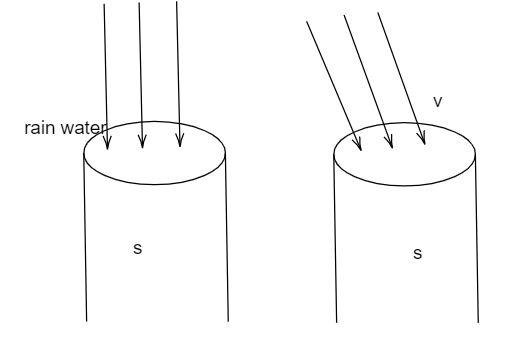
When the wind blows, the direction of the falling of the water in the cylindrical vessel varies and also it affects the velocity of the rain fall by driving it eastwards. The rain will drop at some angles to the vertical and hence the rate at which the water collected is obtained by the product of the area and velocity of the wind.
The rate of collection of water after wind, $r = v.s$
Thus the option (A) is correct.
Note:
The example of this situation is you may see the falling of the rain water in any of the directions. This direction of the rain water depends on the cyclonic wind that originates in the oceans and sea. The wind from there produces the rain and drives it.
Complete step by step solution:
It is given that the Cross sectional area of the cylindrical vessel is $s$
The velocity of the rain water falling vertically downward is $v$.
Before wind blowing, the raindrops enter the opened cylindrical vessel with the velocity $v$ . We know that it has $s$ cross sectional area, hence the water gets filled in the cylindrical vessel in still air.
When the wind blows, the direction of the falling of the water in the cylindrical vessel varies and also it affects the velocity of the rain fall by driving it eastwards. The rain will drop at some angles to the vertical and hence the rate at which the water collected is obtained by the product of the area and velocity of the wind.
The rate of collection of water after wind, $r = v.s$
Thus the option (A) is correct.
Note:
The example of this situation is you may see the falling of the rain water in any of the directions. This direction of the rain water depends on the cyclonic wind that originates in the oceans and sea. The wind from there produces the rain and drives it.
Recently Updated Pages
Master Class 11 Computer Science: Engaging Questions & Answers for Success

Master Class 11 Business Studies: Engaging Questions & Answers for Success
Master Class 11 Economics: Engaging Questions & Answers for Success
Master Class 11 English: Engaging Questions & Answers for Success
Master Class 11 Maths: Engaging Questions & Answers for Success
Master Class 11 Biology: Engaging Questions & Answers for Success
Trending doubts
One Metric ton is equal to kg A 10000 B 1000 C 100 class 11 physics CBSE
There are 720 permutations of the digits 1 2 3 4 5 class 11 maths CBSE
Discuss the various forms of bacteria class 11 biology CBSE
Draw a diagram of a plant cell and label at least eight class 11 biology CBSE
State the laws of reflection of light
10 examples of friction in our daily life