




A cylindrical roller $2.5\,m$ in length, $1.75\,m$ in radius when rolled on a road was found to cover the area of $5500\,{{m}^{2}}$. How many revolutions did it make?
Answer
 Verified
549.9k+ views
Hint: We have a cylindrical roller whose length and radius is given and it is given that when the roller is rolled on a road it covers a certain area we have to find the number of revolutions it made while covering that area. Firstly we want the area covered in one revolution to find the curved area of it. Then we will divide the total area by the area covered in one revolution and hence get our answer.
Formula used:
Curved surface area of cylinder $=2\pi rl$
Where $r$ is the radius of the cylinder base, $h$ is the height of the cylinder.
Complete step-by-step solution:
We have been given a cylindrical roller such that,
Radius $r=1.75\,m$
Length $l=2.5\,m$
Area covered $=5500\,{{m}^{2}}$
So the cylindrical shape will be as follows,
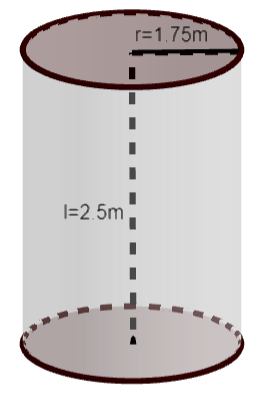
Now we will find the curved surface area of the cylinder by using the formula below,
Curved surface area of cylinder $=2\pi rl$
On substituting the value in the above formula we get,
Curved surface area of cylinder $=2\pi \times 1.75\times 2.5\times {{m}^{2}}$
Put $\pi =\dfrac{22}{7}$ above and simplify,
Curved surface area of cylinder $=2\times \dfrac{22}{7}\times 1.75\times 2.5\times {{m}^{2}}$
Curved surface area of cylinder $=27.5\,{{m}^{2}}$
Area covered by cylindrical roller in one revolution $=$ Curved surface area of cylinder
Area covered by cylindrical roller in one revolution $=27.5\,{{m}^{2}}$
So the total revolution will be calculated as below,
Total Revolution $=$ Total Area $\div $ Area covered in one revolution
Total Revolution $=\dfrac{5500\,{{m}^{2}}}{27.5\,{{m}^{2}}}$
Total Revolution $=200$
Hence, the cylindrical roller makes a $200$ revolution for covering an area of $500\,{{m}^{2}}$.
Note: Cylindrical is one of the basic three-dimensional figures in geometry. It has two parallel circular bases at a distance and the two bases are joined by a curved surface. This line joining the center of the two bases is known as the axis of the cylinder. In this type of question we should know when to find the curved surface area/ Lateral Surface Area and when to find Total Surface area as both of them are differently calculated and also both signify different parts of the cylinder.
Formula used:
Curved surface area of cylinder $=2\pi rl$
Where $r$ is the radius of the cylinder base, $h$ is the height of the cylinder.
Complete step-by-step solution:
We have been given a cylindrical roller such that,
Radius $r=1.75\,m$
Length $l=2.5\,m$
Area covered $=5500\,{{m}^{2}}$
So the cylindrical shape will be as follows,
Now we will find the curved surface area of the cylinder by using the formula below,
Curved surface area of cylinder $=2\pi rl$
On substituting the value in the above formula we get,
Curved surface area of cylinder $=2\pi \times 1.75\times 2.5\times {{m}^{2}}$
Put $\pi =\dfrac{22}{7}$ above and simplify,
Curved surface area of cylinder $=2\times \dfrac{22}{7}\times 1.75\times 2.5\times {{m}^{2}}$
Curved surface area of cylinder $=27.5\,{{m}^{2}}$
Area covered by cylindrical roller in one revolution $=$ Curved surface area of cylinder
Area covered by cylindrical roller in one revolution $=27.5\,{{m}^{2}}$
So the total revolution will be calculated as below,
Total Revolution $=$ Total Area $\div $ Area covered in one revolution
Total Revolution $=\dfrac{5500\,{{m}^{2}}}{27.5\,{{m}^{2}}}$
Total Revolution $=200$
Hence, the cylindrical roller makes a $200$ revolution for covering an area of $500\,{{m}^{2}}$.
Note: Cylindrical is one of the basic three-dimensional figures in geometry. It has two parallel circular bases at a distance and the two bases are joined by a curved surface. This line joining the center of the two bases is known as the axis of the cylinder. In this type of question we should know when to find the curved surface area/ Lateral Surface Area and when to find Total Surface area as both of them are differently calculated and also both signify different parts of the cylinder.
Recently Updated Pages
Basicity of sulphurous acid and sulphuric acid are

Master Class 12 Economics: Engaging Questions & Answers for Success
Master Class 12 Biology: Engaging Questions & Answers for Success
Master Class 11 English: Engaging Questions & Answers for Success
Master Class 11 Physics: Engaging Questions & Answers for Success
Master Class 11 Computer Science: Engaging Questions & Answers for Success
Trending doubts
What is the Total Duration of Football Match?
Explain the Treaty of Vienna of 1815 class 10 social science CBSE
In football, which nation is called "La Roja"?
Why is there a time difference of about 5 hours between class 10 social science CBSE
10 examples of evaporation in daily life with explanations
What is the full form of POSCO class 10 social science CBSE