




A cylindrical glass of radius 7cm is filled with mango juice up to a height of 17cm. When carefully observed, the bottom of glass is observed by a transparent cone of height 6cm and radius 7cm. What is the actual value of juice?
Answer
 Verified
576k+ views
Hint: In this question, we are given measurements of radius and height of a cylindrical glass. We are also given measurements of radius and height of the cone inside the cylindrical glass. We need to find the quantity of juice in the glass which means we need to find the volume of glass. Since the cone covers up space from the cylindrical part, so the volume of glass will be the difference between volume of cylinder and volume of cone. Volume of the cylinder is given by $\pi {{r}^{2}}h$ where r is the radius and h is the height of the cylinder. Volume of cone is given by $\dfrac{1}{3}\pi {{r}^{2}}h$ where r is the radius and h is the height of the cone.
Complete step by step answer:
Here we are given radius and height of cone and cylinder. Cone is placed between the cylinder and glass is formed. Radius of the cylinder is 7cm and the height of the cylinder is 17cm. So, let r = 7cm and h = 17cm.
Radius of the cone is 7cm and the height of the cone is 6cm. So, let R = 7cm and H = 6cm.
Let us draw the diagram to understand the shape of glass clearly.
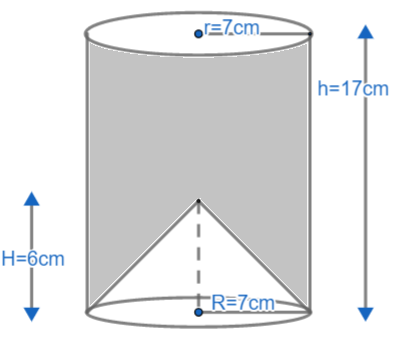
Now, we need to find the actual volume of juice which means we need to find the volume of the shaded portion of the glass. As we can see from the diagram that the volume of the shaded portion of glass will be the difference between the volume of the cylindrical part and the volume of the conical part. So, let us find the volume of the cylinder having r = 7cm, h = 17cm and volume of cone having R = 7cm and H = 6cm.
Volume of cylinder is given by $\pi {{r}^{2}}h$. So,
Volume of cylindrical part of glass will be:
\[\begin{align}
& \Rightarrow \left( \pi {{\left( 7 \right)}^{2}}\left( 17 \right) \right)c{{m}^{3}} \\
& \Rightarrow \left( \dfrac{22}{7}\times 7\times 7\times 17 \right)c{{m}^{3}} \\
& \Rightarrow \left( 22\times 7\times 17 \right)c{{m}^{3}} \\
& \Rightarrow 2618c{{m}^{3}} \\
\end{align}\]
Volume of cone is given by $\dfrac{1}{3}\pi {{r}^{2}}h$. So,
Volume of cone part of glass will be:
\[\begin{align}
& \Rightarrow \left( \dfrac{1}{3}\pi {{\left( 7 \right)}^{2}}\left( 6 \right) \right)c{{m}^{3}} \\
& \Rightarrow \left( \dfrac{1}{3}\times \dfrac{22}{7}\times 7\times 7\times 6 \right)c{{m}^{3}} \\
& \Rightarrow \left( 22\times 7\times 2 \right)c{{m}^{3}} \\
& \Rightarrow 308c{{m}^{3}} \\
\end{align}\]
Now we know that, Volume of glass = volume of cylindrical part - volume of conical part.
So, Volume of glass $\Rightarrow 2618-308c{{m}^{3}}=2310c{{m}^{3}}$
Hence, actual volume of juice will be $2310c{{m}^{3}}$.
Note: Students should always draw the diagram to understand the question clearly. Don't forget to use units after finding the required answer. Cubic units are used for finding volume. We have used $c{{m}^{3}}$ because initial measurements were given in cm. If we had to find the volume of juice in litres, so we can use the formula given as $1000c{{m}^{3}}=1liter$. Therefore, $2310c{{m}^{3}}=2.31\text{liter}$.
Complete step by step answer:
Here we are given radius and height of cone and cylinder. Cone is placed between the cylinder and glass is formed. Radius of the cylinder is 7cm and the height of the cylinder is 17cm. So, let r = 7cm and h = 17cm.
Radius of the cone is 7cm and the height of the cone is 6cm. So, let R = 7cm and H = 6cm.
Let us draw the diagram to understand the shape of glass clearly.
Now, we need to find the actual volume of juice which means we need to find the volume of the shaded portion of the glass. As we can see from the diagram that the volume of the shaded portion of glass will be the difference between the volume of the cylindrical part and the volume of the conical part. So, let us find the volume of the cylinder having r = 7cm, h = 17cm and volume of cone having R = 7cm and H = 6cm.
Volume of cylinder is given by $\pi {{r}^{2}}h$. So,
Volume of cylindrical part of glass will be:
\[\begin{align}
& \Rightarrow \left( \pi {{\left( 7 \right)}^{2}}\left( 17 \right) \right)c{{m}^{3}} \\
& \Rightarrow \left( \dfrac{22}{7}\times 7\times 7\times 17 \right)c{{m}^{3}} \\
& \Rightarrow \left( 22\times 7\times 17 \right)c{{m}^{3}} \\
& \Rightarrow 2618c{{m}^{3}} \\
\end{align}\]
Volume of cone is given by $\dfrac{1}{3}\pi {{r}^{2}}h$. So,
Volume of cone part of glass will be:
\[\begin{align}
& \Rightarrow \left( \dfrac{1}{3}\pi {{\left( 7 \right)}^{2}}\left( 6 \right) \right)c{{m}^{3}} \\
& \Rightarrow \left( \dfrac{1}{3}\times \dfrac{22}{7}\times 7\times 7\times 6 \right)c{{m}^{3}} \\
& \Rightarrow \left( 22\times 7\times 2 \right)c{{m}^{3}} \\
& \Rightarrow 308c{{m}^{3}} \\
\end{align}\]
Now we know that, Volume of glass = volume of cylindrical part - volume of conical part.
So, Volume of glass $\Rightarrow 2618-308c{{m}^{3}}=2310c{{m}^{3}}$
Hence, actual volume of juice will be $2310c{{m}^{3}}$.
Note: Students should always draw the diagram to understand the question clearly. Don't forget to use units after finding the required answer. Cubic units are used for finding volume. We have used $c{{m}^{3}}$ because initial measurements were given in cm. If we had to find the volume of juice in litres, so we can use the formula given as $1000c{{m}^{3}}=1liter$. Therefore, $2310c{{m}^{3}}=2.31\text{liter}$.
Recently Updated Pages
Master Class 10 Computer Science: Engaging Questions & Answers for Success

Master Class 10 General Knowledge: Engaging Questions & Answers for Success
Master Class 10 English: Engaging Questions & Answers for Success
Master Class 10 Social Science: Engaging Questions & Answers for Success
Master Class 10 Maths: Engaging Questions & Answers for Success
Master Class 10 Science: Engaging Questions & Answers for Success
Trending doubts
What is the median of the first 10 natural numbers class 10 maths CBSE
Which women's tennis player has 24 Grand Slam singles titles?
Who is the Brand Ambassador of Incredible India?
Why is there a time difference of about 5 hours between class 10 social science CBSE
Write a letter to the principal requesting him to grant class 10 english CBSE
A moving boat is observed from the top of a 150 m high class 10 maths CBSE