




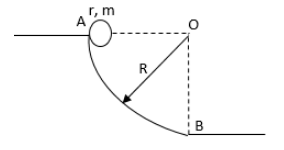
A cylinder of mass \[m\] and radius \[r\] rolls down on a track from point A, as shown in the figure. Assume that the friction is just sufficient to support rolling and velocity of the cylinder at point A was zero. Assume that \[r < < R\] then the reaction by the ground on the cylinder at point B is (Given acceleration due to gravity=g)
A. \[\dfrac{{7mg}}{3}\]
B. \[\dfrac{{4mg}}{3}\]
C. \[\dfrac{{5mg}}{3}\]
D. \[\dfrac{{2mg}}{3}\]
Answer
 Verified
570k+ views
Hint: Apply law of conservation of energy to the cylinder at point A and B. Determine the value of velocity at point B from this. Calculate the acceleration of the cylinder at point B. Then apply Newton’s second law of motion to the cylinder in the vertical direction at point B and determine the reaction force.
Formulae used:
The translational kinetic energy \[{K_t}\] of an object is
\[{K_t} = \dfrac{1}{2}m{v^2}\] …… (1)
Here, \[m\] is the mass of the object and \[v\] is the velocity of the object.
The rotational kinetic energy \[{K_r}\] of an object is
\[{K_r} = \dfrac{1}{2}I{\omega ^2}\] …… (2)
Here, \[I\] is the moment of inertia of the object and \[\omega \] is the angular speed of the object.
The potential energy \[U\] of an object is
\[U = mgh\] …… (3)
Here, \[m\] is the mass of the object, \[g\] is acceleration due to gravity and \[h\] is the height of the object from the ground.
The expression for Newton’s second law is
\[{F_{net}} = ma\] …… (4)
Here, \[{F_{net}}\] is the resultant force acting on the object, \[m\] is mass of the object and \[a\] is acceleration of the object.
Complete step by step answer:
We have given that the mass of the cylinder is \[m\] and radius is \[r\] and it is rolling from point A to B. The friction between the ground and the cylinder can be assumed negligible and the velocity of the cylinder at point A is zero. Draw the free body diagram of the cylinder at point B.
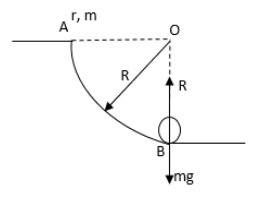
In the above figure, \[mg\] is the weight of the cylinder and \[R\] is the reaction force of the ground at point B.Apply law of conservation of energy to the cylinder at points A and B.The kinetic energy of the cylinder is zero at point A as velocity at point A is zero. The potential energy of the cylinder at point B is zero as the height of the cylinder from the ground is zero.
Hence, the potential energy \[{U_A}\] of the cylinder at point A is equal to the kinetic energy (translational kinetic energy \[{K_{tA}}\] and rotational kinetic energy \[{K_{rA}}\]) of the cylinder at point B.
\[{U_A} = {K_{tA}} + {K_{rA}}\]
Substitute the values of all the energies in the above equation using equations (1), (2) and (3).
\[mgR = \dfrac{1}{2}m{v^2} + \dfrac{1}{2}I{\omega ^2}\]
Here, \[I\] is the moment of inertia of the cylinder about the central axis, \[v\] is the linear velocity of cylinder at point B and \[\omega \] is angular speed of cylinder at point B.
Substitute \[\dfrac{1}{2}m{R^2}\] for \[I\] and \[\dfrac{v}{R}\] for \[\omega \] in the above equation.
\[mgR = \dfrac{1}{2}m{v^2} + \dfrac{1}{2}\left( {\dfrac{1}{2}m{R^2}} \right){\left( {\dfrac{v}{R}} \right)^2}\]
\[ \Rightarrow gR = \dfrac{1}{2}{v^2} + \dfrac{1}{4}{v^2}\]
\[ \Rightarrow {v^2} = \dfrac{4}{3}gR\]
The acceleration of the cylinder is
\[a = \dfrac{{{v^2}}}{R}\]
Substitute \[\dfrac{4}{3}gR\] for \[{v^2}\] in the above equation.
\[a = \dfrac{{\dfrac{4}{3}gR}}{R}\]
\[ \Rightarrow a = \dfrac{4}{3}g\]
Hence, acceleration of the cylinder at point B is \[\dfrac{4}{3}g\].
Apply Newton’s second law of motion on the cylinder in vertical direction.
\[R - mg = ma\]
Substitute \[\dfrac{4}{3}g\] for \[a\] in the above equation.
\[R - mg = m\dfrac{4}{3}g\]
\[ \Rightarrow R = \dfrac{4}{3}mg + mg\]
\[ \therefore R = \dfrac{{7mg}}{3}\]
Therefore, the reaction force of ground on the cylinder is \[\dfrac{{7mg}}{3}\]. Hence, the correct option is A.
Note: The students should not forget to consider the rotational kinetic energy of the cylinder while using the law of conservation of energy. If the rotational kinetic energy of the cylinder is not considered then the final answer for the reaction force will not be correct.
Formulae used:
The translational kinetic energy \[{K_t}\] of an object is
\[{K_t} = \dfrac{1}{2}m{v^2}\] …… (1)
Here, \[m\] is the mass of the object and \[v\] is the velocity of the object.
The rotational kinetic energy \[{K_r}\] of an object is
\[{K_r} = \dfrac{1}{2}I{\omega ^2}\] …… (2)
Here, \[I\] is the moment of inertia of the object and \[\omega \] is the angular speed of the object.
The potential energy \[U\] of an object is
\[U = mgh\] …… (3)
Here, \[m\] is the mass of the object, \[g\] is acceleration due to gravity and \[h\] is the height of the object from the ground.
The expression for Newton’s second law is
\[{F_{net}} = ma\] …… (4)
Here, \[{F_{net}}\] is the resultant force acting on the object, \[m\] is mass of the object and \[a\] is acceleration of the object.
Complete step by step answer:
We have given that the mass of the cylinder is \[m\] and radius is \[r\] and it is rolling from point A to B. The friction between the ground and the cylinder can be assumed negligible and the velocity of the cylinder at point A is zero. Draw the free body diagram of the cylinder at point B.
In the above figure, \[mg\] is the weight of the cylinder and \[R\] is the reaction force of the ground at point B.Apply law of conservation of energy to the cylinder at points A and B.The kinetic energy of the cylinder is zero at point A as velocity at point A is zero. The potential energy of the cylinder at point B is zero as the height of the cylinder from the ground is zero.
Hence, the potential energy \[{U_A}\] of the cylinder at point A is equal to the kinetic energy (translational kinetic energy \[{K_{tA}}\] and rotational kinetic energy \[{K_{rA}}\]) of the cylinder at point B.
\[{U_A} = {K_{tA}} + {K_{rA}}\]
Substitute the values of all the energies in the above equation using equations (1), (2) and (3).
\[mgR = \dfrac{1}{2}m{v^2} + \dfrac{1}{2}I{\omega ^2}\]
Here, \[I\] is the moment of inertia of the cylinder about the central axis, \[v\] is the linear velocity of cylinder at point B and \[\omega \] is angular speed of cylinder at point B.
Substitute \[\dfrac{1}{2}m{R^2}\] for \[I\] and \[\dfrac{v}{R}\] for \[\omega \] in the above equation.
\[mgR = \dfrac{1}{2}m{v^2} + \dfrac{1}{2}\left( {\dfrac{1}{2}m{R^2}} \right){\left( {\dfrac{v}{R}} \right)^2}\]
\[ \Rightarrow gR = \dfrac{1}{2}{v^2} + \dfrac{1}{4}{v^2}\]
\[ \Rightarrow {v^2} = \dfrac{4}{3}gR\]
The acceleration of the cylinder is
\[a = \dfrac{{{v^2}}}{R}\]
Substitute \[\dfrac{4}{3}gR\] for \[{v^2}\] in the above equation.
\[a = \dfrac{{\dfrac{4}{3}gR}}{R}\]
\[ \Rightarrow a = \dfrac{4}{3}g\]
Hence, acceleration of the cylinder at point B is \[\dfrac{4}{3}g\].
Apply Newton’s second law of motion on the cylinder in vertical direction.
\[R - mg = ma\]
Substitute \[\dfrac{4}{3}g\] for \[a\] in the above equation.
\[R - mg = m\dfrac{4}{3}g\]
\[ \Rightarrow R = \dfrac{4}{3}mg + mg\]
\[ \therefore R = \dfrac{{7mg}}{3}\]
Therefore, the reaction force of ground on the cylinder is \[\dfrac{{7mg}}{3}\]. Hence, the correct option is A.
Note: The students should not forget to consider the rotational kinetic energy of the cylinder while using the law of conservation of energy. If the rotational kinetic energy of the cylinder is not considered then the final answer for the reaction force will not be correct.
Recently Updated Pages
Master Class 11 English: Engaging Questions & Answers for Success

Master Class 11 Maths: Engaging Questions & Answers for Success
Master Class 11 Biology: Engaging Questions & Answers for Success
Master Class 11 Social Science: Engaging Questions & Answers for Success
Master Class 11 Physics: Engaging Questions & Answers for Success
Master Class 11 Accountancy: Engaging Questions & Answers for Success
Trending doubts
One Metric ton is equal to kg A 10000 B 1000 C 100 class 11 physics CBSE
Discuss the various forms of bacteria class 11 biology CBSE
Draw a diagram of a plant cell and label at least eight class 11 biology CBSE
State the laws of reflection of light
Explain zero factorial class 11 maths CBSE
10 examples of friction in our daily life