




A cylinder has a base radius r, a height of h, and a total surface area S. Calculate the value of h when S = 198 and r = 3.5. (Take \[\pi \] to be \[\dfrac{{22}}{7}\]).
(a). 4.5
(b). 6
(c). 8.5
(d). 5.5
Answer
 Verified
607.8k+ views
Hint: The formula for the total surface area of the cylinder is given as \[S = 2\pi r(r + h)\]. Substitute the value of S and radius r into this equation and solve it to find the value of h.
Complete step-by-step solution -
A cylinder is a solid 3-dimensional object that has two identical flat ends that are circular and one curved surface. Any cylinder is uniquely represented by its base radius and the height.
The total surface area of a cylinder is equal to the sum of the curved surface area and the surface area of the two circles at two ends.
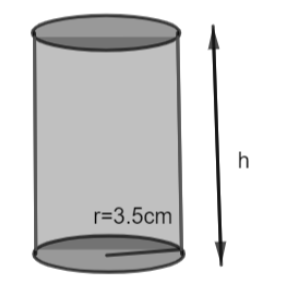
The formula for the total surface area of a cylinder of height h and base radius r is given as follows:
\[S = 2\pi r(r + h)............(1)\]
We are given the radius of the cylinder as 3.5 and the total surface area is 198. Substituting it in equation (1), we have:
\[198 = 2 \times \dfrac{{22}}{7}(3.5)(3.5 + h)\]
Simplifying, we have:
\[198 = 22(3.5 + h)\]
\[\dfrac{{198}}{{22}} = 3.5 + h\]
Dividing 198 by 22, we get the value to be 9. Then, we have:
\[9 = 3.5 + h\]
Solving for h, we have:
\[h = 9 - 3.5\]
\[h = 5.5\]
Hence, the correct answer is option (d).
Note: You may make a mistake by using the formula for the curved surface area of the cylinder \[2\pi rh\] instead of the total surface area in which case you will get a wrong answer as in this case we are also considering the surface areas of the two circle ends, so the total surface area = curved surface area + 2(surface area of one end).
Complete step-by-step solution -
A cylinder is a solid 3-dimensional object that has two identical flat ends that are circular and one curved surface. Any cylinder is uniquely represented by its base radius and the height.
The total surface area of a cylinder is equal to the sum of the curved surface area and the surface area of the two circles at two ends.
The formula for the total surface area of a cylinder of height h and base radius r is given as follows:
\[S = 2\pi r(r + h)............(1)\]
We are given the radius of the cylinder as 3.5 and the total surface area is 198. Substituting it in equation (1), we have:
\[198 = 2 \times \dfrac{{22}}{7}(3.5)(3.5 + h)\]
Simplifying, we have:
\[198 = 22(3.5 + h)\]
\[\dfrac{{198}}{{22}} = 3.5 + h\]
Dividing 198 by 22, we get the value to be 9. Then, we have:
\[9 = 3.5 + h\]
Solving for h, we have:
\[h = 9 - 3.5\]
\[h = 5.5\]
Hence, the correct answer is option (d).
Note: You may make a mistake by using the formula for the curved surface area of the cylinder \[2\pi rh\] instead of the total surface area in which case you will get a wrong answer as in this case we are also considering the surface areas of the two circle ends, so the total surface area = curved surface area + 2(surface area of one end).
Recently Updated Pages
Master Class 10 Computer Science: Engaging Questions & Answers for Success

Master Class 10 General Knowledge: Engaging Questions & Answers for Success
Master Class 10 English: Engaging Questions & Answers for Success
Master Class 10 Social Science: Engaging Questions & Answers for Success
Master Class 10 Maths: Engaging Questions & Answers for Success
Master Class 10 Science: Engaging Questions & Answers for Success
Trending doubts
What is the median of the first 10 natural numbers class 10 maths CBSE
Which women's tennis player has 24 Grand Slam singles titles?
Who is the Brand Ambassador of Incredible India?
Why is there a time difference of about 5 hours between class 10 social science CBSE
Write a letter to the principal requesting him to grant class 10 english CBSE
A moving boat is observed from the top of a 150 m high class 10 maths CBSE