




A current I flows in a long thin-walled cylinder of radius R. What pressure does the walls of cylinder experience?
Answer
 Verified
590.4k+ views
Hint: Express the current density of the current flowing through the cylinder. Determine the expression for the magnetic field at a distance r from the centre of the cylinder due to this current density. We know that the pressure is force per unit area. Express the force on the cylinder due to current density in terms of magnetic field.
Formula used:
The current density J is expressed as,
\[J = \dfrac{I}{A}\]
Here, I is the current and A is the area.
\[\vec F = \int {\vec J \times \vec B\,dV} \]
Here, \[\vec B\,\] is the magnetic field.
Complete step by step answer:
We know that the current density of the current flowing through area of cross-section A is given as,
\[J = \dfrac{I}{A}\]
Here, I is the current and A is the area.
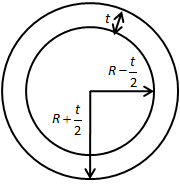
We assume the thickness of the wall of the cylinder is t. Therefore, the inner and outer radius of the cylinder is as shown in the figure below.
We can calculate the area of the cylinder as follows,
\[A = \left( {2\pi R} \right)t\]
Therefore, the current density becomes,
\[J = \dfrac{I}{{2\pi Rt}}\] …… (1)
We can calculate the value of magnetic field due to current density in the cylinder at a distance r from the centre is,
\[B\left( {2\pi r} \right) = \dfrac{{{\mu _0}I}}{{2\pi Rt}}\pi \left[ {{r^2} - {{\left( {R - \dfrac{t}{2}} \right)}^2}} \right]\]
\[ \Rightarrow B = \dfrac{{{\mu _0}I}}{{4\pi Rrt}}\left[ {{r^2} - {{\left( {R - \dfrac{t}{2}} \right)}^2}} \right]\] …… (2)
Now, we have the force due current density acting on the wall of the cylinder is,
\[\vec F = \int {\vec J \times \vec B\,dV} \]
Using equation (1) and (2), we can write the above equation as follows,
\[\vec F = \int\limits_{R - \dfrac{t}{2}}^{R + \dfrac{t}{2}} {\dfrac{{{\mu _0}{I^2}}}{{8{\pi ^2}{R^2}{t^2}r}}\left[ {{r^2} - {{\left( {R - \dfrac{t}{2}} \right)}^2}} \right] \times 2\pi rL\,dr} \] …… (3)
Here, L is the length of the cylinder.
We know that pressure is a net force divided by area. Therefore, the pressure exerted on the walls of cylinder is,
\[p = \dfrac{F}{{2\pi RL}}\]
Using equation (3), we can write the above equation as follows,
\[p = \dfrac{1}{{2\pi RL}}\int\limits_{R - \dfrac{t}{2}}^{R + \dfrac{t}{2}} {\dfrac{{{\mu _0}{I^2}}}{{8{\pi ^2}{R^2}{t^2}r}}\left[ {{r^2} - {{\left( {R - \dfrac{t}{2}} \right)}^2}} \right] \times 2\pi rL\,dr} \]
\[ \Rightarrow p = \dfrac{{{\mu _0}{I^2}}}{{8{\pi ^2}{R^3}{t^2}}}\int\limits_{R - \dfrac{t}{2}}^{R + \dfrac{t}{2}} {\left[ {{r^2} - {{\left( {R - \dfrac{t}{2}} \right)}^2}} \right]\,dr} \]
\[ \Rightarrow p = \dfrac{{{\mu _0}{I^2}}}{{8{\pi ^2}{R^3}{t^2}}}\left[ {\dfrac{{{{\left( {R + \dfrac{t}{2}} \right)}^3} - {{\left( {R - \dfrac{t}{2}} \right)}^3}}}{3} - {{\left( {R - \dfrac{t}{2}} \right)}^2}t} \right]\]
\[ \Rightarrow p = \dfrac{{{\mu _0}{I^2}}}{{8{\pi ^2}{R^3}{t^2}}}\left( {R{t^2}} \right)\]
\[ \therefore p = \dfrac{{{\mu _0}{I^2}}}{{8{\pi ^2}{R^2}}}\]
This is the expression for pressure exerted on the walls of the cylinder.
Note:
The integrations used in the above equations are,\[\int {{x^n}dx = \dfrac{{{x^{n + 1}}}}{{n + 1}} + C} \], where, C is constant of integration which is absent in finite integrations. The formula used to expands the terms in the above calculation is \[{a^3} - {b^3} = \left( {a - b} \right)\left( {{a^2} + ab + {b^2}} \right)\].
Formula used:
The current density J is expressed as,
\[J = \dfrac{I}{A}\]
Here, I is the current and A is the area.
\[\vec F = \int {\vec J \times \vec B\,dV} \]
Here, \[\vec B\,\] is the magnetic field.
Complete step by step answer:
We know that the current density of the current flowing through area of cross-section A is given as,
\[J = \dfrac{I}{A}\]
Here, I is the current and A is the area.
We assume the thickness of the wall of the cylinder is t. Therefore, the inner and outer radius of the cylinder is as shown in the figure below.
We can calculate the area of the cylinder as follows,
\[A = \left( {2\pi R} \right)t\]
Therefore, the current density becomes,
\[J = \dfrac{I}{{2\pi Rt}}\] …… (1)
We can calculate the value of magnetic field due to current density in the cylinder at a distance r from the centre is,
\[B\left( {2\pi r} \right) = \dfrac{{{\mu _0}I}}{{2\pi Rt}}\pi \left[ {{r^2} - {{\left( {R - \dfrac{t}{2}} \right)}^2}} \right]\]
\[ \Rightarrow B = \dfrac{{{\mu _0}I}}{{4\pi Rrt}}\left[ {{r^2} - {{\left( {R - \dfrac{t}{2}} \right)}^2}} \right]\] …… (2)
Now, we have the force due current density acting on the wall of the cylinder is,
\[\vec F = \int {\vec J \times \vec B\,dV} \]
Using equation (1) and (2), we can write the above equation as follows,
\[\vec F = \int\limits_{R - \dfrac{t}{2}}^{R + \dfrac{t}{2}} {\dfrac{{{\mu _0}{I^2}}}{{8{\pi ^2}{R^2}{t^2}r}}\left[ {{r^2} - {{\left( {R - \dfrac{t}{2}} \right)}^2}} \right] \times 2\pi rL\,dr} \] …… (3)
Here, L is the length of the cylinder.
We know that pressure is a net force divided by area. Therefore, the pressure exerted on the walls of cylinder is,
\[p = \dfrac{F}{{2\pi RL}}\]
Using equation (3), we can write the above equation as follows,
\[p = \dfrac{1}{{2\pi RL}}\int\limits_{R - \dfrac{t}{2}}^{R + \dfrac{t}{2}} {\dfrac{{{\mu _0}{I^2}}}{{8{\pi ^2}{R^2}{t^2}r}}\left[ {{r^2} - {{\left( {R - \dfrac{t}{2}} \right)}^2}} \right] \times 2\pi rL\,dr} \]
\[ \Rightarrow p = \dfrac{{{\mu _0}{I^2}}}{{8{\pi ^2}{R^3}{t^2}}}\int\limits_{R - \dfrac{t}{2}}^{R + \dfrac{t}{2}} {\left[ {{r^2} - {{\left( {R - \dfrac{t}{2}} \right)}^2}} \right]\,dr} \]
\[ \Rightarrow p = \dfrac{{{\mu _0}{I^2}}}{{8{\pi ^2}{R^3}{t^2}}}\left[ {\dfrac{{{{\left( {R + \dfrac{t}{2}} \right)}^3} - {{\left( {R - \dfrac{t}{2}} \right)}^3}}}{3} - {{\left( {R - \dfrac{t}{2}} \right)}^2}t} \right]\]
\[ \Rightarrow p = \dfrac{{{\mu _0}{I^2}}}{{8{\pi ^2}{R^3}{t^2}}}\left( {R{t^2}} \right)\]
\[ \therefore p = \dfrac{{{\mu _0}{I^2}}}{{8{\pi ^2}{R^2}}}\]
This is the expression for pressure exerted on the walls of the cylinder.
Note:
The integrations used in the above equations are,\[\int {{x^n}dx = \dfrac{{{x^{n + 1}}}}{{n + 1}} + C} \], where, C is constant of integration which is absent in finite integrations. The formula used to expands the terms in the above calculation is \[{a^3} - {b^3} = \left( {a - b} \right)\left( {{a^2} + ab + {b^2}} \right)\].
Recently Updated Pages
Basicity of sulphurous acid and sulphuric acid are

Master Class 11 Business Studies: Engaging Questions & Answers for Success
Master Class 11 Computer Science: Engaging Questions & Answers for Success
Master Class 11 Economics: Engaging Questions & Answers for Success
Master Class 11 Social Science: Engaging Questions & Answers for Success
Master Class 11 English: Engaging Questions & Answers for Success
Trending doubts
One Metric ton is equal to kg A 10000 B 1000 C 100 class 11 physics CBSE
The largest wind power cluster is located in the state class 11 social science CBSE
Explain zero factorial class 11 maths CBSE
State and prove Bernoullis theorem class 11 physics CBSE
Which among the following are examples of coming together class 11 social science CBSE
Draw a diagram of a plant cell and label at least eight class 11 biology CBSE