




A cuboid of size \[8cm \times 4cm \times 2cm\] is cut into cubes of equal size of 1cm side. What is the ratio of the surface area of the original cuboid to the surface area of all unit cubes so formed?
A. 13:14
B. 8:3
C. 7:24
D. 7:12
Answer
 Verified
629.1k+ views
Hint: In this problem, we need to divide the volume of cuboid with the volume of cube to obtain the number of cubes. Next, find the ratio of surface area of the original cuboid to the surface area of all unit cubes.
Complete step by step answer:
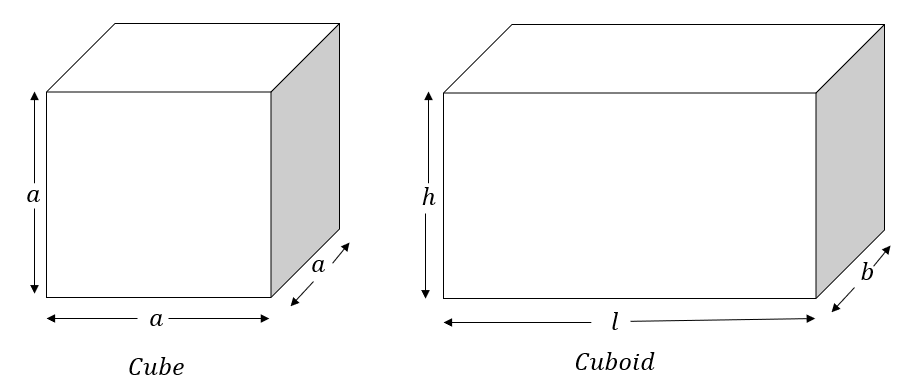
The side of the cuboid is \[8cm \times 4cm \times 2cm\].
The formula of the volume V and surface area S of the cuboid having sides l,b and h is shown below.
\[
V = l \times b \times h\,\,\,\,\,\,\,\,\,\,\,\,\,\,\,\,\,\,\,\,\,\,\,\,\,\,\,\,\,\,\,\,\,\,\,\,\,\,\,\,\,\,\,\,\,\,\,\,\,\,\,\,\,\,\,\,\,\,\,\,\,\,\,\,\,\,\,\,......\left( 1 \right) \\
S = 2\left( {l \times b + b \times h + h \times l} \right)\,\,\,\,\,\,\,\,\,\,\,\,\,\,\,\,\,\,\,\,\,\,\,\,\,\,\,\,\,\,\,\,\,\,\,\,\,\,\,\,\,......\left( 2 \right) \\
\]
Substitute, 8 for l, 4 for b and 2 for h in equation (1) to obtain the volume of the cuboid.
\[
\,\,\,\,\,\,V = 8 \times 4 \times 2 \\
\Rightarrow V = 64c{m^3} \\
\]
Substitute, 8 for l, 4 for b and 2 for h in equation (2) to obtain the surface area of the cuboid.
\[
\,\,\,\,\,\,S = 2\left( {8 \times 4 + 4 \times 2 + 2 \times 8} \right) \\
\Rightarrow S = 2\left( {32 + 8 + 16} \right) \\
\Rightarrow S = 2\left( {56} \right) \\
\Rightarrow S = 112c{m^2} \\
\]
The volume \[{V_1}\] of the cube with side 1 cm is calculated as follows:
\[
\,\,\,\,\,\,{V_1} = {\left( 1 \right)^3} \\
\Rightarrow {V_1} = 1 \\
\]
Now, divide the volume of the cuboid by the volume of the cube to obtain the number of cubes.
\[
\,\,\,\,\,\,{\text{Number of cubes}} = \dfrac{V}{{{V_1}}} \\
\Rightarrow {\text{Number of cubes}} = \dfrac{{64}}{1} \\
\Rightarrow {\text{Number of cubes}} = 64 \\
\]
The surface area \[{S_1}\] of 1 cube with side 1 cm is calculated as follows:
\[
\,\,\,\,\,\,\,{S_1} = 6{\left( 1 \right)^2} \\
\Rightarrow {S_1} = 6c{m^2} \\
\]
Now, the ratio of the surface area of the original cuboid to the surface area of all unit cubes is calculated as follows:
\[
\,\,\,\,\,\,\dfrac{S}{{64 \times {S_1}}} \\
\Rightarrow \dfrac{{112}}{{64 \times 6}} \\
\Rightarrow \dfrac{7}{{24}} \\
\Rightarrow 7:24 \\
\]
So, the correct answer is “Option C”.
Note: When the cuboid cuts into cubes, its volume remains constant whereas the surface area gets changed. This is the point to be remembered.
Complete step by step answer:
The side of the cuboid is \[8cm \times 4cm \times 2cm\].
The formula of the volume V and surface area S of the cuboid having sides l,b and h is shown below.
\[
V = l \times b \times h\,\,\,\,\,\,\,\,\,\,\,\,\,\,\,\,\,\,\,\,\,\,\,\,\,\,\,\,\,\,\,\,\,\,\,\,\,\,\,\,\,\,\,\,\,\,\,\,\,\,\,\,\,\,\,\,\,\,\,\,\,\,\,\,\,\,\,\,......\left( 1 \right) \\
S = 2\left( {l \times b + b \times h + h \times l} \right)\,\,\,\,\,\,\,\,\,\,\,\,\,\,\,\,\,\,\,\,\,\,\,\,\,\,\,\,\,\,\,\,\,\,\,\,\,\,\,\,\,......\left( 2 \right) \\
\]
Substitute, 8 for l, 4 for b and 2 for h in equation (1) to obtain the volume of the cuboid.
\[
\,\,\,\,\,\,V = 8 \times 4 \times 2 \\
\Rightarrow V = 64c{m^3} \\
\]
Substitute, 8 for l, 4 for b and 2 for h in equation (2) to obtain the surface area of the cuboid.
\[
\,\,\,\,\,\,S = 2\left( {8 \times 4 + 4 \times 2 + 2 \times 8} \right) \\
\Rightarrow S = 2\left( {32 + 8 + 16} \right) \\
\Rightarrow S = 2\left( {56} \right) \\
\Rightarrow S = 112c{m^2} \\
\]
The volume \[{V_1}\] of the cube with side 1 cm is calculated as follows:
\[
\,\,\,\,\,\,{V_1} = {\left( 1 \right)^3} \\
\Rightarrow {V_1} = 1 \\
\]
Now, divide the volume of the cuboid by the volume of the cube to obtain the number of cubes.
\[
\,\,\,\,\,\,{\text{Number of cubes}} = \dfrac{V}{{{V_1}}} \\
\Rightarrow {\text{Number of cubes}} = \dfrac{{64}}{1} \\
\Rightarrow {\text{Number of cubes}} = 64 \\
\]
The surface area \[{S_1}\] of 1 cube with side 1 cm is calculated as follows:
\[
\,\,\,\,\,\,\,{S_1} = 6{\left( 1 \right)^2} \\
\Rightarrow {S_1} = 6c{m^2} \\
\]
Now, the ratio of the surface area of the original cuboid to the surface area of all unit cubes is calculated as follows:
\[
\,\,\,\,\,\,\dfrac{S}{{64 \times {S_1}}} \\
\Rightarrow \dfrac{{112}}{{64 \times 6}} \\
\Rightarrow \dfrac{7}{{24}} \\
\Rightarrow 7:24 \\
\]
So, the correct answer is “Option C”.
Note: When the cuboid cuts into cubes, its volume remains constant whereas the surface area gets changed. This is the point to be remembered.
Recently Updated Pages
Master Class 11 English: Engaging Questions & Answers for Success

Master Class 11 Social Science: Engaging Questions & Answers for Success
Master Class 11 Maths: Engaging Questions & Answers for Success
Master Class 11 Biology: Engaging Questions & Answers for Success
Master Class 11 Physics: Engaging Questions & Answers for Success
Master Class 11 Chemistry: Engaging Questions & Answers for Success
Trending doubts
Explain the Treaty of Vienna of 1815 class 10 social science CBSE
What is the Total Duration of Football Match?
The shortest day of the year in India
In which year voting age was reduced from 21 to 18?
10 examples of evaporation in daily life with explanations
What planets have no moons Which one has only one moon class 10 physics CBSE