




A cubical block of mass $M$ and edge $a$ slides down a rough inclined plane of inclination with uniform velocity. The torque of the normal force on the block about its center has magnitude
1) Zero
2) $Mga$
3) $Mga\operatorname{Sin} \theta $
4) $\dfrac{{Mga\operatorname{Sin} \theta }}{2}$
Answer
 Verified
573.9k+ views
Hint: Torque is the moment of force. It is the cross product of the force with a perpendicular distance between the axis of rotation and the point of application of force with the force.
Complete step by step solution:
Given that, a cubical block of mass \[ = m\]
And edge length $ = a$ ; take $r = \dfrac{a}{2}$
Angle of inclination is $ = \theta $
The angle that an inclined plane makes with the horizontal when a body is placed on it is in limiting equilibrium; this angle is called angle of repose.
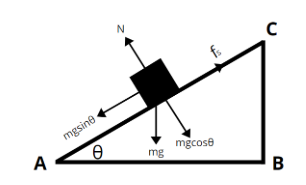
When a cubical block is placed on a rough surface of angle $\theta $ and block slide. Then we have
$F = mg\sin \theta $ …………...(1)
because the force applied is just opposite to the $mg\sin \theta $ similar for normal reaction, When a body is pressed against a surface, the body experiences a force which is perpendicular to the surface.
$N = mg\cos \theta $ ……………..(2)
There are two components, $mg\cos \theta $ and $mg\sin \theta $ but torque is produced only in$mg\sin \theta $ because$mg\cos \theta $ and $N$ pass through the center of the cube, there will be no torque. And
$\overrightarrow \tau = \overrightarrow r \times \overrightarrow F $ ………….(3)
$\tau = rF\sin \theta $
Putting the value of equation (1) in equation (3),
We get,
$\overrightarrow \tau = mg\sin \theta \times \left( {\dfrac{a}{2}} \right)$
Or we can write as,
$\overrightarrow \tau = \dfrac{{mg\sin \theta \times a}}{2}$
Hence, the correct option is (4)
Note: Some point about normal reaction when a block is placed on a table, the normal reaction on the block by the table is $N = mg$ but when block is placed on an inclined plane the normal reaction force, $N = mg\cos \theta $
Complete step by step solution:
Given that, a cubical block of mass \[ = m\]
And edge length $ = a$ ; take $r = \dfrac{a}{2}$
Angle of inclination is $ = \theta $
The angle that an inclined plane makes with the horizontal when a body is placed on it is in limiting equilibrium; this angle is called angle of repose.
When a cubical block is placed on a rough surface of angle $\theta $ and block slide. Then we have
$F = mg\sin \theta $ …………...(1)
because the force applied is just opposite to the $mg\sin \theta $ similar for normal reaction, When a body is pressed against a surface, the body experiences a force which is perpendicular to the surface.
$N = mg\cos \theta $ ……………..(2)
There are two components, $mg\cos \theta $ and $mg\sin \theta $ but torque is produced only in$mg\sin \theta $ because$mg\cos \theta $ and $N$ pass through the center of the cube, there will be no torque. And
$\overrightarrow \tau = \overrightarrow r \times \overrightarrow F $ ………….(3)
$\tau = rF\sin \theta $
Putting the value of equation (1) in equation (3),
We get,
$\overrightarrow \tau = mg\sin \theta \times \left( {\dfrac{a}{2}} \right)$
Or we can write as,
$\overrightarrow \tau = \dfrac{{mg\sin \theta \times a}}{2}$
Hence, the correct option is (4)
Note: Some point about normal reaction when a block is placed on a table, the normal reaction on the block by the table is $N = mg$ but when block is placed on an inclined plane the normal reaction force, $N = mg\cos \theta $
Recently Updated Pages
Master Class 11 Computer Science: Engaging Questions & Answers for Success

Master Class 11 Business Studies: Engaging Questions & Answers for Success
Master Class 11 Economics: Engaging Questions & Answers for Success
Master Class 11 English: Engaging Questions & Answers for Success
Master Class 11 Maths: Engaging Questions & Answers for Success
Master Class 11 Biology: Engaging Questions & Answers for Success
Trending doubts
One Metric ton is equal to kg A 10000 B 1000 C 100 class 11 physics CBSE
There are 720 permutations of the digits 1 2 3 4 5 class 11 maths CBSE
Discuss the various forms of bacteria class 11 biology CBSE
Draw a diagram of a plant cell and label at least eight class 11 biology CBSE
State the laws of reflection of light
10 examples of friction in our daily life