




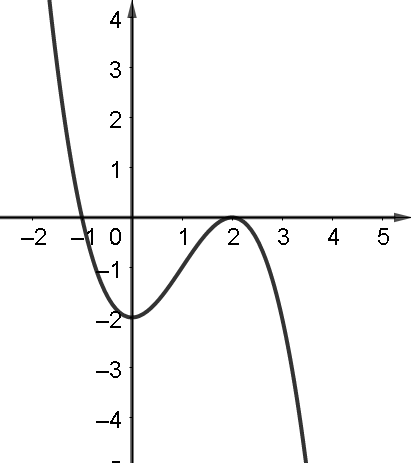
A cubic polynomial $f(x) = a{x^3} + b{x^2} + cx + d$ has a graph which is tangent to the x- axis at $2$ has another x- intercept at $ - 1$ and has y- intercept at $ - 2$ as shown. The values of $a + b + c + d$ is
A. $ - 2$
B. $ - 1$
C. $0$
D. $1$
Answer
 Verified
494.4k+ views
Hint: In this question, we are given a function with unknown constants and their graph. We have to find the values of these constants.
So, we will find the values of the function at different values of $x$ , then solve them to get the values of $a,b,c,d$ .
The point to remember here is, since, it has a tangent at the x-axis at the point $2$ , so, the derivative of this function at the point $2$ will be zero.
Complete step-by-step answer:
We are given a function with unknown constants $f(x) = a{x^3} + b{x^2} + cx + d$ and its graph.
To find the values of $a$ , $b$ , $c$ and $d$ .
First, we will differentiate the given function and find its value at $x = 2$ .
On differentiating, we get, $f'(x) = 3a{x^2} + 2bx + c$ , now, putting $x = 2$ in it, we get, $f'(x) = 3a{(2)^2} + 2b(2) + c$ , i.e., $f'(2) = 8a + 4b + c$ .
From the graph, it is clear that, $f'(2) = 0$ , i.e., $8a + 4b + c = 0$ … (1)
Also, from the graph, $f(2) = 0$ , $f( - 1) = 0$ and $f(0) = - 2$ , so, first putting, $x = 2$ in the given function $f(2) = 8a + 4b + 2c + d = 0$ , then, putting, $x = - 1$ , we get, $f( - 1) = - a + b - c + d = 0$ and finally, putting $x = 0$ , we get, $f(0) = d = - 2$ .
Now, since we have the value of $d$ , so we will put it in all equations, then the equation becomes,
$f( - 1) = - a + b - c = 2$
$f(2) = 8a + 4b + 2c = 2$
$f'(2) = 8a + 4b + c = 0$
On solving these equations simultaneously, we get, $a = - \dfrac{1}{2}$ , $b = \dfrac{3}{2}$ , $c = 0$ and $d = - 2$ .
Hence, the value of $a + b + c + d = - \dfrac{1}{2} + \dfrac{3}{2} + 0 - 2$ , least common multiple of the denominators is $2$ , so we get, $a + b + c + d = \dfrac{{ - 1 + 3 + 0 - 4}}{2}$ , on simplifying, we get, $a + b + c + d = \dfrac{{ - 2}}{2} = - 1$ .
So, the correct answer is “Option B”.
Note: If a function has a tangent at a point $x = a$ , then, it means, it is the critical point of that function and the derivative of the function is zero at that point.
Perform the calculations carefully, to avoid silly mistakes.
One should know how to read a graph to solve such questions.
So, we will find the values of the function at different values of $x$ , then solve them to get the values of $a,b,c,d$ .
The point to remember here is, since, it has a tangent at the x-axis at the point $2$ , so, the derivative of this function at the point $2$ will be zero.
Complete step-by-step answer:
We are given a function with unknown constants $f(x) = a{x^3} + b{x^2} + cx + d$ and its graph.
To find the values of $a$ , $b$ , $c$ and $d$ .
First, we will differentiate the given function and find its value at $x = 2$ .
On differentiating, we get, $f'(x) = 3a{x^2} + 2bx + c$ , now, putting $x = 2$ in it, we get, $f'(x) = 3a{(2)^2} + 2b(2) + c$ , i.e., $f'(2) = 8a + 4b + c$ .
From the graph, it is clear that, $f'(2) = 0$ , i.e., $8a + 4b + c = 0$ … (1)
Also, from the graph, $f(2) = 0$ , $f( - 1) = 0$ and $f(0) = - 2$ , so, first putting, $x = 2$ in the given function $f(2) = 8a + 4b + 2c + d = 0$ , then, putting, $x = - 1$ , we get, $f( - 1) = - a + b - c + d = 0$ and finally, putting $x = 0$ , we get, $f(0) = d = - 2$ .
Now, since we have the value of $d$ , so we will put it in all equations, then the equation becomes,
$f( - 1) = - a + b - c = 2$
$f(2) = 8a + 4b + 2c = 2$
$f'(2) = 8a + 4b + c = 0$
On solving these equations simultaneously, we get, $a = - \dfrac{1}{2}$ , $b = \dfrac{3}{2}$ , $c = 0$ and $d = - 2$ .
Hence, the value of $a + b + c + d = - \dfrac{1}{2} + \dfrac{3}{2} + 0 - 2$ , least common multiple of the denominators is $2$ , so we get, $a + b + c + d = \dfrac{{ - 1 + 3 + 0 - 4}}{2}$ , on simplifying, we get, $a + b + c + d = \dfrac{{ - 2}}{2} = - 1$ .
So, the correct answer is “Option B”.
Note: If a function has a tangent at a point $x = a$ , then, it means, it is the critical point of that function and the derivative of the function is zero at that point.
Perform the calculations carefully, to avoid silly mistakes.
One should know how to read a graph to solve such questions.
Recently Updated Pages
Master Class 11 Social Science: Engaging Questions & Answers for Success

Master Class 11 Physics: Engaging Questions & Answers for Success
Master Class 11 Maths: Engaging Questions & Answers for Success
Master Class 11 Economics: Engaging Questions & Answers for Success
Master Class 11 Computer Science: Engaging Questions & Answers for Success
Master Class 11 Chemistry: Engaging Questions & Answers for Success
Trending doubts
One Metric ton is equal to kg A 10000 B 1000 C 100 class 11 physics CBSE
There are 720 permutations of the digits 1 2 3 4 5 class 11 maths CBSE
1 Quintal is equal to a 110 kg b 10 kg c 100kg d 1000 class 11 physics CBSE
State and prove Bernoullis theorem class 11 physics CBSE
Difference Between Prokaryotic Cells and Eukaryotic Cells
Discuss the various forms of bacteria class 11 biology CBSE