




A cube of side 'a' has a charge q placed at each of its eight corners. The potential at the centre of the cube due to all the charges is:
A) \[\dfrac{16q}{4\pi {{\varepsilon }_{0}}a\sqrt{3}}\]
B) \[\dfrac{16q}{4\pi {{\varepsilon }_{0}}a}\]
C) \[\dfrac{q}{4\pi {{\varepsilon }_{0}}a}\]
D) \[\dfrac{q}{4\pi {{\varepsilon }_{0}}a\sqrt{3}}\]
Answer
 Verified
602.4k+ views
Hint: Here, we calculate potential at centre due to each charge. The distance between each charge and centre is equal to half of the diagonal. The total potential due to 8 charges at the corner will give potential at the centre.
Complete answer:
A diagram can be illustrated as follows:
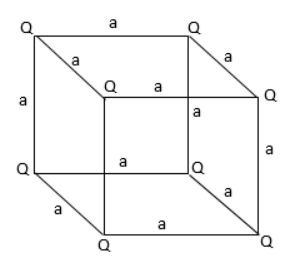
Let the cube of side be 'a’
So the length of each diagonal is given by \[D=\sqrt{{{a}^{2}}+{{a}^{2}}+{{a}^{2}}}\]
\[=\sqrt{3{{a}^{2}}}=\sqrt{3}a\]
Distance of each corner from the Centre O is half of its diagonal\[r=\dfrac{\sqrt{3}a}{2}\]
Potential at O due to charge q at each centre is given by
\[V=\dfrac{1}{4\pi {{\varepsilon }_{0}}}.\dfrac{a}{r}=\dfrac{1}{4\pi {{\varepsilon }_{0}}}.\dfrac{q}{\dfrac{\sqrt{3}a}{2}} \]
\[ =\dfrac{2q}{4\pi {{\varepsilon }_{0}}\sqrt{3}a} \]
Therefore, net potential at O due to all the 8 changes at the corners of the cubes \[V=8\times \dfrac{2q}{4\pi {{\varepsilon }_{0}}\sqrt{3}a}\]
\[V=\dfrac{16q}{4\pi {{\varepsilon }_{0}}\sqrt{3}a}\]
The electric field at O due to charge at all the corners of the cube is zero, since the electric field due to charges at opposite 8 corners are equal and opposite.
Note:
As we know that the cube of side a and diagonal is \[D=\sqrt{3}a\]. So, Be careful during the calculation of distance of each corner from the Centre is half of its diagonal i.e. \[r=\dfrac{\sqrt{3}a}{2}\] and the potential \[V=\dfrac{1}{4\pi {{\varepsilon }_{0}}}\dfrac{2q}{\sqrt{3}a}\] For eight corners we multiplied it by 8 we get the results.
Complete answer:
A diagram can be illustrated as follows:
Let the cube of side be 'a’
So the length of each diagonal is given by \[D=\sqrt{{{a}^{2}}+{{a}^{2}}+{{a}^{2}}}\]
\[=\sqrt{3{{a}^{2}}}=\sqrt{3}a\]
Distance of each corner from the Centre O is half of its diagonal\[r=\dfrac{\sqrt{3}a}{2}\]
Potential at O due to charge q at each centre is given by
\[V=\dfrac{1}{4\pi {{\varepsilon }_{0}}}.\dfrac{a}{r}=\dfrac{1}{4\pi {{\varepsilon }_{0}}}.\dfrac{q}{\dfrac{\sqrt{3}a}{2}} \]
\[ =\dfrac{2q}{4\pi {{\varepsilon }_{0}}\sqrt{3}a} \]
Therefore, net potential at O due to all the 8 changes at the corners of the cubes \[V=8\times \dfrac{2q}{4\pi {{\varepsilon }_{0}}\sqrt{3}a}\]
\[V=\dfrac{16q}{4\pi {{\varepsilon }_{0}}\sqrt{3}a}\]
The electric field at O due to charge at all the corners of the cube is zero, since the electric field due to charges at opposite 8 corners are equal and opposite.
Note:
As we know that the cube of side a and diagonal is \[D=\sqrt{3}a\]. So, Be careful during the calculation of distance of each corner from the Centre is half of its diagonal i.e. \[r=\dfrac{\sqrt{3}a}{2}\] and the potential \[V=\dfrac{1}{4\pi {{\varepsilon }_{0}}}\dfrac{2q}{\sqrt{3}a}\] For eight corners we multiplied it by 8 we get the results.
Recently Updated Pages
Master Class 12 Economics: Engaging Questions & Answers for Success

Master Class 12 English: Engaging Questions & Answers for Success
Master Class 12 Social Science: Engaging Questions & Answers for Success
Master Class 12 Maths: Engaging Questions & Answers for Success
Master Class 12 Physics: Engaging Questions & Answers for Success
Master Class 9 General Knowledge: Engaging Questions & Answers for Success
Trending doubts
One Metric ton is equal to kg A 10000 B 1000 C 100 class 11 physics CBSE
Difference Between Prokaryotic Cells and Eukaryotic Cells
Find the value of the expression given below sin 30circ class 11 maths CBSE
Two of the body parts which do not appear in MRI are class 11 biology CBSE
Draw a diagram of nephron and explain its structur class 11 biology CBSE
10 examples of friction in our daily life